
Free Pre-Start Checklist (Line Pump) Template
Download our Free Pre-Start Checklist (Line Pump) Template to formalise equipment inspections. This structured DOCX & PDF helps manage WHS risks. Get started.
Free Pre-Start Checklist (Line Pump) Template
DOCX • 125 KB + PDF
Updated Oct 2026
No signup required
Purpose of the Free Pre-Start Checklist (Line Pump) Template
Regularly inspecting high-risk plant like concrete line pumps is a critical control measure for any construction or industrial site. This Free Pre-Start Checklist (Line Pump) Template provides a structured framework for operators to conduct thorough, documented inspections before each use.
Implementing a consistent pre-start process helps your organisation identify mechanical faults, hydraulic leaks, or structural damage before they can lead to equipment failure, serious injury, or costly project delays. Using a checklist formalises the inspection, creates a record of due diligence, and reinforces a proactive safety culture among your team.
By standardising the inspection process, you ensure that no critical checks are overlooked. This record-keeping is fundamental for maintenance planning, incident investigation, and demonstrating procedural fairness.
A well-maintained line pump is a safer and more reliable asset. Integrating this checklist is a practical step towards building more robust WHS management systems on your site.
Video walkthrough
How to use the Free Pre-Start Checklist (Line Pump) Template
This template is designed for ease of use and customisation. After downloading the DOCX or PDF file, you should adapt it to suit the specific requirements of your workplace.
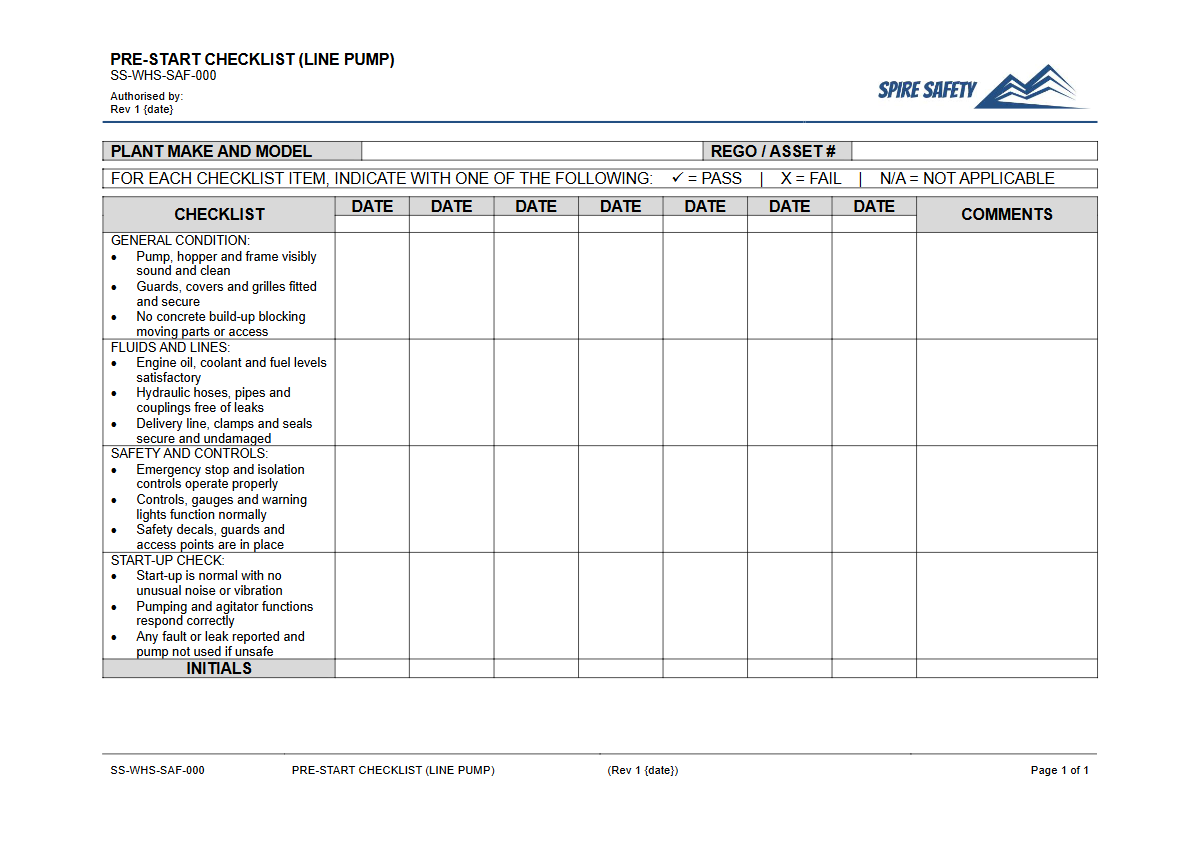
The checklist is divided into logical sections covering critical components like the engine, hydraulics, delivery lines, hopper, and safety features.
Process:
- Download: Choose your preferred format (DOCX for easy editing or PDF for direct printing).
- Customise: Add your company branding and specific details. Review every item on the checklist and modify it to match the make, model, and configuration of your line pump. Add or remove checks based on manufacturer recommendations and a site-specific risk assessment.
- Train: Ensure all operators are trained not only on how to operate the line pump but also on how to correctly complete this pre-start checklist. They must understand the 'what' and the 'why' behind each check.
- Implement: Integrate the checklist into your daily operational procedures. The check should be completed by the operator before commencing work for their shift.
- Review: Completed checklists should be reviewed by a supervisor and filed securely. Any identified faults must be reported, documented, and rectified before the pump is used.
Important: This document is a template only. We provide it as a starting point, and you must customise it to reflect the specific equipment in your fleet, as well as your unique site conditions and operational risks.
For other types of heavy machinery, you might require a different document, such as our Pre-Start Checklist (Forwarder) Template for forestry equipment.
When to use it
A line pump pre-start check should be conducted at the beginning of every shift or before the equipment is used for the first time on any given day. If the pump is relocated and set up in a new position on-site during a shift, it is good practice to perform a partial re-inspection of the outriggers, delivery lines, and immediate work area to ensure stability and safety have not been compromised.
Regular checks are a cornerstone of preventative maintenance and are essential for managing day-to-day operational risks. Consistent use demonstrates a commitment to workplace safety that is often verified during WHS compliance audits.
Who should use it
The pre-start checklist must be completed by a person who is trained, competent, and authorised to operate the specific line pump. This is typically the designated pump operator for the shift.
They have the most immediate control over the equipment and are best placed to notice any changes in its condition or performance. Supervisors or site managers are responsible for ensuring that operators are completing the checks correctly and that any reported defects are addressed through a formal tag-out and repair process. If your team requires support in establishing these roles and responsibilities, consider engaging expert WHS consulting services.
While this checklist is for line pumps, other pumping systems require their own specific checks. For example, a stationary system for building services would use a document like our Free Pre-Start Checklist (Fire Pump) Template to ensure emergency readiness.
You can find more templates like these in our free WHS resources library for a wide range of plant and equipment.
Common mistakes
Common mistakes to avoid
- Ticking boxes without physically inspecting the corresponding component ('pencil-whipping').
- Ignoring minor faults or leaks that could indicate a more serious developing issue.
- Failing to report identified defects to a supervisor or maintenance team immediately.
- Using a generic checklist that doesn't match the specific make and model of the pump being used.
Legal references
Legal considerations
The following legal requirements may be relevant to this type of work.
- Work Health and Safety Act (Harmonised) — Provides the primary duties for protecting workers and other people from work health and safety risks.
- Work Health and Safety Regulations (Harmonised) — Sets out requirements supporting the management of workplace hazards and risks.
The following codes may be relevant to this type of work.
- Managing WHS Risks Code of Practice — Provides practical guidance on identifying hazards, assessing risks and applying effective controls.
- Work Health and Safety Consultation, Cooperation and Coordination Code of Practice — Provides practical guidance on consulting workers and coordinating with other duty holders.
- Managing the Work Environment and Facilities Code of Practice — Provides practical guidance on safe work environments, workplace facilities and related controls.
Did you know
High-Pressure Hazard
The pressure inside a concrete pump's delivery lines can exceed 85 bar (1200 psi). A ruptured line or failed coupling can release this pressure violently, projecting concrete and debris with enough force to cause fatal injuries.
Tip-Over Risks
Instability is a leading cause of concrete pump incidents. A thorough pre-start check of outriggers, ground conditions, and stabiliser pads is crucial to prevent catastrophic tip-overs during operation.
FAQ
Frequently asked questions
01What should a line pump pre-start inspection cover?
02Why is it important to customise a pre-start checklist template?
03Who is responsible for completing the line pump pre-start?
04How long should we keep completed pre-start records?
Share this resource
Free Pre-Start Checklist (Line Pump) Template
Browse Categories
How To Use It
- 1Download and open in Word or PDF.
- 2Replace the placeholders with your business details.
- 3Get it reviewed by a WHS specialist before rollout.
Need it customised?
Our WHS consultants can adapt this template to your site, run a gap analysis, or audit what you already have in place.
Book a Free Consultation WHS consulting servicesor call 1300 156 382