
Free Pre-Start Checklist (Laser Welder) Template
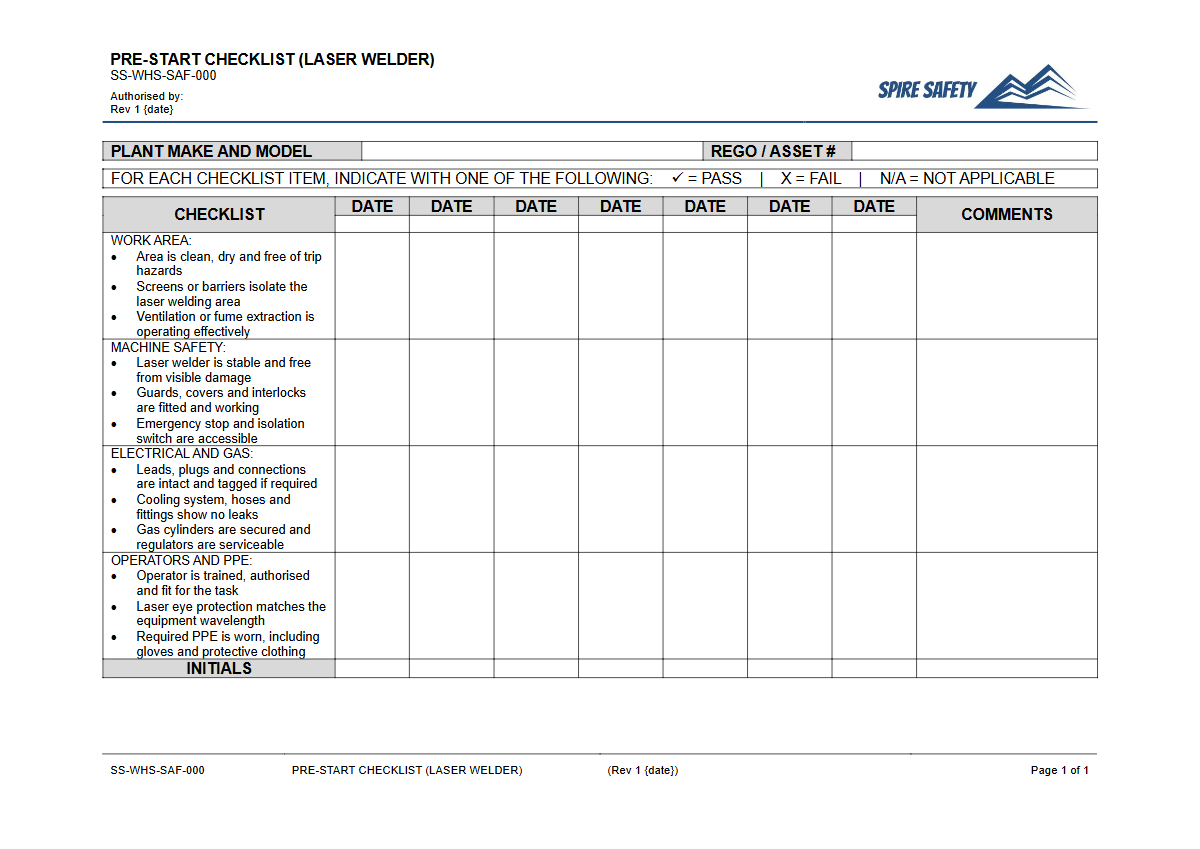
Download our free Pre-Start Checklist (Laser Welder) Template. This structured Word & PDF document helps formalise daily equipment safety checks. Get yours now.
Free Pre-Start Checklist (Laser Welder) Template
DOCX • 125 KB + PDF
Updated Oct 2026
No signup required
Purpose of the Free Pre-Start Checklist (Laser Welder) Template
A laser welder is a sophisticated piece of equipment that presents significant hazards if not operated and maintained correctly. This Free Pre-Start Checklist (Laser Welder) Template provides a structured framework for operators to conduct consistent, documented safety inspections before each use.
Implementing a formal pre-start process helps your organisation meet its duty of care under Australian WHS laws by proactively identifying potential faults, damage, or unsafe conditions that could lead to incidents involving optical radiation, electrical shock, fire, or hazardous fumes.
Regular checks ensure that critical safety features like interlocks, ventilation systems, and emergency stops are functional. Using this template helps embed safety into daily routines, creating a record of due diligence that demonstrates a commitment to a safe working environment.
Integrating these daily checks is a foundational component of all robust WHS management systems, linking operational practice directly to your organisation's safety objectives.
Video walkthrough
How to use the Free Pre-Start Checklist (Laser Welder) Template
This checklist is available for immediate download in both DOCX and PDF formats. The DOCX version is fully editable, allowing you to tailor the content to your specific operational needs.
A pre-start checklist is most effective when it is part of a complete safe system of work, which should also include documented procedures. For related equipment, you might find our FREE Laser Cutter SOP (Safe Operating Procedure) Template a useful starting point for developing your own internal documentation.
Important: This document is a template, not a finished, universal safety tool. We have designed it as a comprehensive starting point, but you must customise it to suit the exact make, model, and configuration of your laser welder.
It is essential to incorporate findings from your own site-specific risk assessments to ensure all relevant hazards are controlled. Spire Safety is not liable for any incident arising from the use or misuse of this template.
You must adapt it to your workplace.
When to use it
A pre-start checklist for a laser welder should be completed before the equipment is used for the first time on any given day or shift. This ensures that any issues that may have developed overnight, during cleaning, or from previous use are identified before the machine is energised and put into operation.
This routine is a critical control measure that prevents faults from escalating into failures.
Establishing this as a non-negotiable daily habit is vital for maintaining a strong safety culture. Reinforcing the importance of these checks can be effectively achieved through regular team meetings.
Using a resource like a Pre-Start Checks and Plant Maintenance toolbox talk can help communicate expectations and the reasons behind the procedure to all relevant workers.
Who should use it
The pre-start checklist must be completed by a person who is trained, competent, and authorised to operate the specific laser welder. This is typically the operator assigned to the equipment for the shift.
While the operator performs the check, supervisors and managers are responsible for ensuring the system is followed, records are correctly filed, and any reported defects are addressed promptly and effectively.
Operator competency is the cornerstone of equipment safety. A checklist is only as effective as the person using it.
It's crucial to verify that operators not only know how to run the equipment but also understand its safety systems and potential failure points. While this template focuses on laser welding, the principle of competency applies to all high-risk work, and you can formalise this with tools like a Verification of Competency (MIG Welder) Template, adapted for your specific processes.
Completed checklists serve as a critical communication tool. If an operator identifies a fault, the checklist provides a formal record to tag the equipment out of service and notify maintenance or management.
These records create a historical log of the machine's condition, which is invaluable for tracking recurring issues, planning preventative maintenance, and demonstrating compliance during an audit. For guidance on structuring your safety documentation and record-keeping, consider leveraging professional WHS consulting services.
This Pre-Start Checklist is one of many tools designed to help streamline your safety processes. By formalising inspections for each piece of plant and equipment, you create a more consistent and reliable safety environment.
For more templates covering a wide range of tasks and machinery, explore our complete free WHS resources library, which is regularly updated with new documents to support Australian businesses.
Common mistakes
Common mistakes to avoid
- "Pencil-whipping" the checklist without physically inspecting each item.
- Failing to immediately report and tag out equipment with identified safety defects.
- Using a generic checklist that doesn't cover the specific safety features of the machine's make and model.
- Neglecting to check that the correct laser-safe PPE is available and in good condition.
Legal references
Legal considerations
The following legal requirements may be relevant to this type of work.
- Work Health and Safety Act (Harmonised) — Provides the primary duties for protecting workers and other people from work health and safety risks.
- Work Health and Safety Regulations (Harmonised) — Sets out requirements supporting the management of workplace hazards and risks.
The following codes may be relevant to this type of work.
- Managing WHS Risks Code of Practice — Provides practical guidance on identifying hazards, assessing risks and applying effective controls.
- Work Health and Safety Consultation, Cooperation and Coordination Code of Practice — Provides practical guidance on consulting workers and coordinating with other duty holders.
- Managing the Work Environment and Facilities Code of Practice — Provides practical guidance on safe work environments, workplace facilities and related controls.
Did you know
Laser Classification
Most industrial laser welders are Class 4 lasers, the highest and most hazardous classification. A Class 4 laser is powerful enough to cause immediate and severe eye and skin damage from direct or scattered beams and also poses a significant fire hazard.
Invisible Danger
Many high-power lasers used for welding operate in the infrared spectrum, meaning the hazardous beam is completely invisible to the human eye. This makes adherence to safety protocols and the use of correct personal protective equipment (PPE) absolutely critical.
FAQ
Frequently asked questions
01What are the key hazards of a laser welder to check for?
02How often should a laser welder pre-start inspection be performed?
03Who is responsible for completing the laser welder pre-start checklist?
04Can this template be used for other types of welders like MIG or TIG?
Share this resource
Free Pre-Start Checklist (Laser Welder) Template
Browse Categories
How To Use It
- 1Download and open in Word or PDF.
- 2Replace the placeholders with your business details.
- 3Get it reviewed by a WHS specialist before rollout.
Need it customised?
Our WHS consultants can adapt this template to your site, run a gap analysis, or audit what you already have in place.
Book a Free Consultation WHS consulting servicesor call 1300 156 382