
Free Pre-Start Checklist (Laser Screed) Template
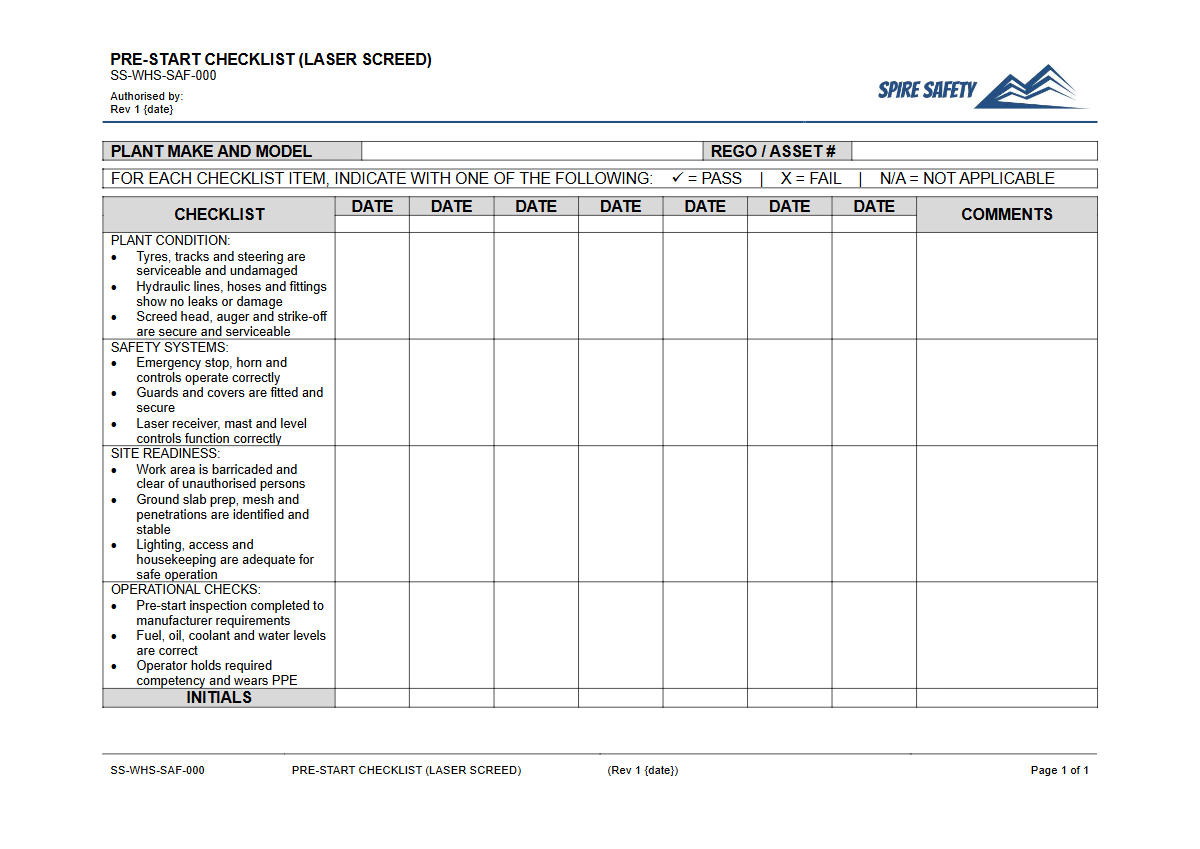
Download our free Pre-Start Checklist for Laser Screeds. This DOCX & PDF template helps formalise equipment checks and supports your WHS processes.
Free Pre-Start Checklist (Laser Screed) Template
DOCX • 125 KB + PDF
Updated Oct 2026
No signup required
Purpose of the Free Pre-Start Checklist (Laser Screed) Template
Operating specialised plant like a laser screed involves significant risks that must be managed to ensure the safety of operators and other workers on a construction site. This free Pre-Start Checklist (Laser Screed) Template provides a structured framework for conducting and documenting daily equipment inspections.
Regular pre-start checks are a fundamental part of any proactive safety culture, helping to identify mechanical faults, fluid leaks, or damage before the machine is used. Using this checklist helps your organisation meet its primary duty of care under WHS legislation by ensuring plant is safe to operate.
It also contributes to better equipment maintenance, reduces costly downtime, and improves the quality and accuracy of the concrete finish.
Formalising this process demonstrates a commitment to safety and provides valuable records for incident investigations or audits. These daily checks are a critical component of broader WHS management systems, providing a practical tool for risk management at the operational level.
Video walkthrough
How to use the Free Pre-Start Checklist (Laser Screed) Template
This template is designed as a starting point for developing a site-specific safety document. Follow these steps to implement it effectively in your workplace:
- Download: Choose your preferred format, either DOCX for easy editing or PDF for straightforward printing.
- Customise: It is essential that you adapt the checklist to your specific circumstances. We cannot guarantee that this template covers all hazards unique to your site or the specific make and model of your laser screed. Add, remove, or modify items to align with the manufacturer’s operating manual and your own risk assessments.
- Train: Ensure all operators are trained not only on how to operate the laser screed but also on how to properly conduct the pre-start inspection using the customised checklist. A Pre-Start Checks and Plant Maintenance toolbox talk can be an effective way to introduce the new process.
- Implement: Integrate the checklist into your daily routine. Make it a mandatory step before any laser screed is used for a shift. Store completed checklists in a designated location for record-keeping purposes.
When to Conduct a Laser Screed Pre-Start Check
A pre-start inspection should be completed before the laser screed is used for the first time each day or at the beginning of every shift. This consistent routine ensures that the equipment's condition is verified before it is subjected to operational stresses.
It also provides an opportunity to catch any damage that may have occurred overnight or during transport. Discussing any findings from the checklist can be a valuable part of your daily site safety briefing, which can be documented using a free Pre-Start Meeting Template.
Who Should Use This Checklist
The pre-start checklist should be completed by a worker who is competent to operate the laser screed. A 'competent person' is someone who has acquired the necessary knowledge and skills through a combination of training, qualification, and experience to perform the task safely.
The Person Conducting a Business or Undertaking (PCBU) is responsible for verifying this competency and ensuring operators have the resources and time to complete these critical safety checks thoroughly. The operator's familiarity with the machine makes them the ideal person to notice subtle changes in its condition or performance.
Key Inspection Items on a Laser Screed Checklist
While your customised checklist will be more detailed, it should cover several key areas of the machine. These typically include:
- General Condition: Checking for visible damage, cracks in the chassis, or loose components.
- Fluid Levels: Verifying engine oil, hydraulic fluid, and coolant levels are within safe operating ranges.
- Hydraulic System: Inspecting hoses, cylinders, and connections for leaks or damage.
- Laser System: Ensuring the laser transmitter, receivers, and control box are clean, secure, and functioning.
- Screed Head: Checking the auger, vibrator, and plough for wear, damage, or concrete buildup.
- Controls & Safety: Testing all operational controls, steering, brakes, and critically, the emergency stop buttons.
- Tyres: Inspecting for correct pressure, wear, and any visible damage.
These checks are vital for the entire concrete pouring process. Ensuring the screed is in top condition is just as important as having a clear procedure for associated tasks, such as our SWMS for Concrete Truck Operations.
Beyond the Checklist: Reporting and Records
Simply ticking boxes is not enough. The pre-start process must be linked to a clear procedure for actioning any defects found.
If an issue is identified that poses a risk to health and safety, the operator must not use the equipment. The machine should be immediately tagged out of service and the defect reported to a supervisor or maintenance team.
Keeping accurate records of these checks, identified faults, and corrective actions is crucial. These documents are essential for demonstrating procedural fairness and due diligence during a WHS compliance auditing process.
A well-documented pre-start system forms part of a robust safe system of work. For other high-risk laser equipment, you might also require a detailed procedural document, similar in principle to our free Laser Cutter SOP, to guide operators on correct usage.
Common mistakes
Common mistakes to avoid
- Ignoring minor hydraulic fluid leaks, which can indicate a developing major failure.
- Failing to check the laser transmitter and receiver for calibration issues or damage.
- "Pencil-whipping" the checklist without physically inspecting each item properly.
- Neglecting to formally report identified defects, leading to unsafe equipment remaining in service.
Legal references
Legal considerations
The following legal requirements may be relevant to this type of work.
- Work Health and Safety Act (Harmonised) — Provides the primary duties for protecting workers and other people from work health and safety risks.
- Work Health and Safety Regulations (Harmonised) — Sets out requirements supporting the management of workplace hazards and risks.
The following codes may be relevant to this type of work.
- Managing WHS Risks Code of Practice — Provides practical guidance on identifying hazards, assessing risks and applying effective controls.
- Work Health and Safety Consultation, Cooperation and Coordination Code of Practice — Provides practical guidance on consulting workers and coordinating with other duty holders.
- Managing the Work Environment and Facilities Code of Practice — Provides practical guidance on safe work environments, workplace facilities and related controls.
Did you know
Floor Flatness
Modern laser screeds are capable of producing concrete floors with extremely high 'FF' (Floor Flatness) and 'FL' (Floor Levelness) numbers, critical for facilities like warehouses that use automated guided vehicles (AGVs).
Invention
The first ride-on laser screed was invented in the mid-1980s, revolutionising the productivity and quality of large-scale concrete floor construction.
FAQ
Frequently asked questions
01What is the main purpose of a laser screed pre-start check?
02How often should laser screed pre-start inspections be done?
03Who is responsible for completing a laser screed checklist?
04Can a digital checklist be used for a laser screed pre-start?
Share this resource
Free Pre-Start Checklist (Laser Screed) Template
Browse Categories
How To Use It
- 1Download and open in Word or PDF.
- 2Replace the placeholders with your business details.
- 3Get it reviewed by a WHS specialist before rollout.
Need it customised?
Our WHS consultants can adapt this template to your site, run a gap analysis, or audit what you already have in place.
Book a Free Consultation WHS consulting servicesor call 1300 156 382