
Free Pre-Start Checklist (Label Machine) Template
Download our free Pre-Start Checklist (Label Machine) Template in Word and PDF. A structured starting point for formalising equipment safety inspections.
Free Pre-Start Checklist (Label Machine) Template
DOCX • 125 KB + PDF
Updated Oct 2026
No signup required
Purpose of the Free Pre-Start Checklist (Label Machine) Template
Operating machinery like a label applicator involves risks from moving parts, electrical systems, and cutting mechanisms. This Free Pre-Start Checklist (Label Machine) Template provides a structured framework for operators to conduct systematic safety inspections before using the equipment.
The primary goal is to identify and control hazards before they can cause injury or damage, ensuring the machine is fit for use at the start of every shift. A consistent pre-start process helps a Person Conducting a Business or Undertaking (PCBU) meet their primary duty of care under Australian WHS legislation.
By formalising these checks, you create a documented record of equipment condition, which is crucial for maintenance scheduling and incident investigations. These routine inspections are a cornerstone of effective plant safety management.
For a broader discussion on this topic with your team, our Pre-Start Checks and Plant Maintenance Toolbox Talk can be a valuable aid.
Video walkthrough
How to use the Free Pre-Start Checklist (Label Machine) Template
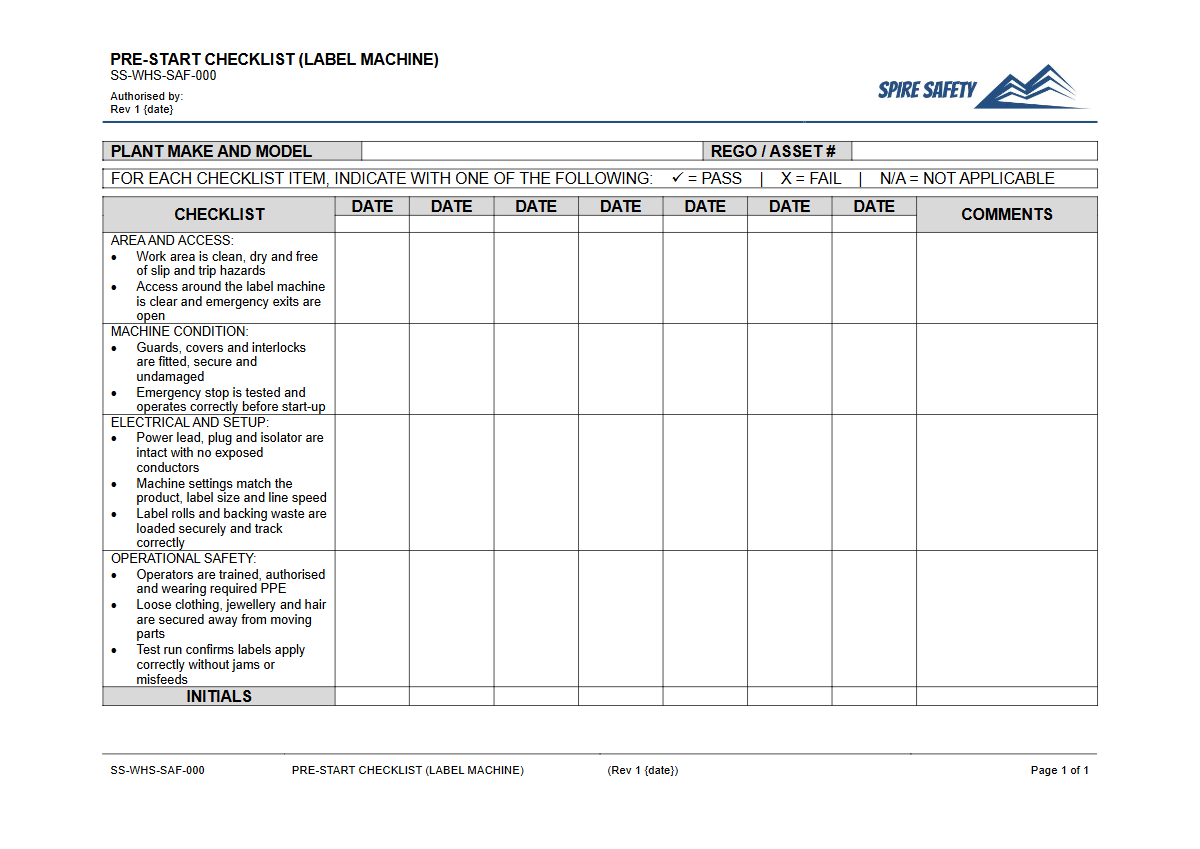
This resource is available for download as a DOCX file for easy editing and a PDF for straightforward printing. The template includes common inspection points relevant to label machines, such as guards, emergency stops, rollers, sensors, and electrical connections.
However, it is designed as a starting point, not a final document.
Important: We have created this template as a guide. You must customise it to suit the specific make, model, and configuration of the label machine in your workplace.
Consider the environment it operates in, the materials used (e.g., adhesives, inks), and any unique modifications. A generic checklist is not sufficient for ensuring safety.
This checklist is one part of a safe system of work. For more complex machinery, you may also need other documents, such as our FREE Milling Machine SOP (Safe Operating Procedure) Template, which outlines step-by-step instructions for safe operation.
When to use a Label Machine Pre-Start Checklist
A pre-start inspection should be completed before the first use of the label machine on any given day or shift. This frequency ensures that any faults that may have developed overnight, during cleaning, or from previous use are identified before the machine is put into operation.
Integrating this check into the daily startup routine helps build a consistent safety habit among operators. These daily checks are an excellent topic to cover in daily safety huddles, which can be documented using a Free Pre-Start Meeting Template to record attendance and topics discussed.
Who should use this Pre-Start Checklist
The pre-start check should be conducted by the person operating the label machine. It is essential that operators are trained and competent not only in using the equipment but also in how to properly conduct the inspection.
They must understand what each checkpoint means and what constitutes a 'pass' or 'fail'. Supervisors or managers have a responsibility to ensure these checks are being completed correctly and to review any submitted checklists.
Any identified faults or defects must be reported immediately and actioned according to your organisation's fault reporting and maintenance procedures. These documented procedures form a critical part of your overall WHS management systems.
What makes a good Pre-Start Checklist?
An effective checklist is more than just a list of items. It should be:
- Specific: Checkpoints should refer to actual components on your specific machine (e.g., 'Check tension on applicator arm' instead of 'Check machine parts').
- Clear: Use simple language that all operators can understand. Avoid jargon where possible or ensure it is well-defined during training.
- Actionable: Each checkpoint should result in a clear outcome (e.g., Safe/Unsafe, Pass/Fail). The checklist must also include clear instructions on what to do if an item is found to be unsafe, such as 'Do Not Operate' and 'Report to Supervisor'.
The effectiveness of your safety documentation and processes is often a focus during a WHS compliance audit, which verifies that your safety practices are being implemented as intended. Properly completed checklists provide auditors with valuable evidence of your commitment to safety. For more templates and tools, you can browse our complete free WHS resources library.
Common mistakes
Common mistakes to avoid
- Using a generic template without customising it for the specific label machine model and its associated risks.
- Operators 'ticking and flicking' the checklist without performing a thorough physical and visual inspection.
- Failing to have a clear procedure for reporting, isolating, and rectifying faults found during the check.
- Not providing adequate training to operators on how to properly conduct the inspection and what each item means.
Legal references
Legal considerations
The following legal requirements may be relevant to this type of work.
- Work Health and Safety Act (Harmonised) — Provides the primary duties for protecting workers and other people from work health and safety risks.
- Work Health and Safety Regulations (Harmonised) — Sets out requirements supporting the management of workplace hazards and risks.
The following codes may be relevant to this type of work.
- Managing WHS Risks Code of Practice — Provides practical guidance on identifying hazards, assessing risks and applying effective controls.
- Work Health and Safety Consultation, Cooperation and Coordination Code of Practice — Provides practical guidance on consulting workers and coordinating with other duty holders.
- Managing the Work Environment and Facilities Code of Practice — Provides practical guidance on safe work environments, workplace facilities and related controls.
Did you know
Machine Guarding
Inadequate machine guarding is consistently one of the most common safety breaches identified by regulators in Australia. Pre-start checks are a critical line of defence in verifying that guards are in place and effective.
FAQ
Frequently asked questions
01What should be included in a label machine pre-start checklist?
02Are pre-start checklists a legal requirement in Australia?
03How often should a label machine pre-start check be performed?
04What happens if a fault is found during a pre-start inspection?
Share this resource
Free Pre-Start Checklist (Label Machine) Template
Browse Categories
How To Use It
- 1Download and open in Word or PDF.
- 2Replace the placeholders with your business details.
- 3Get it reviewed by a WHS specialist before rollout.
Need it customised?
Our WHS consultants can adapt this template to your site, run a gap analysis, or audit what you already have in place.
Book a Free Consultation WHS consulting servicesor call 1300 156 382