
Free Pre-Start Checklist (Lab Analyser) Template
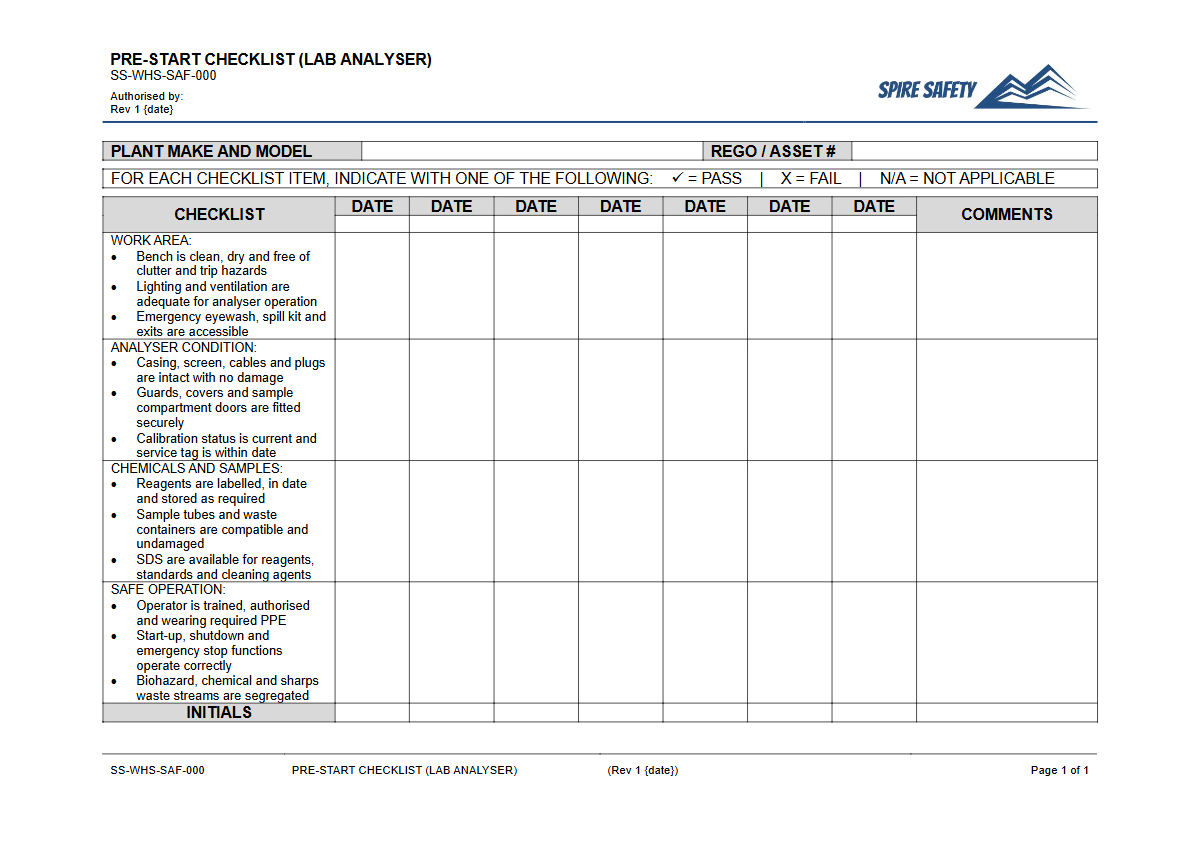
Download our Free Pre-Start Checklist (Lab Analyser) Template (DOCX & PDF) to formalise your lab equipment inspections and manage WHS risks.
Free Pre-Start Checklist (Lab Analyser) Template
DOCX • 125 KB + PDF
Updated Oct 2026
No signup required
Purpose of the Free Pre-Start Checklist (Lab Analyser) Template
A lab analyser is a sophisticated piece of equipment critical for generating accurate data in medical, research, and industrial settings. Integrating a formal pre-start check into your daily laboratory procedures is a fundamental step in managing workplace health and safety.
This Free Pre-Start Checklist (Lab Analyser) Template provides a structured starting point for confirming the equipment is safe to operate and ready for use. Regular, documented checks help identify potential faults, prevent equipment damage, ensure the integrity of results, and protect operators from electrical, chemical, or biological hazards.
Using a documented system for these inspections demonstrates a commitment to proactive risk management. It forms a crucial part of broader WHS management systems by creating auditable records and fostering a culture of safety-consciousness among lab personnel.
It helps your organisation meet its duty of care to provide and maintain safe plant and equipment.
These routine verifications are essential not just for safety but for operational consistency. A comprehensive pre-start inspection can catch minor issues like blocked tubing, low reagent levels, or incorrect calibration settings before they lead to skewed results, costly downtime, or equipment failure.
For more general guidance on integrating these checks into your daily routine, our pre-start checks and plant maintenance toolbox talk provides a useful framework for team discussions.
Video walkthrough
How to use the Free Pre-Start Checklist (Lab Analyser) Template
This resource is provided in both DOCX and PDF formats for your convenience. The DOCX file is fully editable, allowing you to tailor the checklist to the specific requirements of your laboratory and the analysers you use.
The process is straightforward: download the template, add your company branding, and then customise the checklist items to align with the manufacturer’s instructions and your site's risk assessment.
When customising, consider factors unique to your equipment, such as specific reagents, waste disposal systems, software initialisation sequences, and calibration checks. Just as you would use a specific free pre-start checklist for a CNC router in a workshop, this lab analyser checklist must be adapted to be effective.
Once finalised, train all relevant personnel on its correct use, emphasising that it is an active inspection tool, not just a paperwork exercise. Completed checklists should be stored as a record of your safety diligence.
Important Note: This is a template only. It provides a starting point, but it is not a substitute for a specific risk assessment or manufacturer's operating manual.
We recommend you customise this document to reflect the specific lab analysers, processes, and risks present in your workplace.
The effectiveness of your pre-start process should be reviewed periodically to ensure it remains relevant and effective. Incorporating a review of your safety documentation as part of your WHS compliance auditing program helps identify opportunities for improvement and ensures ongoing alignment with Australian WHS standards.
When to use it
The pre-start checklist should be completed before the first use of the lab analyser at the beginning of each day or shift. This establishes a baseline of operational safety and readiness for the work period.
The checklist should also be used following any maintenance, repair, or relocation of the equipment to verify it has been returned to service in a safe condition. It is also good practice to perform the checks if there is any suspicion of a malfunction or after an extended period of inactivity.
Integrating this check into daily routines, such as morning setup procedures or shift handovers, helps ensure it is completed consistently. Discussing the importance of these checks during team meetings, perhaps using a structured format like our pre-start meeting template, can reinforce the habit and highlight any recurring issues identified during the checks.
Who should use it
This checklist is designed for use by any person who is trained, competent, and authorised to operate the specific lab analyser. This typically includes laboratory technicians, scientists, research assistants, and other qualified personnel.
The operator conducting the check should have a thorough understanding of the machine’s functions and potential hazards. It is the responsibility of the Person Conducting a Business or Undertaking (PCBU) to ensure that operators receive adequate information, training, and instruction.
Verifying that an operator is competent to both use the equipment and perform the pre-start check correctly is a critical part of the safety process. While this template focuses on the equipment, a separate process is often needed to confirm operator skill, such as a verification of competency for a pipe threader does for a different type of equipment.
This principle of confirming and documenting skills is applicable across all high-risk plant. Find more templates to support your safety processes in our complete free WHS resources library.
Common mistakes
Common mistakes to avoid
- Using a generic checklist that doesn't match the specific analyser model.
- Ticking boxes without physically inspecting the corresponding item ('pencil-whipping').
- Failing to report, isolate, and tag faulty equipment identified during the check.
- Not retaining completed checklists as a record of safety diligence and maintenance history.
Legal references
Legal considerations
The following legal requirements may be relevant to this type of work.
- Work Health and Safety Act (Harmonised) — Provides the primary duties for protecting workers and other people from work health and safety risks.
- Work Health and Safety Regulations (Harmonised) — Sets out requirements supporting the management of workplace hazards and risks.
The following codes may be relevant to this type of work.
- Managing WHS Risks Code of Practice — Provides practical guidance on identifying hazards, assessing risks and applying effective controls.
- Work Health and Safety Consultation, Cooperation and Coordination Code of Practice — Provides practical guidance on consulting workers and coordinating with other duty holders.
- Managing the Work Environment and Facilities Code of Practice — Provides practical guidance on safe work environments, workplace facilities and related controls.
Did you know
Calibration Drift
Regular pre-start checks that include verification of calibration can prevent 'calibration drift', a gradual deviation that can compromise the accuracy of thousands of results over time.
Electrical Safety in Labs
According to Safe Work Australia, contact with electricity is a significant cause of injury and death. Pre-start checks that include inspecting cords and connections are a simple but vital control measure in a lab environment.
FAQ
Frequently asked questions
01What should be included in a lab analyser pre-start checklist?
02How often should lab analyser pre-start checks be performed?
03Who is responsible for completing the lab analyser pre-start checklist?
04Why is it important to customise this checklist template?
Share this resource
Free Pre-Start Checklist (Lab Analyser) Template
Browse Categories
How To Use It
- 1Download and open in Word or PDF.
- 2Replace the placeholders with your business details.
- 3Get it reviewed by a WHS specialist before rollout.
Need it customised?
Our WHS consultants can adapt this template to your site, run a gap analysis, or audit what you already have in place.
Book a Free Consultation WHS consulting servicesor call 1300 156 382