
Free Pre-Start Checklist (Kerb Machine) Template
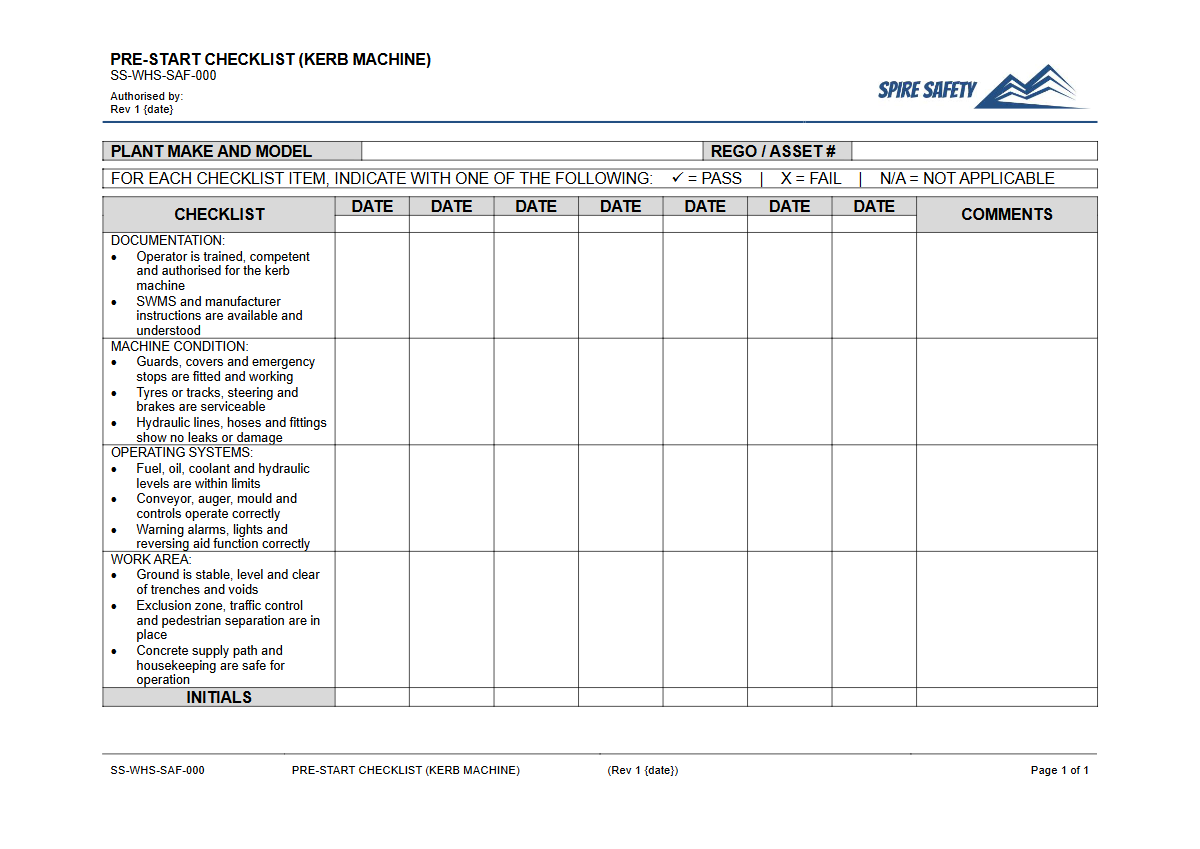
Download our free Pre-Start Checklist (Kerb Machine) Template. This structured DOCX and PDF helps formalise equipment safety checks and manage WHS risks.
Free Pre-Start Checklist (Kerb Machine) Template
DOCX • 125 KB + PDF
Updated Oct 2026
No signup required
Purpose of the Free Pre-Start Checklist (Kerb Machine) Template
This free Pre-Start Checklist (Kerb Machine) Template provides a structured starting point for formalising daily equipment inspections. Regular pre-start checks are a critical part of managing the risks associated with mobile plant in construction and civil works.
Using a formal checklist helps a Person Conducting a Business or Undertaking (PCBU) meet their primary duty of care to ensure, so far as is reasonably practicable, that plant is safe to use. This template helps operators systematically inspect critical components like controls, guards, emergency stops, hydraulic systems, and extrusion mechanisms before operation begins.
It creates a documented record that the machine was in a safe condition at the start of each shift. This process is a fundamental part of a proactive safety culture and can be reinforced through regular pre-start checks and plant maintenance toolbox talks.
Video walkthrough
How to use the Free Pre-Start Checklist (Kerb Machine) Template
This template is available as a DOCX file, which is fully editable, and a PDF for immediate use. It is essential that you customise the Word document to the specific make, model, and configuration of the kerb machine used in your operations.
A generic checklist is not sufficient for compliance or safety.
Note: We have included common inspection points based on standard kerb machine designs, but your equipment may have different features or require additional checks specific to its manufacturer or the work being performed. This template is a starting point, not a finished, document.
You must adapt it to your specific context.
Once customised, the Pre-Start Checklist should be integrated into your daily operational procedures. It should form part of a broader safe system of work, which may include other key safety documents such as a SWMS for concrete truck operations, especially when working on busy construction sites.
When to use a Kerb Machine Pre-Start Checklist
A kerb machine pre-start check should be completed before the machine is used for the first time on any given day, or at the beginning of each operator's shift. This ensures that the equipment's condition is verified before work starts, capturing any damage or faults that may have occurred overnight, during transport, or in the previous shift.
Making the check a non-negotiable routine for every operator helps prevent incidents caused by equipment failure. The completed checklists serve as an important record of maintenance and safety diligence within your broader WHS management systems.
Who should use it
The pre-start check must be completed by a competent person. This is typically the machine operator, who should be trained not only in its operation but also in how to conduct a thorough visual and functional inspection.
Competency means the operator has the necessary knowledge and skill to identify potential defects or damage that could compromise safety. It is good practice for the checklist to be reviewed and signed off by a supervisor to ensure accountability and that any reported issues are actioned promptly.
Verifying an operator's ability to conduct these checks can be part of their initial assessment, similar to how an organisation might use a verification of competency for pipe threaders or other specialised plant.
Ensuring Ongoing Compliance
Simply filling out a checklist is not enough. An effective safety system requires a clear process for managing the findings.
This includes immediately reporting defects, tagging and removing faulty equipment from service, and tracking repairs through to completion. Completed checklists should be retained as part of your WHS records.
Regularly reviewing these documents can help identify recurring issues or trends, which may signal a need for changes in maintenance schedules or additional operator training. The effectiveness of your overall safety processes can be validated through periodic WHS compliance auditing to ensure they remain robust and aligned with best practice. For more tools to enhance your safety framework, browse our complete free WHS resources library.
Common mistakes
Common mistakes to avoid
- Operator 'pencil-whipping' the form without physically inspecting the items.
- Failing to have a clear procedure for reporting and rectifying defects found during the check.
- Using a generic, non-specific checklist that doesn't cover all critical components of the machine's make and model.
- Not training operators on what to look for during the inspection, leading to missed faults.
Legal references
Legal considerations
The following legal requirements may be relevant to this type of work.
- Work Health and Safety Act (Harmonised) — Provides the primary duties for protecting workers and other people from work health and safety risks.
- Work Health and Safety Regulations (Harmonised) — Sets out requirements supporting the management of workplace hazards and risks.
The following codes may be relevant to this type of work.
- Managing WHS Risks Code of Practice — Provides practical guidance on identifying hazards, assessing risks and applying effective controls.
- Work Health and Safety Consultation, Cooperation and Coordination Code of Practice — Provides practical guidance on consulting workers and coordinating with other duty holders.
- Managing the Work Environment and Facilities Code of Practice — Provides practical guidance on safe work environments, workplace facilities and related controls.
Did you know
Slipform Kerbing
Modern kerb machines often use a 'slipform' process, where concrete is extruded through a mould to create a continuous kerb without the need for traditional formwork. This method was pioneered in the mid-20th century and revolutionised road construction.
Plant-Related Incidents
According to Safe Work Australia, incidents involving machinery and fixed plant are a leading cause of serious injuries in the workplace. Thorough pre-start checks are a key control measure to mitigate these risks.
FAQ
Frequently asked questions
01What should be included in a kerb machine pre-start checklist?
02Why are pre-start checklists for machinery like kerb machines important?
03How often should a kerb machine pre-start check be completed?
04Can this template be used for other types of construction plant?
Share this resource
Free Pre-Start Checklist (Kerb Machine) Template
Browse Categories
How To Use It
- 1Download and open in Word or PDF.
- 2Replace the placeholders with your business details.
- 3Get it reviewed by a WHS specialist before rollout.
Need it customised?
Our WHS consultants can adapt this template to your site, run a gap analysis, or audit what you already have in place.
Book a Free Consultation WHS consulting servicesor call 1300 156 382