
Free Pre-Start Checklist (Keyseater) Template
Download our free Pre-Start Checklist (Keyseater) Template to formalise equipment safety inspections.
Free Pre-Start Checklist (Keyseater) Template
DOCX • 125 KB + PDF
Updated Oct 2026
No signup required
Purpose of the Free Pre-Start Checklist (Keyseater) Template
A keyseater is a powerful piece of machinery used for cutting keyways inside machine parts. Like all workshop plant, it presents significant risks if not properly maintained and inspected.
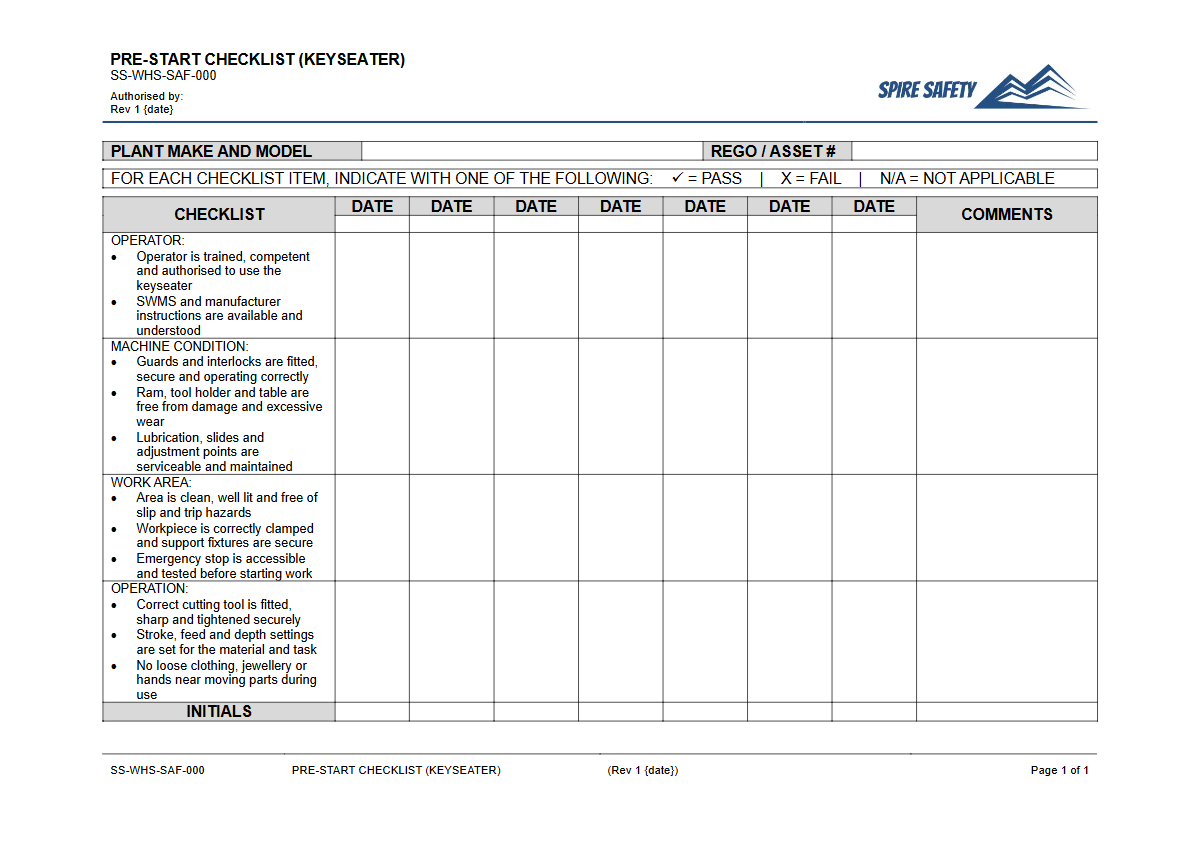
This Free Pre-Start Checklist (Keyseater) Template provides a structured framework for operators to conduct thorough, documented safety inspections before commencing work. The primary purpose is to identify any faults, damage, or missing safety features that could lead to an incident, injury, or costly breakdown.
Regularly completing a pre-start check is a fundamental aspect of proactive risk management. It helps ensure the machine is in a safe operating condition, that all guards are in place and functioning, and that emergency systems are operational.
This process not only protects the operator but also helps a Person Conducting a Business or Undertaking (PCBU) meet their primary duty of care under Australian WHS laws. Formalising this process with a checklist creates a consistent record of due diligence and contributes to a stronger safety culture within your organisation.
For a broader perspective on this topic, our Pre-Start Checks and Plant Maintenance Toolbox Talk provides excellent discussion points for your team.
Video walkthrough
How to use the Free Pre-Start Checklist (Keyseater) Template
This template is provided in both DOCX and PDF formats for your convenience. The DOCX file is fully editable, allowing you to tailor it to the specific make and model of keyseater used in your workplace, as well as incorporate your company branding and specific procedural requirements.
The PDF is a ready-to-print option for immediate use.
To use the template effectively:
- Download: Choose either the DOCX or PDF version.
- Customise: Open the DOCX file and adapt the checklist items. Add or remove checks based on your machine's manual, your risk assessment, and any state-specific regulations. Add your company name, logo, and relevant site information.
- Train: Ensure all operators are trained not only on how to operate the keyseater safely but also on the importance and correct procedure for completing the pre-start checklist.
- Implement: Integrate the checklist into your daily operational procedures. Establish a clear process for what happens when a fault is found, including 'tag out' procedures and reporting to a supervisor.
Important: This document is a template and is not a substitute for a specific risk assessment. We have created it as a starting point, but it is your responsibility to customise it to reflect the specific hazards and control measures relevant to your equipment and your workplace. Integrating such procedures is a key part of building robust WHS management systems.
When to use it
The pre-start checklist should be completed at the beginning of every shift before the keyseater is first used. It should also be completed if the machine has been shut down for an extended period, after any maintenance or repair work has been performed, or if a new operator is taking over mid-shift.
This frequency ensures that the machine's condition is verified before any work that could expose an operator to risk is undertaken. A consistent routine helps catch developing issues before they become critical failures.
Who should use it
The checklist is designed to be completed by the competent person assigned to operate the keyseater. This individual should have the necessary training and experience to understand the machine's functions and recognise potential hazards.
A supervisor or manager should then periodically review the completed checklists to monitor compliance, identify recurring faults, and ensure maintenance actions are being completed. Defining these roles and responsibilities is a critical step in managing workplace safety, an area where WHS consulting can provide valuable clarity and structure for your organisation.
What's included in the template?
Our keyseater pre-start checklist template is structured to be clear and comprehensive. It is divided into logical sections to guide the operator through a systematic inspection. Key sections typically include:
- Administrative Details: Fields for the date, operator's name, machine ID, and supervisor's signature.
- General Environment: Checks for the surrounding area, such as clear access, adequate lighting, and slip/trip hazards.
- Structural and Mechanical Checks: Inspection points for the machine frame, guards, and critical moving parts.
- Controls and E-Stops: A test to verify that all operational controls, and especially the emergency stop buttons, are functioning correctly.
- Tooling and Clamping: Checks to ensure the cutting tool and workpiece clamping mechanisms are secure and in good condition.
- Fluid and Lubrication: Verification of correct levels for hydraulic fluid or lubricants as specified by the manufacturer.
- Corrective Actions: A section to document any faults found and record the actions taken to rectify them.
Thorough record-keeping of these checks is essential, as these documents are often reviewed during internal safety reviews and external WHS compliance audits. For different machinery, such as computer-controlled equipment, you might need a different set of checks, as seen in our Free Pre-Start Checklist for a CNC Router.
Benefits of a Documented Pre-Start Process
Implementing a formal pre-start check process provides numerous benefits beyond simple compliance. It fosters a proactive safety culture where operators take ownership of their equipment and safety.
It creates a reliable record for maintenance planning, helping to identify trends in equipment wear and tear. Furthermore, in the unfortunate event of an incident, a history of completed, diligent checklists serves as powerful evidence of your organisation's commitment to safety and risk management. This single document is a valuable addition to your safety toolkit, which can be expanded with resources from our free WHS resources library.
Common mistakes
Common mistakes to avoid
- Using a generic 'one-size-fits-all' checklist that misses model-specific hazards.
- Rushing through the checklist and ticking boxes without physically verifying each item ('pencil-whipping').
- Failing to immediately tag out and report faulty equipment, allowing it to remain in service.
- Poor record-keeping, such as losing completed forms or not having them reviewed by a supervisor.
Legal references
Legal considerations
The following legal requirements may be relevant to this type of work.
- Work Health and Safety Act (Harmonised) — Provides the primary duties for protecting workers and other people from work health and safety risks.
- Work Health and Safety Regulations (Harmonised) — Sets out requirements supporting the management of workplace hazards and risks.
The following codes may be relevant to this type of work.
- Managing WHS Risks Code of Practice — Provides practical guidance on identifying hazards, assessing risks and applying effective controls.
- Work Health and Safety Consultation, Cooperation and Coordination Code of Practice — Provides practical guidance on consulting workers and coordinating with other duty holders.
- Managing the Work Environment and Facilities Code of Practice — Provides practical guidance on safe work environments, workplace facilities and related controls.
Did you know
A Precise Purpose
Keyseaters are specialised machines designed for one primary task: cutting keyways in the bores of components like gears, pulleys, and sprockets. This precise groove is essential for locking the component to a shaft and transmitting torque.
Prevention is Key
Safe Work Australia data consistently shows that a significant number of machinery-related incidents are preventable. Effective pre-start inspections and preventative maintenance are among the most effective controls for reducing these risks.
FAQ
Frequently asked questions
01What are the most critical safety checks for a keyseater?
02How often should our keyseater pre-start checklist be reviewed and updated?
03Is a digital pre-start checklist better than a paper one?
04What happens if a fault is found during the keyseater pre-start check?
Share this resource
Free Pre-Start Checklist (Keyseater) Template
Browse Categories
How To Use It
- 1Download and open in Word or PDF.
- 2Replace the placeholders with your business details.
- 3Get it reviewed by a WHS specialist before rollout.
Need it customised?
Our WHS consultants can adapt this template to your site, run a gap analysis, or audit what you already have in place.
Book a Free Consultation WHS consulting servicesor call 1300 156 382