
Free Pre-Start Checklist (Juicer) Template
Download our free Pre-Start Checklist (Juicer) Template to formalise daily equipment inspections.
Free Pre-Start Checklist (Juicer) Template
DOCX • 125 KB + PDF
Updated Oct 2026
No signup required
Purpose of the Free Pre-Start Checklist (Juicer) Template
Regularly inspecting workplace equipment is a fundamental requirement of managing health and safety risks. This is particularly important for plant with moving parts, like commercial juicers.
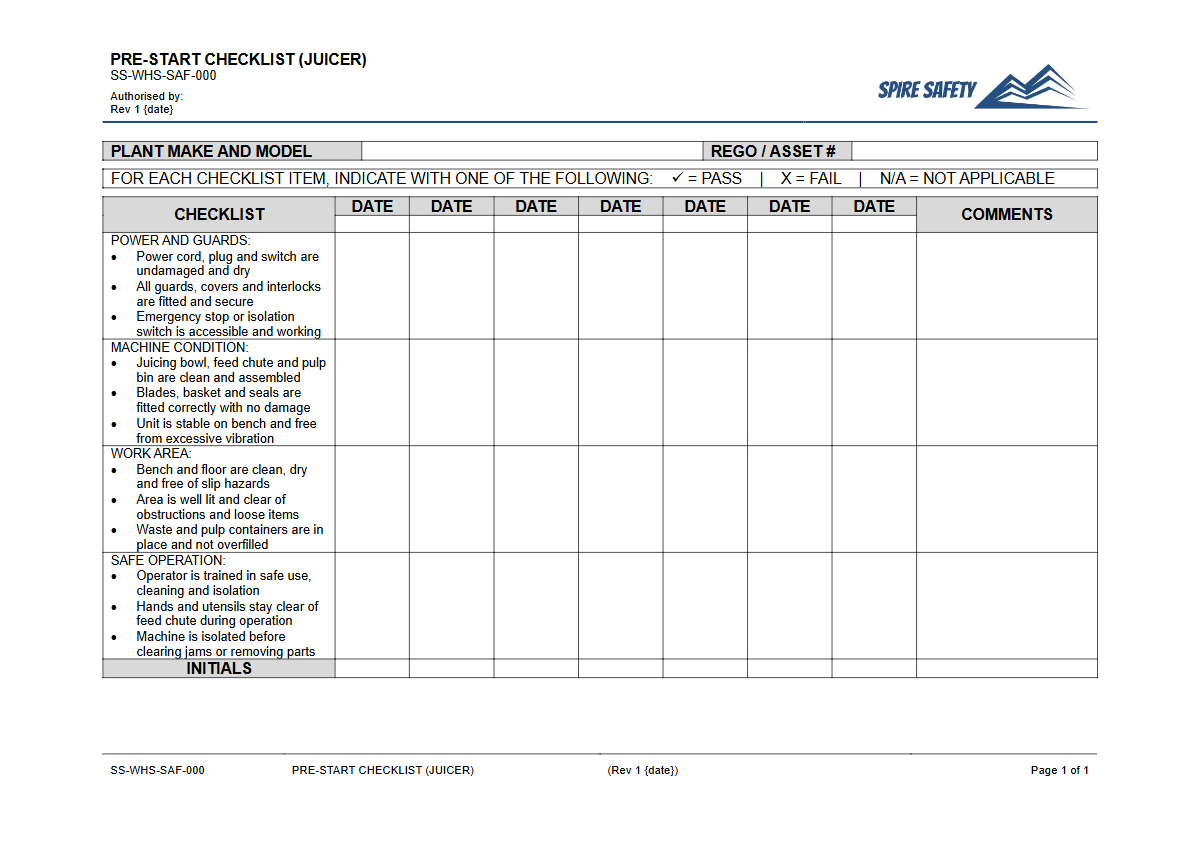
Our Free Pre-Start Checklist (Juicer) Template provides a structured way to formalise these daily checks, helping your team identify potential faults or damage before the equipment is used. By documenting these inspections, you create a clear record of due diligence and a proactive approach to maintenance.
Using a checklist helps prevent incidents arising from mechanical failure, electrical faults, or missing safety components like guards and interlocks. It standardises the inspection process, ensuring every operator checks for the same hazards consistently. This process is a key part of any effective plant safety program and can be reinforced with practical training, such as a Pre-Start Checks and Plant Maintenance toolbox talk.
Video walkthrough
How to Use the Free Pre-Start Checklist (Juicer) Template
This document, available as a DOCX or PDF file, is a starting point designed for easy adaptation. After downloading, you should integrate it into your operational procedures by following these steps:
- Review and Customise: This is the most important step. We have included common inspection points for commercial juicers, but you must modify the checklist to match the specific make and model of your equipment. Add or remove items to reflect your machine's features, the environment it's used in, and your organisation's specific safety rules.
- Add Site Details: Insert your company name, logo, the specific location, and an equipment ID or asset number for the juicer being inspected.
- Train Your Workers: Ensure all operators are trained on not just how to use the juicer safely, but also how to complete the pre-start checklist thoroughly. Emphasise the importance of not 'pencil-whipping' the form and reporting faults immediately.
- Implement and Monitor: Make the checklist a non-negotiable step before every shift. Supervisors should periodically review completed forms to identify recurring issues that may signal a need for more significant maintenance or equipment replacement.
Integrating tools like this checklist is a core component of a comprehensive WHS management system, demonstrating a systematic approach to risk control.
When to Use This Pre-Start Checklist
A pre-start check should be conducted at the following times:
- Before the juicer is used for the first time on any given day or shift.
- After the equipment has been cleaned or serviced, to ensure it has been reassembled correctly and all safety features are functional.
- If the equipment has been relocated or has undergone any repairs.
Who Should Use It
The primary user of this checklist is the trained and authorised operator of the juicer. They have the most hands-on interaction with the equipment and are best placed to notice small changes or defects.
Additionally, supervisors or managers should review the completed checklists as part of their safety oversight duties. This allows them to verify that checks are being done correctly and to take action on any reported faults. This principle of operator-led checks applies to a wide range of equipment, from a juicer to an industrial pre-start checklist for an agitator.
Key Inspection Points on a Juicer Checklist
While your customised version will be specific to your machine, a robust juicer pre-start checklist generally includes checks for:
- Guards & Interlocks: Ensure all physical guards are secure and that safety interlock switches function correctly (i.e., the machine cannot start if a guard is open).
- Electrical Safety: Inspect the power cord and plug for any fraying, cuts, or damage. Ensure the connection is secure.
- Mechanical Integrity: Check that cutting blades, augers, or press components are secure, clean, and free from chips or cracks.
- Emergency Controls: Verify that the emergency stop button or power switch is accessible and functional.
- Structural Condition: Look for any cracks, leaks, or damage to the machine's housing and collection bins.
- Work Area: Confirm the surrounding area is clean, dry, and free from slip hazards or obstructions.
The goal is to build a list that is thorough yet efficient, much like a well-designed CNC router pre-start checklist would be for a workshop environment.
Beyond the Checklist: Your Safety Responsibilities
A pre-start checklist is an essential tool, but it's only one part of your overall safety obligation. It must be supported by a robust safety framework that includes formal risk assessments, Safe Work Method Statements (SWMS) for high-risk activities, adequate worker training and supervision, and a clear process for reporting and rectifying faults.
If you need assistance developing or reviewing these broader systems, engaging specialist WHS consulting can provide expert guidance and ensure your approach is effective and sustainable. Explore our free WHS resources library for more templates and tools to support your safety program.
Common mistakes
Common mistakes to avoid
- Failing to customise the generic template for the specific juicer model in use.
- Operators 'pencil-whipping' the form without physically performing each check.
- Not immediately isolating faulty equipment and attaching an 'Out of Service' tag.
- Neglecting to train new or casual staff on how to complete the checklist properly.
Legal references
Legal considerations
The following legal requirements may be relevant to this type of work.
- Work Health and Safety Act (Harmonised) — Provides the primary duties for protecting workers and other people from work health and safety risks.
- Work Health and Safety Regulations (Harmonised) — Sets out requirements supporting the management of workplace hazards and risks.
The following codes may be relevant to this type of work.
- Managing WHS Risks Code of Practice — Provides practical guidance on identifying hazards, assessing risks and applying effective controls.
- Work Health and Safety Consultation, Cooperation and Coordination Code of Practice — Provides practical guidance on consulting workers and coordinating with other duty holders.
- Managing the Work Environment and Facilities Code of Practice — Provides practical guidance on safe work environments, workplace facilities and related controls.
Did you know
Entanglement Hazards
Many serious food service injuries involve the entanglement of hands, hair, or loose clothing in the moving parts of equipment like commercial juicers. Functional guards and safety interlocks are critical defences against these incidents.
Electrical Safety First
Damaged power cords on portable kitchen equipment are a leading cause of electric shock and fires in commercial settings. A daily visual inspection is a simple but highly effective control measure.
FAQ
Frequently asked questions
01What is the difference between a pre-start checklist and a risk assessment?
02How often should our juicer pre-start checklist be reviewed and updated?
03Do I need to keep completed juicer checklists?
04Can I use this template for a domestic juicer at home?
Share this resource
Free Pre-Start Checklist (Juicer) Template
Browse Categories
How To Use It
- 1Download and open in Word or PDF.
- 2Replace the placeholders with your business details.
- 3Get it reviewed by a WHS specialist before rollout.
Need it customised?
Our WHS consultants can adapt this template to your site, run a gap analysis, or audit what you already have in place.
Book a Free Consultation WHS consulting servicesor call 1300 156 382