
Free Pre-Start Checklist (Jib Crane) Template
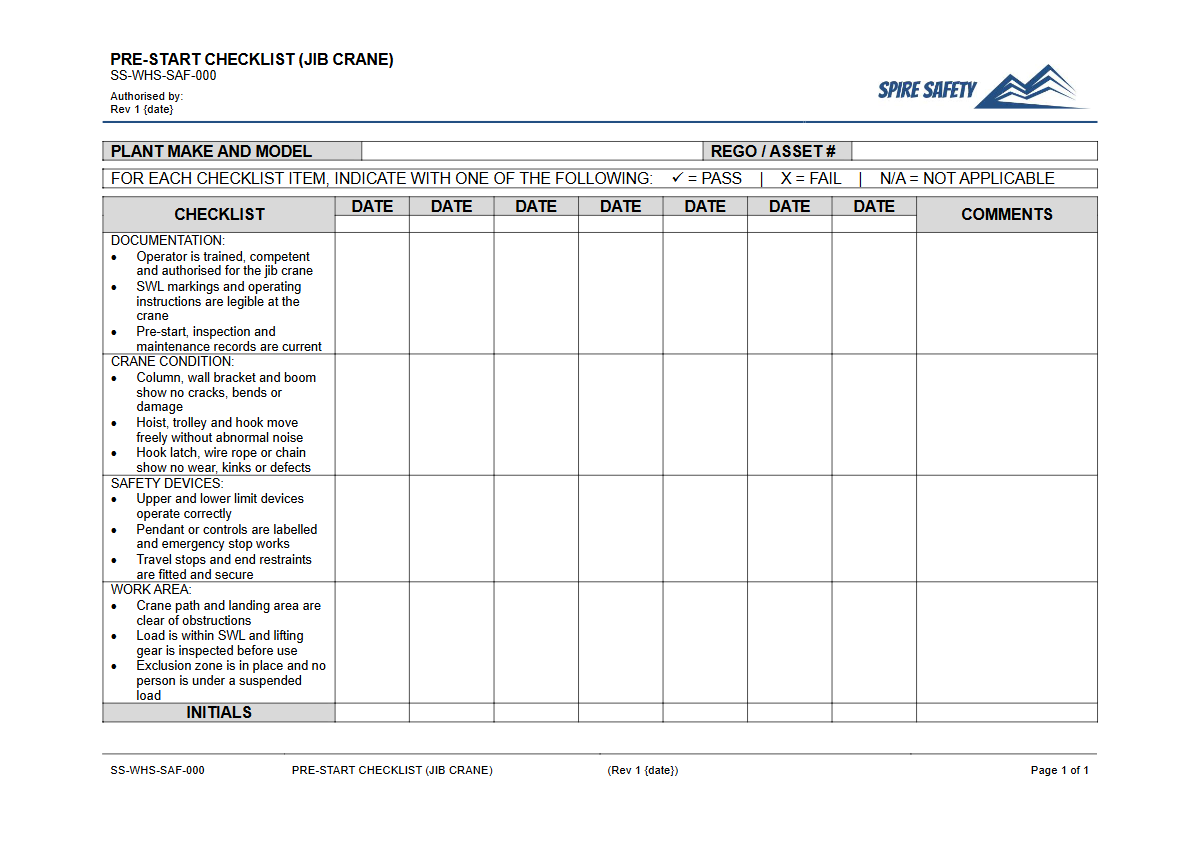
Download our free Pre-Start Checklist (Jib Crane) Template to standardise daily equipment inspections. This Word & PDF resource helps manage WHS risks.
Free Pre-Start Checklist (Jib Crane) Template
DOCX • 125 KB + PDF
Updated Oct 2026
No signup required
Purpose of the Free Pre-Start Checklist (Jib Crane) Template
Regular, documented inspections are critical for the safe operation of any lifting equipment. This Free Pre-Start Checklist (Jib Crane) Template provides a structured framework for operators to verify that a jib crane is safe to use before commencing work.
The goal is to systematically identify potential faults, damage, or wear and tear that could lead to equipment failure, property damage, or serious injury. By formalising this daily process, organisations can strengthen their safety culture and create a clear record of due diligence.
Integrating these checks helps meet the primary duty of care under Australian WHS laws to provide and maintain safe plant and equipment. Consistent use of a thorough checklist ensures that nothing is overlooked and that safety remains a top priority.
For a broader perspective on lifting safety, our Crane and Lifting Operations Safety Toolbox Talk Template provides valuable discussion points for your team.
Video walkthrough
How to use the Free Pre-Start Checklist (Jib Crane) Template
This Jib Crane Pre-Start Checklist is available for download as a DOCX file for easy customisation in Microsoft Word, and as a PDF for straightforward printing. It is designed as a starting point, aligned with general Australian WHS principles for plant inspection.
Important: This is a template, not a finished document. You must customise it to suit the specific make and model of your jib crane, its operating environment, and your organisation's specific procedures.
We recommend consulting the manufacturer's manual and conducting a risk assessment to identify all relevant inspection points. This process of customisation and implementation is a key component of effective WHS management systems.
What to Inspect on a Jib Crane
While your customised checklist will be specific to your equipment, a comprehensive jib crane pre-start should generally cover the following areas:
Key Inspection Points
- Structure: Check the mast, jib arm (boom), and mounting connections (base plate bolts, column connections) for any signs of cracking, bending, deformation, or corrosion.
- Hoist and Trolley: Inspect the hoist body, wire rope or chain for kinks, broken strands or links, and proper lubrication. Check the trolley for smooth movement along the jib and ensure wheels are not excessively worn.
- Hooks and Latches: Examine the hook for signs of stretching, cracks, or twisting. Ensure the safety latch is present, functions correctly, and is not damaged.
- Controls: Test all pendant or remote control functions (up/down, travel) to ensure they operate correctly and that emergency stop buttons are functional.
- Electrics: Look for damaged cables, conduits, or exposed wires. Ensure power collector systems are intact and functioning.
- Load Path: Confirm the area under and around the crane's operating radius is clear of obstructions, personnel, and potential hazards.
- Signage and Labels: Verify that the Safe Working Load (SWL) is clearly marked and legible, along with any other required warning labels.
Reinforcing these points with regular team training is essential. Our Pre-Start Checks and Plant Maintenance Toolbox Talk Template can help facilitate these crucial conversations.
When to Use This Checklist
A pre-start inspection should be completed at the beginning of every shift, or before the jib crane is used for the first time on any given day. It should also be performed if a new operator takes over during a shift.
This routine ensures the crane's condition is assessed before it is put under load. The checklist should not be confused with the detailed planning required for the lift itself, which often requires a separate document like a lift plan or a Safe Work Method Statement (Vehicle Loading Crane Operation) Template to control risks associated with the task.
Who Should Use It
The pre-start checklist should be completed by the person operating the jib crane for that shift. This operator must be deemed competent, meaning they have received the necessary information, training, and instruction to perform the inspection and operate the crane safely.
Supervisors or managers also have a responsibility to ensure these checks are being completed correctly and that any reported faults are addressed promptly. Verifying worker capability is a crucial step; for similar high-risk equipment, a formal assessment such as our Verification of Competency (Overhead Bridge Crane) Template can be adapted and used.
Completed checklists should be reviewed and filed as part of your plant safety records. These records can be invaluable during safety investigations, maintenance planning, and when demonstrating compliance.
Regular reviews of these records as part of a formal audit process helps ensure the system is working as intended. Consider engaging professional WHS compliance auditing services to periodically validate your safety processes.
Common mistakes
Common mistakes to avoid
- Using a generic checklist that doesn't match the specific crane model.
- 'Pencil-whipping' the form without physically conducting the checks.
- Failing to immediately tag out and report faulty equipment for repair.
- Operators not being adequately trained on what specific defects look like (e.g., fine cracks, wire rope damage).
Legal references
Legal considerations
The following legal requirements may be relevant to this type of work.
- Work Health and Safety Act (Harmonised) — Provides the primary duties for protecting workers and other people from work health and safety risks.
- Work Health and Safety Regulations (Harmonised) — Sets out requirements supporting the management of workplace hazards and risks.
The following codes may be relevant to this type of work.
- Managing WHS Risks Code of Practice — Provides practical guidance on identifying hazards, assessing risks and applying effective controls.
- Work Health and Safety Consultation, Cooperation and Coordination Code of Practice — Provides practical guidance on consulting workers and coordinating with other duty holders.
- Managing the Work Environment and Facilities Code of Practice — Provides practical guidance on safe work environments, workplace facilities and related controls.
Did you know
Structural Integrity is Key
The majority of catastrophic jib crane failures are not related to the hoist, but to the failure of the mast, boom, or mounting structure, often due to overloading, fatigue, or corrosion.
Australian Standards
Australian Standard AS 2550.1 provides general requirements for the safe use of cranes, while AS 1418 outlines design and manufacturing standards. Pre-start checks are a fundamental part of the 'safe use' lifecycle described in these standards.
FAQ
Frequently asked questions
01Is a pre-start checklist legally required for a jib crane in Australia?
02What is the difference between a jib crane and an overhead crane pre-start?
03Who is responsible for ensuring jib crane pre-start checks are done?
04What should an operator do if they find a fault during a pre-start check?
Share this resource
Free Pre-Start Checklist (Jib Crane) Template
Browse Categories
How To Use It
- 1Download and open in Word or PDF.
- 2Replace the placeholders with your business details.
- 3Get it reviewed by a WHS specialist before rollout.
Need it customised?
Our WHS consultants can adapt this template to your site, run a gap analysis, or audit what you already have in place.
Book a Free Consultation WHS consulting servicesor call 1300 156 382