
Free Pre-Start Checklist (Jetter Trailer) Template
Download our free Pre-Start Checklist (Jetter Trailer) Template to formalise equipment inspections and manage WHS risks. Download the DOCX and PDF today.
Free Pre-Start Checklist (Jetter Trailer) Template
DOCX • 125 KB + PDF
Updated Oct 2026
No signup required
Purpose of the Free Pre-Start Checklist (Jetter Trailer) Template
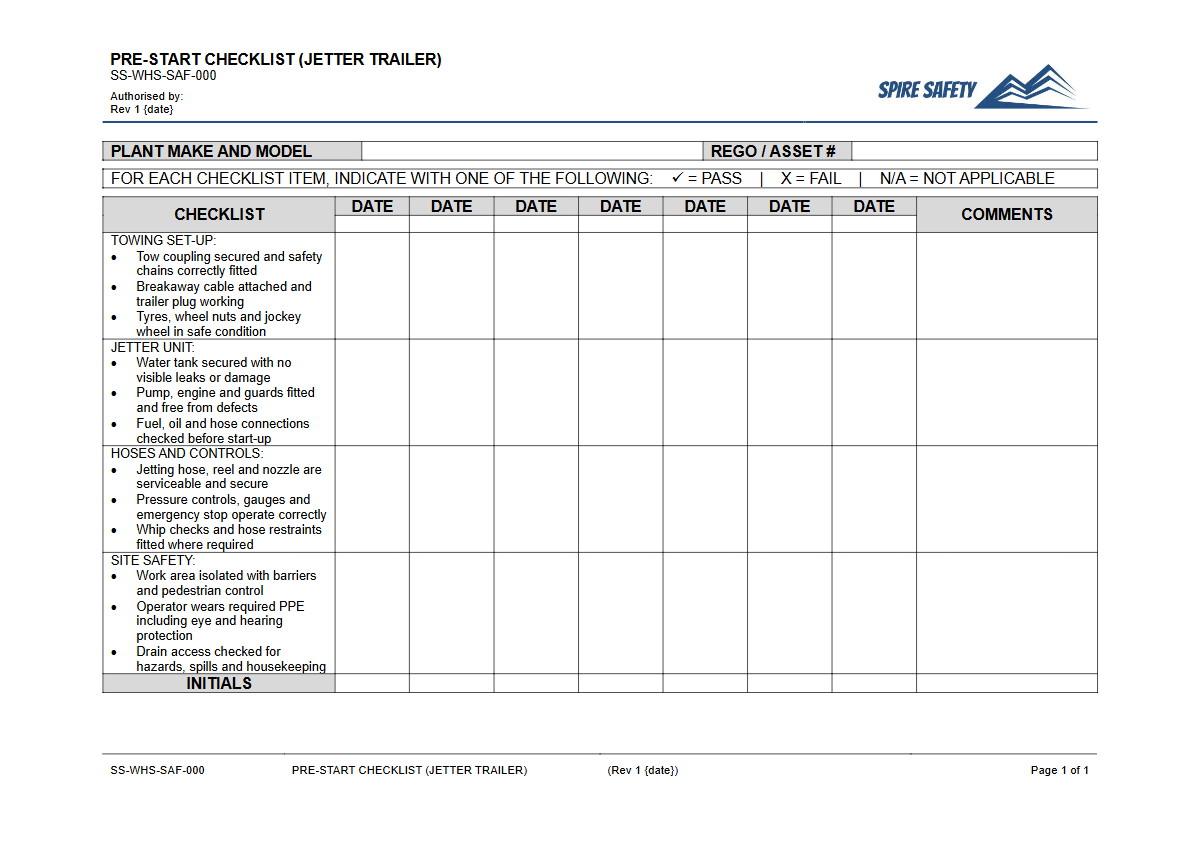
This Free Pre-Start Checklist (Jetter Trailer) Template provides a structured starting point for organisations to formalise daily safety inspections of their high-pressure water jetting trailers. Regularly completing a pre-start check is a fundamental safety practice that helps identify potential faults, damage, or wear and tear before the equipment is used.
By documenting these checks, you create a clear record of due diligence, which is a key part of managing your Work Health and Safety (WHS) obligations for plant and equipment.
Available in both DOCX and PDF formats, the template covers critical components specific to jetter trailers, including the engine, water pump, hoses, nozzles, safety features, and trailer components like wheels, lights, and coupling. Implementing a consistent inspection process demonstrates a commitment to worker safety and helps prevent equipment failure that could lead to serious incidents or costly downtime. This process forms an essential part of an effective WHS management system.
Video walkthrough
How to use the Free Pre-Start Checklist (Jetter Trailer) Template
Using this template effectively involves more than just downloading and printing it. To integrate it properly into your safety procedures, follow these steps:
- Download: Choose the DOCX format for easy customisation or the PDF for immediate use.
- Customise: Adapt the checklist to match the specific make and model of the jetter trailers used in your workplace. Add your company branding and any site-specific requirements.
- Train: Ensure all operators are trained on how to conduct a thorough inspection using the customised checklist and what to do if they find a defect.
- Implement: Make the pre-start check a mandatory step before any operator begins a shift or uses the equipment.
- Review: Periodically review completed checklists to identify recurring issues or patterns that may indicate a need for changes in maintenance schedules or operator training.
Note: This document is a template and not a complete safety solution. It is your organisation's responsibility to ensure the checklist is customised to reflect the specific equipment, tasks, and risks present in your workplace.
We recommend a competent person reviews and approves the final document before implementation.
When to use it
A jetter trailer pre-start checklist should be completed by the operator before the start of each work shift or prior to the first use of the day. This frequency ensures that the equipment's condition is verified before it is put into operation, catching any issues that may have developed overnight or during transport.
For continuous operations, a new check should also be considered at handover between shifts. The findings can be discussed during daily site meetings, which can be documented using a Pre-Start Meeting Template.
Who should use it
The pre-start checklist must be completed by a person who is trained and competent in the safe operation of the specific jetter trailer. This is typically the operator assigned to use the equipment for the shift.
Supervisors should also be familiar with the checklist content to effectively review completed forms and address any reported defects. These documented checks provide valuable evidence of safety procedures and are often reviewed during a formal WHS compliance auditing process.
The pre-start process should be integrated with other key safety documents. For example, the requirement to complete the checklist should be referenced in the relevant risk assessment or safe work method statement for the task.
This ensures a holistic approach to managing the hazards associated with high-pressure water jetting and trailer operations. For a related example, see our Safe Work Method Statement (SWMS) for tip truck and trailer operations.
To further embed the importance of these checks, consider running regular refresher sessions with your team. Our Pre-Start Checks and Plant Maintenance Toolbox Talk Template provides an excellent framework for facilitating these crucial safety discussions.
Common mistakes
Common mistakes to avoid
- "Pencil-whipping" the checklist without physically inspecting each item.
- Failing to tag out and report faulty equipment, allowing it to be used by the next person.
- Overlooking "minor" issues like worn hoses or low tyre pressure that can lead to major failures.
- Using a generic checklist that doesn't cover all specific features of the jetter trailer model.
Legal references
Legal considerations
The following legal requirements may be relevant to this type of work.
- Work Health and Safety Act (Harmonised) — Provides the primary duties for protecting workers and other people from work health and safety risks.
- Work Health and Safety Regulations (Harmonised) — Sets out requirements supporting the management of workplace hazards and risks.
The following codes may be relevant to this type of work.
- Managing WHS Risks Code of Practice — Provides practical guidance on identifying hazards, assessing risks and applying effective controls.
- Work Health and Safety Consultation, Cooperation and Coordination Code of Practice — Provides practical guidance on consulting workers and coordinating with other duty holders.
- Managing the Work Environment and Facilities Code of Practice — Provides practical guidance on safe work environments, workplace facilities and related controls.
Did you know
High-Pressure Hazards
Water jetting pressures can exceed 5,000 PSI (34,500 kPa). A jet stream at this pressure can cause severe injuries similar to a gunshot wound, easily piercing skin, muscle, and even bone.
Trailer Towing Troubles
In Australia, inadequate trailer maintenance and incorrect coupling are significant factors in towing-related incidents. A thorough pre-start check is the first line of defence against preventable accidents.
FAQ
Frequently asked questions
01What are the key items on a jetter trailer pre-start checklist?
02How often should a jetter trailer pre-start check be done?
03Who is responsible for completing the jetter trailer pre-start?
04Why is it important to customise a generic jetter trailer checklist?
Share this resource
Free Pre-Start Checklist (Jetter Trailer) Template
Browse Categories
How To Use It
- 1Download and open in Word or PDF.
- 2Replace the placeholders with your business details.
- 3Get it reviewed by a WHS specialist before rollout.
Need it customised?
Our WHS consultants can adapt this template to your site, run a gap analysis, or audit what you already have in place.
Book a Free Consultation WHS consulting servicesor call 1300 156 382