
Free Pre-Start Checklist (Jaw Crusher) Template
Download our Free Pre-Start Checklist (Jaw Crusher) Template to formalise daily equipment inspections and manage WHS risks in your Australian workplace.
Free Pre-Start Checklist (Jaw Crusher) Template
DOCX • 125 KB + PDF
Updated Oct 2026
No signup required
Purpose of the Free Pre-Start Checklist (Jaw Crusher) Template
Jaw crushers are powerful machines essential to mining, quarrying, and demolition operations, but they also present significant safety risks. This Free Pre-Start Checklist (Jaw Crusher) Template provides a structured starting point for organisations to formalise daily equipment inspections.
Using a consistent checklist helps operators systematically identify and report potential hazards before they cause incidents involving entanglement, ejected materials, noise, dust, or component failure. Formalising this process demonstrates a commitment to proactive risk management, creating a safer work environment and a documented record of safety checks.
Implementing regular pre-start inspections is a key component of managing high-risk plant and is aligned with Australian WHS best practices. It helps ensure that critical safety features like guards, emergency stops, and warning systems are functional before operation begins.
For sites that use a variety of heavy equipment, this process is fundamental. Similar principles apply to related machinery, as seen in our Pre-Start Checklist for Crusher Buckets, which also focuses on pre-operational safety.
Video walkthrough
How to use the Free Pre-Start Checklist (Jaw Crusher) Template
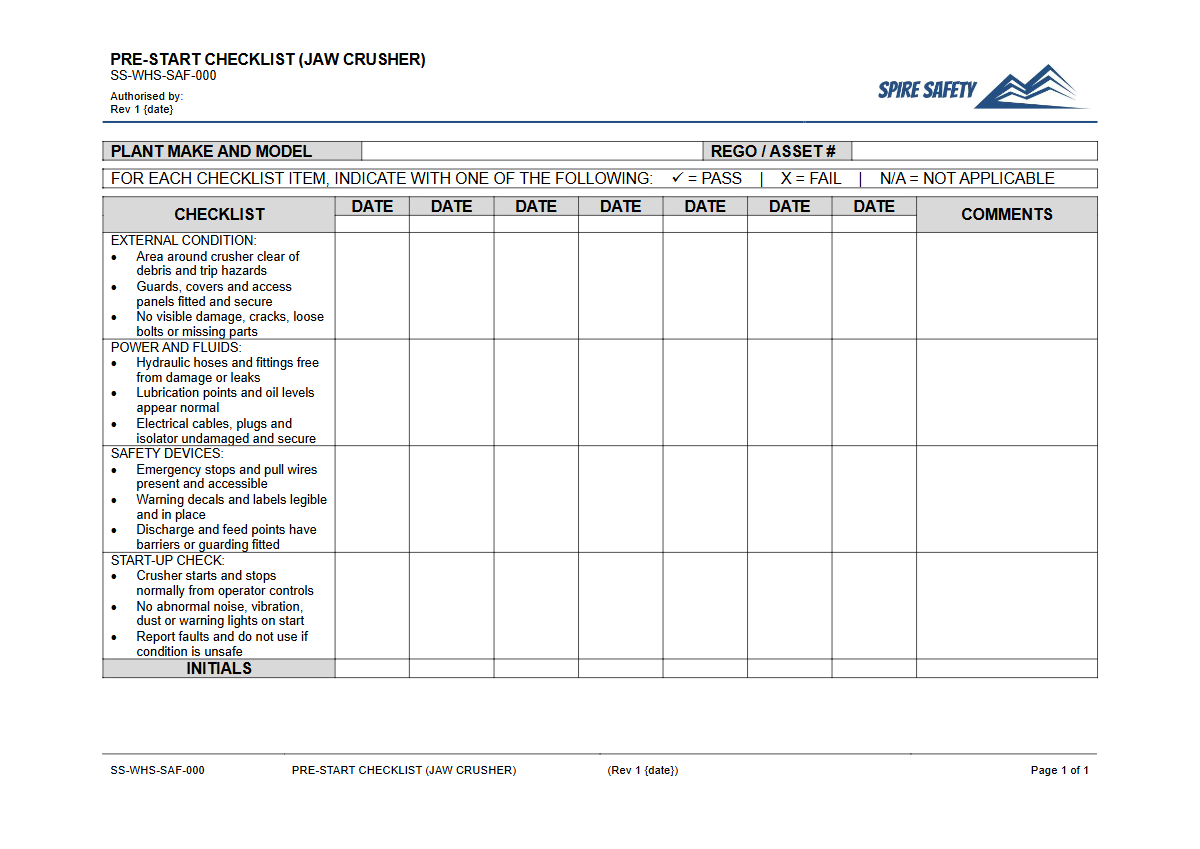
This resource is available for download as a fully editable DOCX file and a ready-to-print PDF. The checklist is designed as a foundational template that should be integrated into your broader safety protocols.
It provides a comprehensive list of common inspection points for a generic jaw crusher, covering mechanical, electrical, and hydraulic systems, as well as general site safety.
Important: This template must be customised to your specific needs. Before use, a competent person should review and amend the checklist to reflect the exact make and model of your jaw crusher, the manufacturer’s instructions, your site-specific hazards, and any unique operational requirements.
We recommend integrating this document into your existing WHS management systems to ensure it works alongside your Safe Work Method Statements (SWMS) and maintenance schedules.
The goal is to create a document that is practical and relevant for your operators. Similar customisation is required for other specialised machinery, whether it's a large piece of processing equipment or a smaller unit like those covered in our Free Pre-Start Checklist (Granulator) Template.
When to use it
A pre-start check should be completed by a competent operator before the jaw crusher is used at the beginning of each shift or after any prolonged break. It is a routine check, not a substitute for scheduled maintenance or detailed inspections.
If a fault or hazard is identified during the pre-start check, the equipment must be tagged out of service, and the issue must be reported to a supervisor immediately for rectification. The equipment should not be used until it is deemed safe.
Regularly completing and documenting these checks helps create a historical record of the machine's condition, which can be invaluable during maintenance planning and safety investigations. Consistent record-keeping is also a key part of demonstrating safety compliance, a process often reviewed during a WHS compliance auditing program.
Who should use it
This checklist is designed for any person conducting a business or undertaking (PCBU) where jaw crushers are used. It should be physically completed by trained and competent machine operators.
Supervisors and managers are responsible for ensuring the checks are completed correctly and that any reported issues are addressed promptly. It is also a useful tool for safety officers and maintenance personnel to understand the daily operational status of critical equipment.
The principles of operator-led checks apply across many types of high-risk plant. For example, in construction and demolition settings, workers may also use a pre-start checklist for floor saws to ensure blade guards and water suppression systems are functional before cutting concrete.
In all cases, the operator is the first line of defence against equipment-related incidents.
While this template is specific to jaw crushers, the fundamental process of pre-start checks is universal in managing plant safety. In recycling facilities, for instance, a similar but distinct process would apply, as shown in our bottle crusher pre-start checklist. You can explore many other templates in our free WHS resources library to build a comprehensive safety system for all your plant and equipment.
Common mistakes
Common mistakes to avoid
- "Pencil-whipping" the checklist without physically inspecting the components.
- Ignoring minor issues like worn belts or small hydraulic leaks, which can lead to major failures.
- Failing to lock out and tag out the equipment after identifying a serious fault.
- Conducting checks with the engine running or power connected, creating a severe risk of entanglement.
Legal references
Legal considerations
The following legal requirements may be relevant to this type of work.
- Work Health and Safety Act (Harmonised) — Provides the primary duties for protecting workers and other people from work health and safety risks.
- Work Health and Safety Regulations (Harmonised) — Sets out requirements supporting the management of workplace hazards and risks.
The following codes may be relevant to this type of work.
- Managing WHS Risks Code of Practice — Provides practical guidance on identifying hazards, assessing risks and applying effective controls.
- Work Health and Safety Consultation, Cooperation and Coordination Code of Practice — Provides practical guidance on consulting workers and coordinating with other duty holders.
- Managing the Work Environment and Facilities Code of Practice — Provides practical guidance on safe work environments, workplace facilities and related controls.
Did you know
Incredible Force
A large industrial jaw crusher can exert compressive forces of over 7,000 kilonewtons (kN). That's equivalent to the weight of more than 100 adult elephants, concentrated on a small area to fracture rock.
Flying Rock Hazard
Material can be ejected from the feed opening of a jaw crusher with significant force. This is why exclusion zones, proper guarding, and personal protective equipment (PPE) like face shields are critical for operator safety.
FAQ
Frequently asked questions
01What are the most critical safety checks for a jaw crusher?
02How often should a jaw crusher pre-start check be performed?
03Can this template be used for cone crushers or impact crushers?
04Who is responsible for ensuring pre-start checks are completed?
Share this resource
Free Pre-Start Checklist (Jaw Crusher) Template
Browse Categories
How To Use It
- 1Download and open in Word or PDF.
- 2Replace the placeholders with your business details.
- 3Get it reviewed by a WHS specialist before rollout.
Need it customised?
Our WHS consultants can adapt this template to your site, run a gap analysis, or audit what you already have in place.
Book a Free Consultation WHS consulting servicesor call 1300 156 382