
Free Pre-Start Checklist (Crusher Bucket) Template
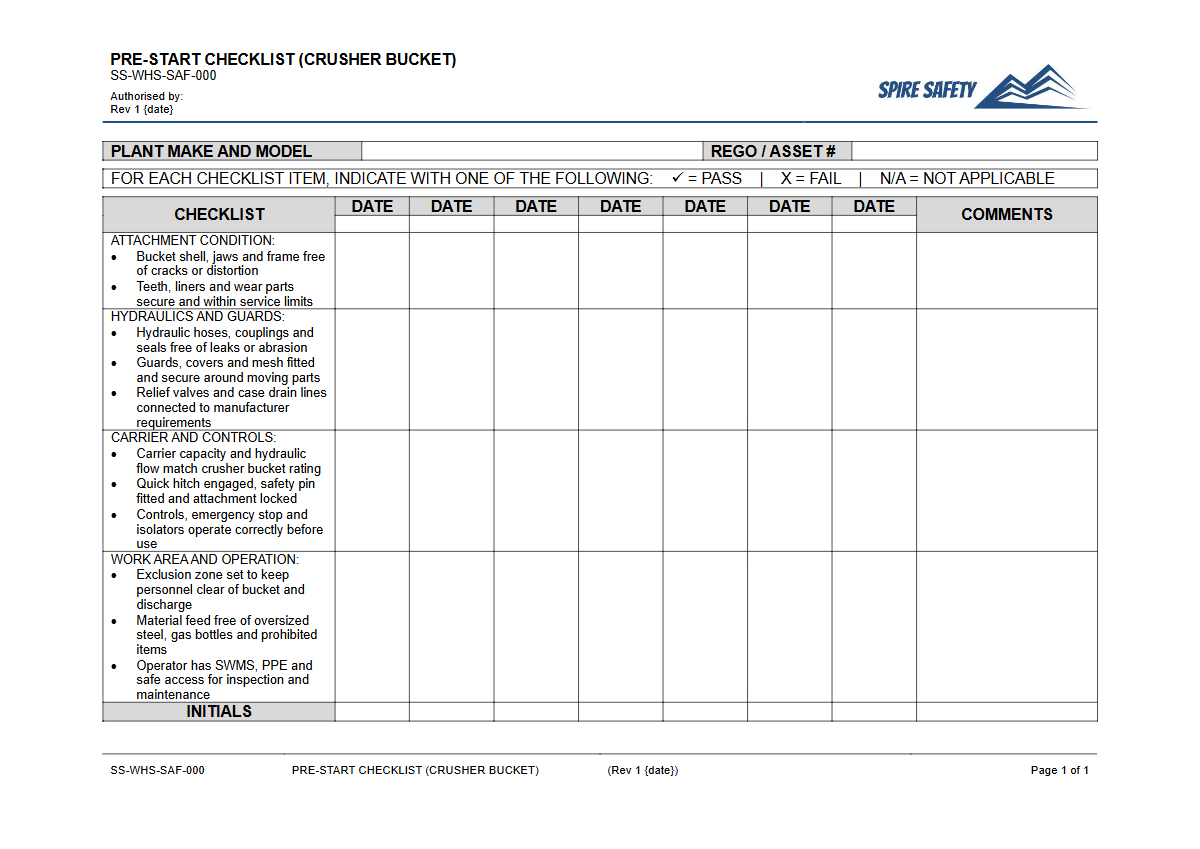
Formalise equipment safety checks with our free Pre-Start Checklist for Crusher Buckets. Download the DOCX & PDF to identify hazards before each use.
Free Pre-Start Checklist (Crusher Bucket) Template
DOCX • 125 KB + PDF
Updated Oct 2026
No signup required
Purpose of the Free Pre-Start Checklist (Crusher Bucket) Template
Operating heavy machinery attachments like crusher buckets involves significant risks. This free Pre-Start Checklist (Crusher Bucket) Template provides a structured method for operators to conduct thorough safety inspections before each use.
Its primary purpose is to systematically identify potential hazards, mechanical faults, or wear and tear that could lead to equipment failure, property damage, or serious injury. By formalising this process, organisations can promote a proactive safety culture and ensure machinery is fit for purpose before work begins.
Regular checks help prevent incidents arising from issues like hydraulic fluid leaks, worn or damaged crushing jaws, structural fatigue, and insecure attachment connections. Documenting these checks creates a clear record of due diligence and equipment condition over time.
Integrating this checklist into daily operations is a critical step in managing risks associated with heavy plant. The consequences of attachment failure can be catastrophic, as highlighted in a tragic incident involving an excavator bucket which resulted in a fatality.
Video walkthrough
How to use the Free Pre-Start Checklist (Crusher Bucket) Template
This template is designed as a foundational document for your workplace safety procedures. Follow these steps to implement it effectively:
- Download: Choose between the DOCX and PDF formats. The DOCX file is fully editable.
- Customise: Adapt the checklist to your specific operational needs. It is crucial to add details relevant to the make and model of your crusher bucket, the host machine (e.g., excavator, skid steer), and your specific site conditions. This is not a one-size-fits-all solution; you must customise it to reflect your workplace's unique risks.
- Train: Ensure all operators are trained on how to conduct the checks thoroughly. They should understand what each item means and what constitutes a 'fail'. A practical way to reinforce this is by using our Pre-Start Checks and Plant Maintenance Toolbox Talk to facilitate discussion and understanding among your team.
- Implement: Integrate the checklist into your daily start-of-shift procedures. Establish a clear process for reporting and rectifying any identified defects. Defective equipment must be tagged out of service until it is repaired by a competent person.
- Review: Periodically review the checklist's effectiveness and update it as necessary, especially after an incident or when new equipment is introduced.
Key Inspection Points for Crusher Buckets
While your customised checklist will be more detailed, a thorough pre-start inspection should always cover several core areas. These checks ensure the attachment is mechanically sound and safe to operate.
Structural and Mechanical Integrity
Visually inspect the entire bucket for signs of stress, such as cracks in welds, bent plates, or warping. Check the condition of the crushing jaws or teeth for excessive wear, chips, or missing components that could affect performance or become projectiles.
Confirm that all pins, bolts, and fasteners connecting the bucket to the host machine are secure and correctly fitted with locking mechanisms in place.
Hydraulic and Electrical Systems
Examine all hydraulic hoses and connections for leaks, abrasion, or signs of perishing. A sudden hydraulic failure can cause a loss of control or unexpected movement.
Ensure couplers are clean and securely connected. If the bucket has any electrical components, check that wiring is insulated, secured, and free from damage. This systematic verification is a cornerstone of any effective WHS management system.
Guards and Safety Features
Confirm that all manufacturer-supplied guards are in place and undamaged. These are designed to protect against moving parts and ejected material.
If the attachment has specific safety lockouts or emergency stop functions, verify they are operational. Ensuring all safety controls are functional is a non-negotiable part of the pre-start process.
In work environments that may also involve concrete, having a documented process like a Safe Work Method Statement for Concrete Truck Operation for other plant on site can help build a comprehensive safety picture.
Who Should Use This Checklist?
This checklist should be completed by a person who is trained, competent, and authorised to operate the specific crusher bucket and host machine. Competency goes beyond simply knowing how to operate the equipment; it includes the ability to identify potential defects and understand the associated risks.
Supervisors or managers should also be familiar with the checklist to ensure it is being completed correctly and that any reported issues are addressed promptly. Periodically, your organisation may benefit from WHS compliance auditing to verify that procedures like pre-start checks are being effectively implemented across all operations.
If your operations require other forms or checklists, you can explore our comprehensive free WHS resources library for more templates.
Common mistakes
Common mistakes to avoid
- Completing the checklist from memory or the cab without physically inspecting the attachment.
- Failing to tag out and report equipment with identified defects, continuing to use it 'just for a small job'.
- Using a generic checklist that doesn't match the specific make or model of the crusher bucket.
- Operators not being adequately trained on what to look for, leading to a superficial 'tick and flick' exercise.
Legal references
Legal considerations
The following legal requirements may be relevant to this type of work.
- Work Health and Safety Act (Harmonised) — Provides the primary duties for protecting workers and other people from work health and safety risks.
- Work Health and Safety Regulations (Harmonised) — Sets out requirements supporting the management of workplace hazards and risks.
The following codes may be relevant to this type of work.
- Managing WHS Risks Code of Practice — Provides practical guidance on identifying hazards, assessing risks and applying effective controls.
- Work Health and Safety Consultation, Cooperation and Coordination Code of Practice — Provides practical guidance on consulting workers and coordinating with other duty holders.
- Managing the Work Environment and Facilities Code of Practice — Provides practical guidance on safe work environments, workplace facilities and related controls.
Did you know
Hydraulic Pressure
The hydraulic systems on heavy equipment like excavators can operate at pressures exceeding 5,000 PSI. A pinhole leak at this pressure can inject hydraulic fluid into the skin, causing severe injury.
Impact Force
Crusher buckets generate immense force to break concrete and rock. Jaw wear is a critical inspection point, as a worn or fractured jaw can fail under load, posing a significant risk to people and property nearby.
FAQ
Frequently asked questions
01What is the main purpose of a crusher bucket pre-start checklist?
02How often should a crusher bucket pre-start inspection be performed?
03Who is responsible for completing the crusher bucket pre-start checklist?
04Is this crusher bucket checklist a legal document?
Share this resource
Free Pre-Start Checklist (Crusher Bucket) Template
Browse Categories
How To Use It
- 1Download and open in Word or PDF.
- 2Replace the placeholders with your business details.
- 3Get it reviewed by a WHS specialist before rollout.
Need it customised?
Our WHS consultants can adapt this template to your site, run a gap analysis, or audit what you already have in place.
Book a Free Consultation WHS consulting servicesor call 1300 156 382