
Free Pre-Start Checklist (Cut Off Saw) Template
Formalise equipment safety checks with our free Pre-Start Checklist for Cut Off Saws.
Free Pre-Start Checklist (Cut Off Saw) Template
DOCX • 125 KB + PDF
Updated Oct 2026
No signup required
Purpose of the Free Pre-Start Checklist (Cut Off Saw) Template
A cut-off saw, also known as a demolition saw or quick-cut, is a powerful and hazardous piece of equipment. Using one without proper safety checks exposes workers to significant risks, including severe lacerations, blade-shatter projectiles, respiratory illness from dust, hearing loss, and ergonomic injuries.
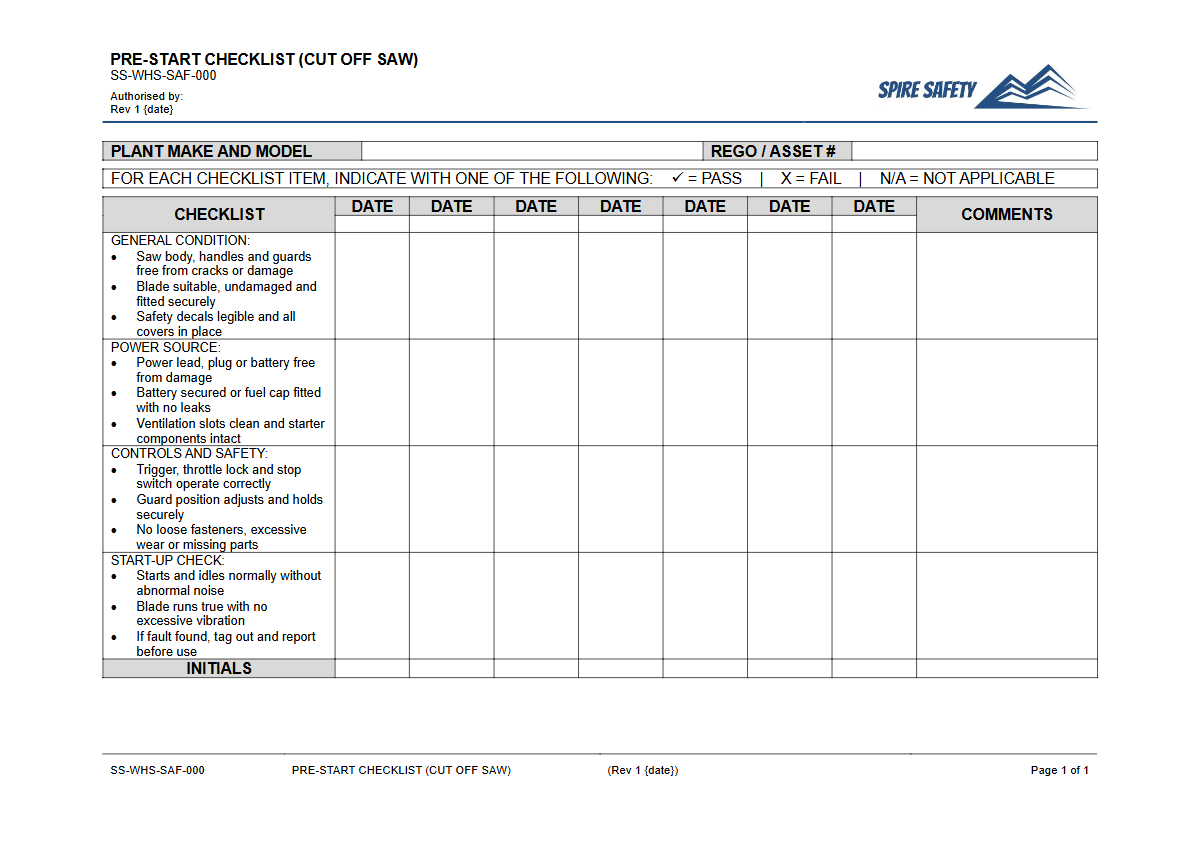
This free Pre-Start Checklist (Cut Off Saw) Template provides a structured framework for operators to conduct a thorough and consistent inspection before each use, formalising the process of identifying and controlling potential hazards before they can cause harm.
Implementing a routine pre-start inspection helps organisations meet their duty of care under Australian WHS laws by proactively managing risks associated with high-risk plant. It creates a documented record that the equipment was in a safe condition at the start of the shift, which is a key component of a safe system of work. Similar principles apply to other high-risk cutting equipment, as outlined in our floor saw pre-start checklist.
Video walkthrough
How to use the Free Pre-Start Checklist (Cut Off Saw) Template
This resource is available for immediate download as both a DOCX file for easy customisation and a PDF for straightforward printing. The DOCX version allows you to modify the checklist to suit the specific models of cut-off saws used in your workplace, the materials you cut, and your unique operational risks.
Once customised, it should be integrated into your daily operational procedures and used to train all operators.
Important: This document is a template and a starting point. We have not been to your workplace, assessed your specific equipment, or reviewed your processes.
Therefore, you MUST customise this template to reflect the actual hazards and control measures relevant to your operations. A generic checklist that doesn't match your equipment is not an effective control.
What a Cut-Off Saw Check Should Include
A comprehensive pre-start inspection for a cut-off saw should cover all critical safety components and functions. While your customised checklist will be more detailed, it should always verify the following points:
- Guards: The blade guard and any spark deflectors must be in place, securely attached, and functioning correctly. Never use a saw with a missing or modified guard.
- Blade: Check that the blade is the correct type for the material being cut (e.g., masonry, metal). Inspect it for cracks, missing segments, warping, or other signs of damage. Ensure it is mounted securely.
- Handles and Grips: All handles should be intact, secure, and provide a firm grip. Check for any damage or excessive vibration.
- Power Source: For electric models, inspect cords and plugs for damage. For petrol models, check for fuel leaks and ensure the fuel cap is secure. For battery models, check the battery housing for damage.
- Controls: Test the throttle trigger, trigger lock-out, and stop switch to ensure they function smoothly and correctly.
- Dust Suppression: If the saw has an integrated water delivery system for dust control, check that it is connected and working effectively. Controlling dust is critical, especially when cutting materials that generate silica. For fixed workshops, other controls may be necessary, similar to those managed with a pre-start checklist for fume cabinets.
When to use it
A pre-start check should be completed by the operator at the beginning of each day or shift before the cut-off saw is first used. It should also be performed after any significant break, if the saw is being used by a new operator, after a blade change, or if there is any reason to suspect the saw may have been damaged, such as after being dropped.
Who should use it
Only workers who have been trained, are deemed competent, and are authorised to use a cut-off saw should perform the pre-start inspection. Supervisors should also be familiar with the checklist to ensure they can verify that the checks are being completed correctly and consistently.
Documenting these checks is a vital element within broader WHS management systems, demonstrating proactive risk management.
Beyond the Checklist: Maintaining a Safe System of Work
A pre-start checklist is an essential tool, but it is only one part of a comprehensive safety strategy. It must be supported by other critical elements, including Safe Work Method Statements (SWMS) for high-risk construction work, regular maintenance schedules, and comprehensive operator training.
Providing the correct personal protective equipment (PPE)—including eye and face protection, hearing protection, respiratory protection, and appropriate gloves and footwear—is non-negotiable. For a deeper dive into other helpful safety documents, explore our free WHS resources library.
Regular verification ensures that these procedures are not just paperwork but are actively improving safety on site. Engaging in periodic reviews or WHS compliance auditing can help identify gaps in your system before an incident occurs, ensuring your processes for managing high-risk equipment like cut-off saws remain effective. For organisations needing assistance in developing these robust systems, Spire Safety offers expert general WHS consulting services.
Common mistakes
Common mistakes to avoid
- Using an abrasive blade for a material it's not designed for, causing rapid wear or shatter.
- Removing or pinning back the blade guard to get a better view of the cut, exposing the operator to the spinning blade.
- Applying excessive force to 'push' the saw through a cut, instead of letting the blade's speed do the work.
- Failing to use or check the water suppression system, resulting in the release of hazardous dust clouds.
Legal references
Legal considerations
The following legal requirements may be relevant to this type of work.
- Work Health and Safety Act (Harmonised) — Provides the primary duties for protecting workers and other people from work health and safety risks.
- Work Health and Safety Regulations (Harmonised) — Sets out requirements supporting the management of workplace hazards and risks.
The following codes may be relevant to this type of work.
- Managing WHS Risks Code of Practice — Provides practical guidance on identifying hazards, assessing risks and applying effective controls.
- Work Health and Safety Consultation, Cooperation and Coordination Code of Practice — Provides practical guidance on consulting workers and coordinating with other duty holders.
- Managing the Work Environment and Facilities Code of Practice — Provides practical guidance on safe work environments, workplace facilities and related controls.
Did you know
The Danger of Dust
Cutting concrete, brick, or stone with a cut-off saw can generate respirable crystalline silica (RCS), a hazardous substance linked to serious lung diseases. Using water suppression can reduce airborne dust by over 80%.
Blade Speed
The outer edge of a 14-inch (350mm) cut-off saw blade can travel at speeds over 300 km/h. This is why a fully functional blade guard is a critical, non-negotiable safety feature.
FAQ
Frequently asked questions
01What is the biggest hazard when using a cut-off saw?
02Is a pre-start checklist legally required for a cut-off saw in Australia?
03How often should the blade on a cut-off saw be replaced?
04What PPE is essential when using a cut-off saw?
Share this resource
Free Pre-Start Checklist (Cut Off Saw) Template
Browse Categories
How To Use It
- 1Download and open in Word or PDF.
- 2Replace the placeholders with your business details.
- 3Get it reviewed by a WHS specialist before rollout.
Need it customised?
Our WHS consultants can adapt this template to your site, run a gap analysis, or audit what you already have in place.
Book a Free Consultation WHS consulting servicesor call 1300 156 382