
Free Pre-Start Checklist (Demo Hammer) Template
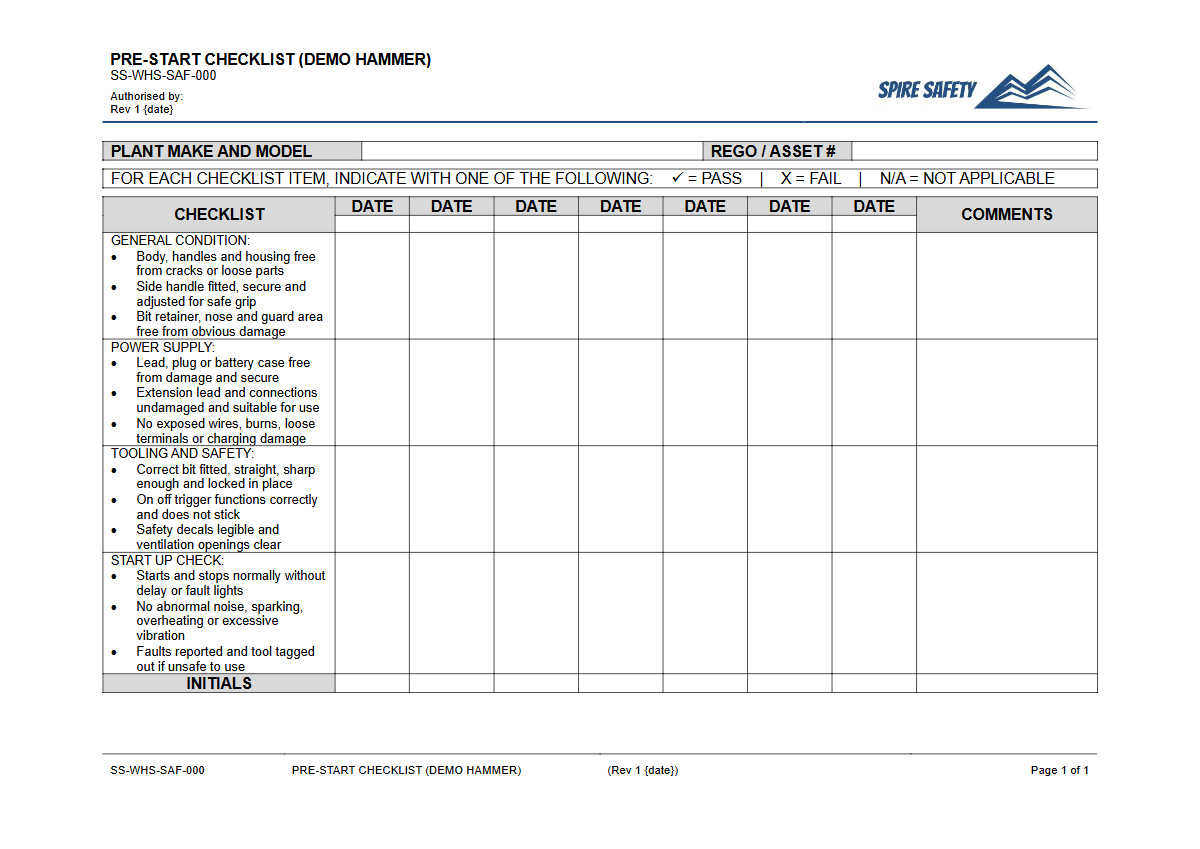
Download our Free Pre-Start Checklist (Demo Hammer) Template. This DOCX & PDF resource helps formalise safety checks and manage WHS risks. Get your copy.
Free Pre-Start Checklist (Demo Hammer) Template
DOCX • 125 KB + PDF
Updated Oct 2026
No signup required
Purpose of the Free Pre-Start Checklist (Demo Hammer) Template
Demolition hammers, also known as breaker hammers or jackhammers, are powerful tools essential for many construction and demolition tasks. However, their operation introduces significant workplace hazards, including hand-arm vibration, high noise levels, airborne dust (like silica), and electrical risks.
This Free Pre-Start Checklist (Demo Hammer) Template provides a structured starting point for organisations to formalise their equipment inspection process. Using a consistent checklist helps operators systematically identify potential faults or damage before they lead to an incident, injury, or equipment failure.
Implementing this Pre-Start Checklist helps a Person Conducting a Business or Undertaking (PCBU) meet their primary duty of care under Australian WHS laws. It serves as documented evidence that steps are being taken to ensure the equipment is safe to use, contributing to a safer work environment.
It also prompts operators to consider the condition of the tool in relation to the specific task, encouraging a proactive safety mindset. For similar concrete-related equipment, you may also find our free Pre-Start Checklist for Floor Saws useful.
Video walkthrough
How to use the Free Pre-Start Checklist (Demo Hammer) Template
This resource is available for download in both DOCX and PDF formats. The DOCX version is fully editable, allowing you to tailor it to your specific needs.
To use the template effectively, you should review each item and adapt it to the models of demolition hammers used at your workplace, the specific attachments (bits, chisels), and the environments in which they are operated.
Important: This template is a guide only. To ensure it is effective, you must customise it to reflect the specific hazards and control measures relevant to your workplace.
We recommend consulting with operators and maintenance personnel during the customisation process to ensure the checklist is practical and comprehensive. Integrating these checks into your broader WHS management system ensures they are part of a holistic approach to site safety.
When to use it
A pre-start inspection should be completed by the operator before every use or, at a minimum, at the beginning of each shift where the demolition hammer will be used. A new check should be performed if the equipment is transferred between operators during a shift.
This frequency ensures that any damage or faults that may have occurred during previous use, transport, or storage are identified before the tool is operated again.
Who should use it
This Pre-Start Checklist is designed for several key personnel within an organisation:
- Operators: The primary user of the checklist. They are responsible for conducting the physical inspection of the demolition hammer before they use it.
- Supervisors and Site Foremen: Responsible for ensuring operators complete the pre-start checks correctly and for taking appropriate action when faults are reported, such as tagging out unsafe equipment.
- WHS Officers and Managers: Use the completed records to monitor compliance, identify trends in equipment failure, and verify the effectiveness of safety procedures during site inspections. Regular WHS compliance auditing helps confirm these processes are being followed correctly.
- Maintenance Personnel: Can use the information from completed checklists to schedule preventative maintenance and prioritise repairs based on reported issues.
For organisations looking to standardise safety checks across all workshop equipment, our Pre-Start Checklist for Bench Grinders offers a similar structured approach. If you require assistance in developing a full suite of customised safety documentation for your site, our WHS consulting services can provide expert guidance.
You can also explore our complete free WHS resources library for more templates and guides.
Common mistakes
Common mistakes to avoid
- Performing a 'tick and flick' exercise without physically inspecting each item.
- Ignoring minor cracks or damage to the casing, power cord, or chisel bit.
- Failing to remove faulty equipment from service and tag it out correctly.
- Using a checklist that hasn't been customised for the specific model of demo hammer.
Legal references
Legal considerations
The following legal requirements may be relevant to this type of work.
- Work Health and Safety Act (Harmonised) — Provides the primary duties for protecting workers and other people from work health and safety risks.
- Work Health and Safety Regulations (Harmonised) — Sets out requirements supporting the management of workplace hazards and risks.
The following codes may be relevant to this type of work.
- Managing WHS Risks Code of Practice — Provides practical guidance on identifying hazards, assessing risks and applying effective controls.
- Work Health and Safety Consultation, Cooperation and Coordination Code of Practice — Provides practical guidance on consulting workers and coordinating with other duty holders.
- Managing the Work Environment and Facilities Code of Practice — Provides practical guidance on safe work environments, workplace facilities and related controls.
Did you know
Vibration Exposure
The vibration from a typical demolition hammer can be so intense that operators may reach their daily exposure limit, as recommended by safety bodies, in less than 15-30 minutes of continuous use.
Silica Dust
Breaking concrete or masonry with a demo hammer can release high concentrations of respirable crystalline silica, an industrial hazard that can lead to serious lung diseases like silicosis if inhaled.
FAQ
Frequently asked questions
01What are the main hazards of a demolition hammer?
02How often should a pre-start check be performed on a demo hammer?
03Can I use a generic checklist for all my power tools?
04What should an operator do if they find a fault during a pre-start check?
Share this resource
Free Pre-Start Checklist (Demo Hammer) Template
Browse Categories
How To Use It
- 1Download and open in Word or PDF.
- 2Replace the placeholders with your business details.
- 3Get it reviewed by a WHS specialist before rollout.
Need it customised?
Our WHS consultants can adapt this template to your site, run a gap analysis, or audit what you already have in place.
Book a Free Consultation WHS consulting servicesor call 1300 156 382