
Free Pre-Start Checklist (Demo Saw) Template
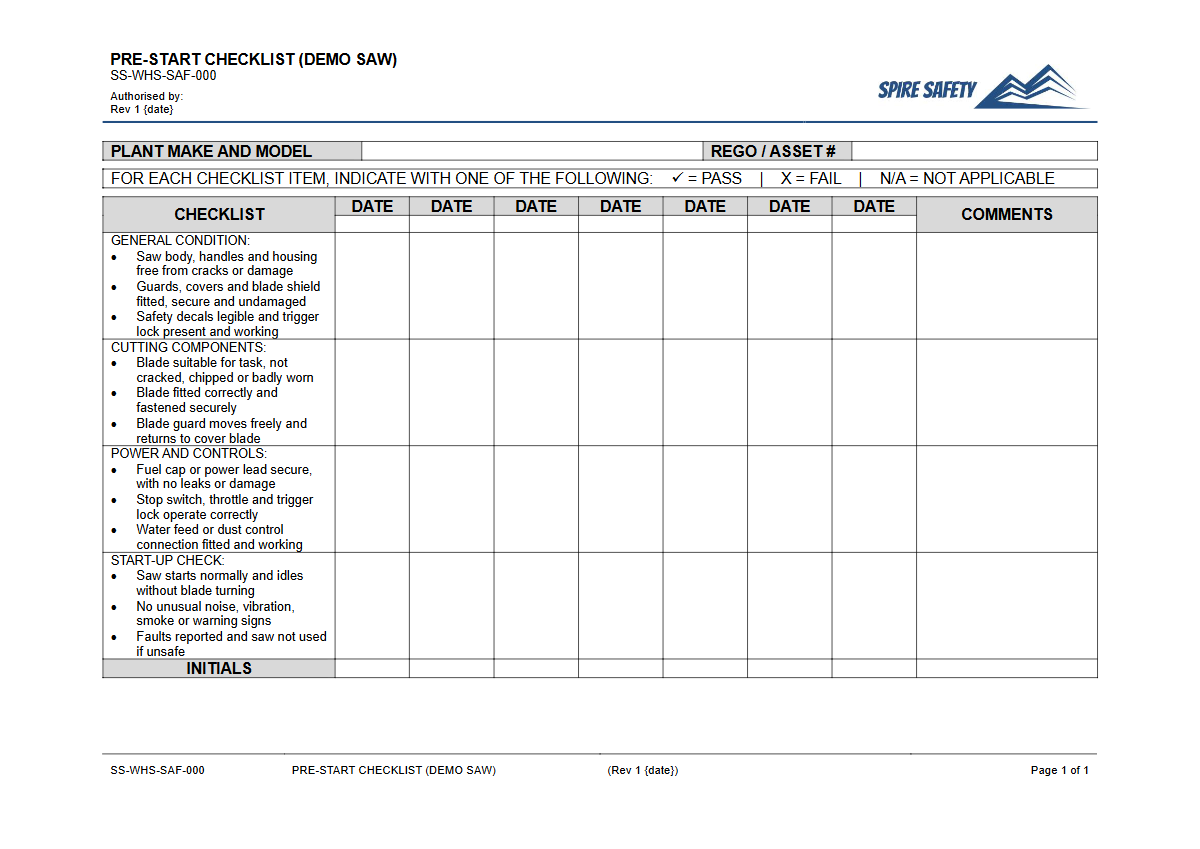
Formalise equipment safety inspections with our Free Pre-Start Checklist (Demo Saw) Template. Designed for Australian workplaces, it helps manage WHS risks.
Free Pre-Start Checklist (Demo Saw) Template
DOCX • 125 KB + PDF
Updated Oct 2026
No signup required
Purpose of the Free Pre-Start Checklist (Demo Saw) Template
Operating a demolition saw, commonly known as a 'demo saw' or 'quick cut', involves significant health and safety risks, including severe lacerations, musculoskeletal injuries, and exposure to hazardous substances like silica dust. This Free Pre-Start Checklist (Demo Saw) Template provides a structured framework for operators to conduct thorough, consistent inspections before each use.
Using a Pre-Start Checklist helps identify mechanical faults, damage, or missing safety features before they can cause an incident.
Formalising this process demonstrates due diligence in meeting your duties as a Person Conducting a Business or Undertaking (PCBU). Regular checks are a cornerstone of preventative maintenance and are essential for managing risks associated with high-powered plant and equipment.
Integrating these checks is a practical step towards building more robust WHS management systems that protect workers and ensure operational safety.
Video walkthrough
How to use the Free Pre-Start Checklist (Demo Saw) Template
This template is provided in both DOCX and PDF formats for your convenience. To use it, simply download the file and integrate it into your daily operational procedures.
Operators should complete the checklist before their first use of the demo saw each day or at the beginning of their shift. The process should involve a physical and visual inspection of each component listed, with the operator noting the item's condition.
Important: This document is a template, not a finished procedure. We strongly advise that you customise it to reflect the specific make and model of the saws used at your site, the unique tasks being performed (e.g., cutting concrete vs.
metal), and your operational environment. You may need to add or remove checks to ensure it is fully relevant to your workplace.
It's also vital to ensure the work area is clear of trip hazards and unnecessary personnel before starting. For related site equipment, you might also find our free Pre-Start Checklist (Bin Lifter) Template useful for managing waste-handling machinery.
When to use a Demo Saw Pre-Start Checklist
A Pre-Start Checklist should be completed:
- Before the first use of the demo saw on any given day or shift.
- After a change of operator.
- Following any maintenance or repair work.
- If the saw has been dropped or subjected to an impact that could cause damage.
- Before using a saw that has been in storage for an extended period.
Consistency is key. Making the pre-start check a non-negotiable part of the daily routine helps cultivate a strong safety culture where potential hazards are identified and controlled proactively.
Who should use this Pre-Start Checklist
This checklist should be used by any worker who is required to operate a demolition saw. Crucially, the user must be a 'competent person'—someone who has received adequate information, instruction, training, and supervision to operate the equipment safely.
This includes understanding the specific hazards of the saw, such as kickback, blade integrity, and dust generation, as well as the correct use of all safety features and personal protective equipment (PPE).
Supervisors and managers should also use the completed checklists to verify that inspections are being carried out correctly and to monitor the condition of their equipment over time. These records are vital during safety reviews and can be verified through WHS compliance auditing to confirm that safety procedures are being followed.
Key Inspection Points
While our downloadable template provides a comprehensive list, key areas of focus for any demo saw inspection include:
- Blade: Check for cracks, missing segments (on diamond blades), warping, or excessive wear. Ensure it is the correct type for the material being cut and is securely mounted.
- Guards: The blade guard must be in place, functioning correctly, and adjusted to provide maximum protection to the operator.
- Handles: Inspect both the front and rear handles for damage or looseness. Ensure anti-vibration mounts are intact.
- Throttle & Controls: Test the throttle trigger, trigger lockout, and stop switch to ensure they function smoothly and reliably.
- Fuel & Fluids: Check for fuel or oil leaks. Ensure the fuel cap seals correctly.
- General Condition: Look for any loose or missing nuts and bolts, cracks in the casing, or other visible damage. The principles of inspecting high-speed cutting tools are similar across different equipment; our free Pre-Start Checklist for Floor Saws addresses comparable hazards.
If any item on the checklist fails inspection, the demo saw must be immediately removed from service, tagged 'Out of Service', and reported to a supervisor for repair. Explore our complete free WHS resources library for more templates and guides to support your safety management efforts.
Common mistakes
Common mistakes to avoid
- Using the wrong type of blade for the material being cut.
- Neglecting to check or adjust the blade guard for proper coverage.
- Failing to use on-tool water suppression, leading to excessive hazardous dust.
- Operating the saw in an awkward posture or over-reaching, increasing the risk of losing control.
Legal references
Legal considerations
The following legal requirements may be relevant to this type of work.
- Work Health and Safety Act (Harmonised) — Provides the primary duties for protecting workers and other people from work health and safety risks.
- Work Health and Safety Regulations (Harmonised) — Sets out requirements supporting the management of workplace hazards and risks.
The following codes may be relevant to this type of work.
- Managing WHS Risks Code of Practice — Provides practical guidance on identifying hazards, assessing risks and applying effective controls.
- Work Health and Safety Consultation, Cooperation and Coordination Code of Practice — Provides practical guidance on consulting workers and coordinating with other duty holders.
- Managing the Work Environment and Facilities Code of Practice — Provides practical guidance on safe work environments, workplace facilities and related controls.
Did you know
Silica Dust Hazard
Cutting concrete or masonry with a demo saw can generate respirable crystalline silica dust. Long-term inhalation can lead to serious lung diseases like silicosis, so water suppression and proper RPE are critical controls.
Kickback Risk
Kickback is a sudden, violent upward and backward movement of the saw. It's a leading cause of serious injuries and often occurs when the upper quadrant of the spinning blade's tip contacts a hard object or gets pinched in the cut.
FAQ
Frequently asked questions
01Is a pre-start check legally required for a demo saw in Australia?
02What's the difference between a demo saw and a quick cut saw?
03How often should I replace the blade on a demo saw?
04Who is a 'competent person' to operate a demolition saw?
Share this resource
Free Pre-Start Checklist (Demo Saw) Template
Browse Categories
How To Use It
- 1Download and open in Word or PDF.
- 2Replace the placeholders with your business details.
- 3Get it reviewed by a WHS specialist before rollout.
Need it customised?
Our WHS consultants can adapt this template to your site, run a gap analysis, or audit what you already have in place.
Book a Free Consultation WHS consulting servicesor call 1300 156 382