
Free Pre-Start Checklist (Dethatcher) Template
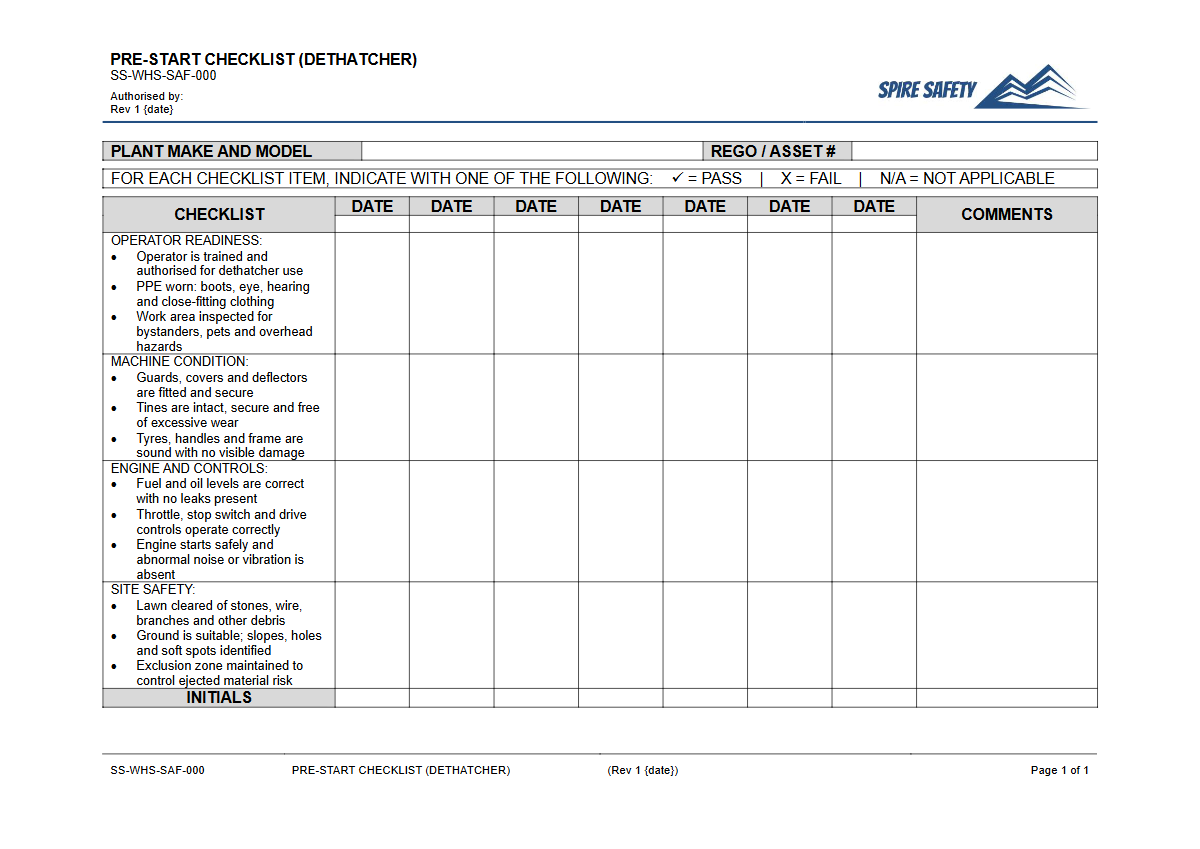
Formalise equipment safety checks with our Free Pre-Start Checklist (Dethatcher) Template. This structured DOCX and PDF helps improve WHS practices.
Free Pre-Start Checklist (Dethatcher) Template
DOCX • 125 KB + PDF
Updated Oct 2026
No signup required
Purpose of the Free Pre-Start Checklist (Dethatcher) Template
The primary purpose of a dethatcher pre-start checklist is to systematically verify that the equipment is in safe, working order before use. It serves as a formal record that key safety and operational components have been inspected by a competent person.
Regular use of this checklist helps to identify potential faults, defects, or maintenance needs before they escalate into hazardous situations or cause costly breakdowns.
By standardising the inspection process, you ensure that no critical checks are missed, regardless of who is operating the equipment. These records are invaluable for demonstrating due diligence, tracking equipment condition over time, and identifying patterns of wear or failure.
Integrating such procedures is a critical component of developing robust WHS management systems that proactively manage plant-related risks in the workplace.
Video walkthrough
How to use the Free Pre-Start Checklist (Dethatcher) Template
This resource is available for download in both DOCX (for easy editing) and PDF formats. Once downloaded, it should be adapted to suit the specific requirements of your workplace and the equipment in use.
A well-designed checklist is an essential tool for managing the risks associated with operating machinery.
Important: This template is a starting point, not a finished document. To ensure it is effective, we recommend a competent person customises the checklist to reflect the specific make and model of your dethatcher, unique site hazards, and your organisation's safe operating procedures.
It must be integrated into your existing safety framework.
Key Customisation and Implementation Steps:
- Review and Adapt: Modify the checklist items to match the manufacturer's recommendations and your risk assessment findings. Add or remove checks as necessary for your specific dethatcher model.
- Train Your Team: Ensure all operators are trained on how to properly conduct the pre-start inspection using the finalised checklist. A practical way to introduce this is through a focused safety meeting, for which our Pre-Start Checks and Plant Maintenance Toolbox Talk Template can provide a useful structure.
- Implement and Monitor: Make the checklist readily available near the equipment storage area. Supervisors should periodically monitor that checks are being completed correctly and consistently.
- Review and Update: Periodically review the checklist's effectiveness and update it following any incidents, equipment changes, or updates to regulations.
When to use a Dethatcher Pre-Start Checklist
A pre-start inspection should be completed before each use or at the beginning of each shift where the dethatcher will be operated. This frequency ensures that the equipment's condition has not changed since its last operation and that it remains safe to use.
Forgetting to perform a check, even once, exposes the operator and others to unnecessary risk.
In addition to daily checks, a pre-start should also be conducted after the equipment has undergone maintenance or repair to verify that it has been returned to a safe operational state. This consistent approach is crucial for all types of groundskeeping machinery, and a similar process should be followed for related equipment, as outlined in our Free Pre-Start Checklist (Aerator) Template.
Who Should Use This Checklist
The pre-start checklist is designed to be used by the person operating the dethatcher. This includes groundskeepers, landscapers, maintenance staff, and any other workers tasked with using the equipment.
The operator has the most immediate responsibility for ensuring the machine is safe before they start work.
Supervisors and managers also have a key role. They are responsible for ensuring that the pre-start system is implemented correctly, that workers are trained, and that completed records are maintained.
Verifying that these procedures are followed is a core part of safety oversight and can be assessed during a formal WHS compliance auditing process to ensure your safety systems are functioning as intended.
Looking for more templates to support your safety systems? Browse our complete free WHS resources library for a wide range of checklists, SWMS, and toolbox talks to help manage your workplace risks.
Common mistakes
Common mistakes to avoid
- "Pencil-whipping" the checklist without actually inspecting the equipment.
- Failing to customise the generic template for the specific machine model.
- Not tagging out and reporting faulty equipment found during the inspection.
- Treating the pre-start as a paperwork exercise instead of a critical safety function.
Legal references
Legal considerations
The following legal requirements may be relevant to this type of work.
- Work Health and Safety Act (Harmonised) — Provides the primary duties for protecting workers and other people from work health and safety risks.
- Work Health and Safety Regulations (Harmonised) — Sets out requirements supporting the management of workplace hazards and risks.
The following codes may be relevant to this type of work.
- Managing WHS Risks Code of Practice — Provides practical guidance on identifying hazards, assessing risks and applying effective controls.
- Work Health and Safety Consultation, Cooperation and Coordination Code of Practice — Provides practical guidance on consulting workers and coordinating with other duty holders.
- Managing the Work Environment and Facilities Code of Practice — Provides practical guidance on safe work environments, workplace facilities and related controls.
Did you know
Operator Responsibility
Under Australian WHS laws, operators have a duty to take reasonable care for their own health and safety. Conducting a pre-start check is a key part of fulfilling this personal responsibility.
Hidden Dangers
The rotating tines of a dethatcher can travel at speeds over 3,000 RPM. A loose or damaged tine can become a high-velocity projectile, making guard integrity a critical safety check.
FAQ
Frequently asked questions
01Is a digital pre-start checklist better than a paper one?
02What happens if a fault is found during a pre-start check?
03Do I still need a pre-start check for a brand new dethatcher?
04How long should we keep completed pre-start checklists?
Share this resource
Free Pre-Start Checklist (Dethatcher) Template
Browse Categories
How To Use It
- 1Download and open in Word or PDF.
- 2Replace the placeholders with your business details.
- 3Get it reviewed by a WHS specialist before rollout.
Need it customised?
Our WHS consultants can adapt this template to your site, run a gap analysis, or audit what you already have in place.
Book a Free Consultation WHS consulting servicesor call 1300 156 382