
Free Pre-Start Checklist (Diesel Pump) Template
Formalise your equipment safety checks with our free Pre-Start Checklist (Diesel Pump) Template. This structured DOCX & PDF helps you manage WHS risks.
Free Pre-Start Checklist (Diesel Pump) Template
DOCX • 125 KB + PDF
Updated Oct 2026
No signup required
Purpose of the Free Pre-Start Checklist (Diesel Pump) Template
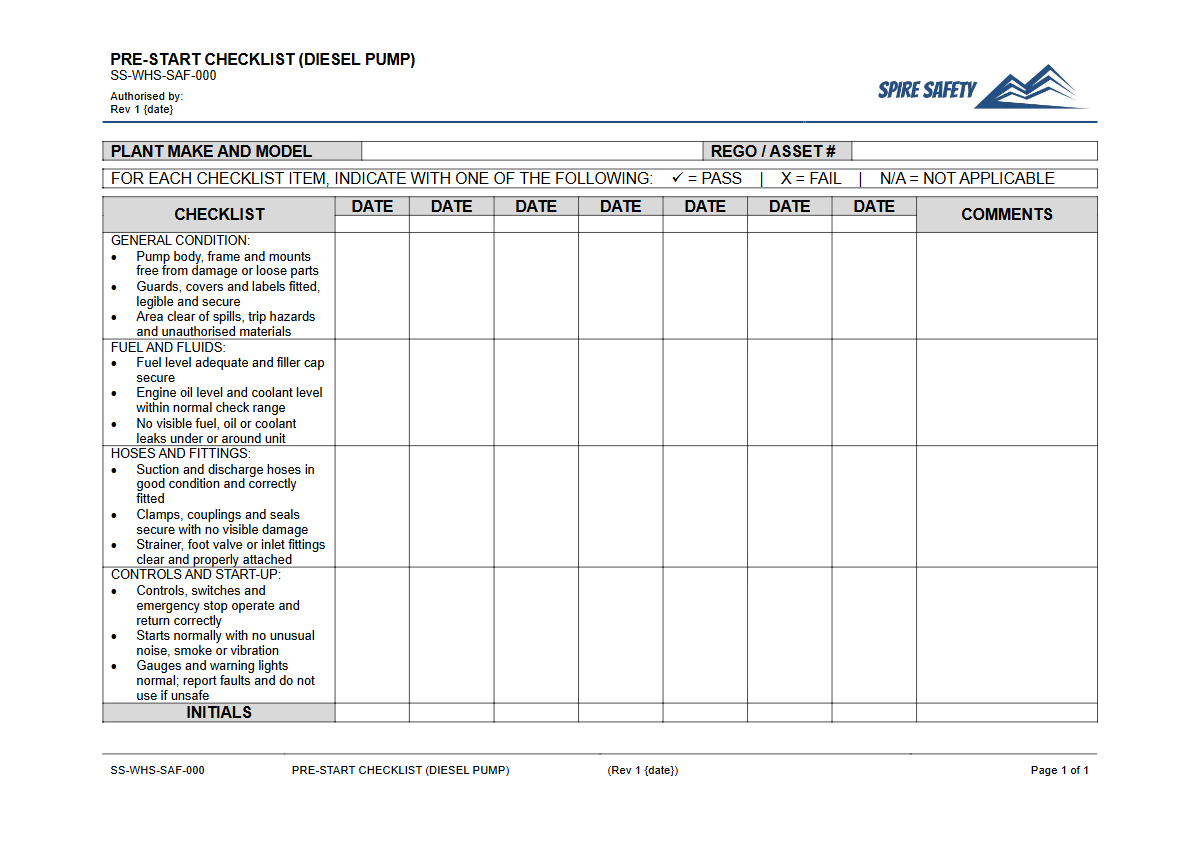
Regularly inspecting equipment is a cornerstone of workplace health and safety. This Free Pre-Start Checklist (Diesel Pump) Template provides a structured framework for operators to conduct consistent, thorough checks before using a diesel pump.
Using a formal checklist helps identify mechanical defects, fluid leaks, damaged components, or other potential hazards before they lead to equipment failure, costly downtime, or a serious incident. It establishes a clear record of due diligence, demonstrating that your organisation is taking proactive steps to manage risks associated with plant and machinery.
Implementing routine pre-start checks is a practical way to meet your WHS duties. These records can be integrated into your broader safety framework to inform maintenance schedules and risk assessments.
Formalising this process is a key component of robust WHS management systems, ensuring safety procedures are consistently applied across all operations.
Video walkthrough
How to use the Free Pre-Start Checklist (Diesel Pump) Template
Our free Pre-Start Checklist for diesel pumps is available as an editable DOCX file and a print-ready PDF. The template is designed as a comprehensive starting point, aligned with Australian WHS principles for plant safety.
To use it effectively, download the file and adapt it to your specific operational needs. This ensures the checklist is relevant and effective for the equipment your team uses every day.
Important: You must customise this template for your specific diesel pump model, its application, and your workplace environment. We provide this document as a starting point, not a universal, out-of-the-box solution.
Always consult the manufacturer's operating manual and your own risk assessments to add or remove checklist items. For example, the safety checks for a high-pressure firefighting pump will differ from those for a dewatering pump, as shown in our Free Pre-Start Checklist (Fire Pump) Template.
Key inspection areas include:
- General Condition: Checking for visible damage, leaks, and ensuring the pump is on a stable, level surface.
- Fluid Levels: Verifying engine oil, coolant, and diesel fuel levels are adequate for the intended task.
- Hoses and Fittings: Inspecting for cracks, wear, and secure connections on all suction and discharge lines.
- Guards and Safety Features: Ensuring all moving parts (belts, pulleys) are properly guarded and that safety features like emergency stops are functional.
- Work Area: Assessing the surrounding area for slip, trip, and fire hazards, and ensuring adequate ventilation.
When to use a Pre-Start Checklist
A pre-start inspection should be completed before every shift or each time the diesel pump is used, whichever is more frequent. This routine ensures that the equipment's condition is verified before operation begins.
Additional checks are also recommended after the pump has been moved, following any maintenance or repair work, or if it has been idle for an extended period.
Completed checklists create a valuable historical record of the equipment's condition over time. These records are essential for identifying recurring faults and can be reviewed during safety investigations or audits.
Regular reviews of your processes, including the effectiveness of pre-start checks, can be formalised through WHS compliance auditing to drive continuous improvement.
Who should use it
The primary user of the Pre-Start Checklist is the trained and competent operator assigned to the diesel pump. They are in the best position to assess the equipment's immediate fitness for use.
However, responsibility extends beyond the operator. Supervisors and managers must ensure that the checks are being completed correctly and that any reported defects are actioned promptly.
Maintenance personnel rely on the information from these checklists to schedule preventative maintenance and address identified issues before they escalate. Consistent use of checklists across different pump types, such as those covered in our Free Pre-Start Checklist (Cooling Pump) Template, helps foster a proactive safety culture where everyone shares responsibility for maintaining a safe working environment. You can find many more templates like this in our free WHS resources library.
Common mistakes
Common mistakes to avoid
- Using a generic checklist that hasn't been customised for the specific pump model and its working environment.
- Skipping checks on 'minor' items like the work area cleanliness or fluid levels to save time.
- Failing to formally report identified defects, leading to unsafe equipment remaining in service.
- Pencil-whipping the checklist without physically inspecting each item.
Legal references
Legal considerations
The following legal requirements may be relevant to this type of work.
- Work Health and Safety Act (Harmonised) — Provides the primary duties for protecting workers and other people from work health and safety risks.
- Work Health and Safety Regulations (Harmonised) — Sets out requirements supporting the management of workplace hazards and risks.
The following codes may be relevant to this type of work.
- Managing WHS Risks Code of Practice — Provides practical guidance on identifying hazards, assessing risks and applying effective controls.
- Work Health and Safety Consultation, Cooperation and Coordination Code of Practice — Provides practical guidance on consulting workers and coordinating with other duty holders.
- Managing the Work Environment and Facilities Code of Practice — Provides practical guidance on safe work environments, workplace facilities and related controls.
Did you know
Fuel Degradation
Diesel fuel can begin to degrade and grow bacteria or fungus after just a few months in storage, which can clog fuel filters and injectors. Regular pump operation and fuel cycling is important for reliability.
Noise Hazard
A typical diesel water pump can operate at levels between 85 and 100 decibels (dBA), exceeding the Australian exposure standard for noise. Hearing protection is almost always a requirement for operators working near the unit.
FAQ
Frequently asked questions
01What are the main hazards associated with diesel pumps?
02How often should a diesel pump pre-start check be performed?
03What should an operator do if a fault is found during a pre-start check?
04Is a paper checklist better than a digital one?
Share this resource
Free Pre-Start Checklist (Diesel Pump) Template
Browse Categories
How To Use It
- 1Download and open in Word or PDF.
- 2Replace the placeholders with your business details.
- 3Get it reviewed by a WHS specialist before rollout.
Need it customised?
Our WHS consultants can adapt this template to your site, run a gap analysis, or audit what you already have in place.
Book a Free Consultation WHS consulting servicesor call 1300 156 382