
Free Pre-Start Checklist (Disc Sander) Template
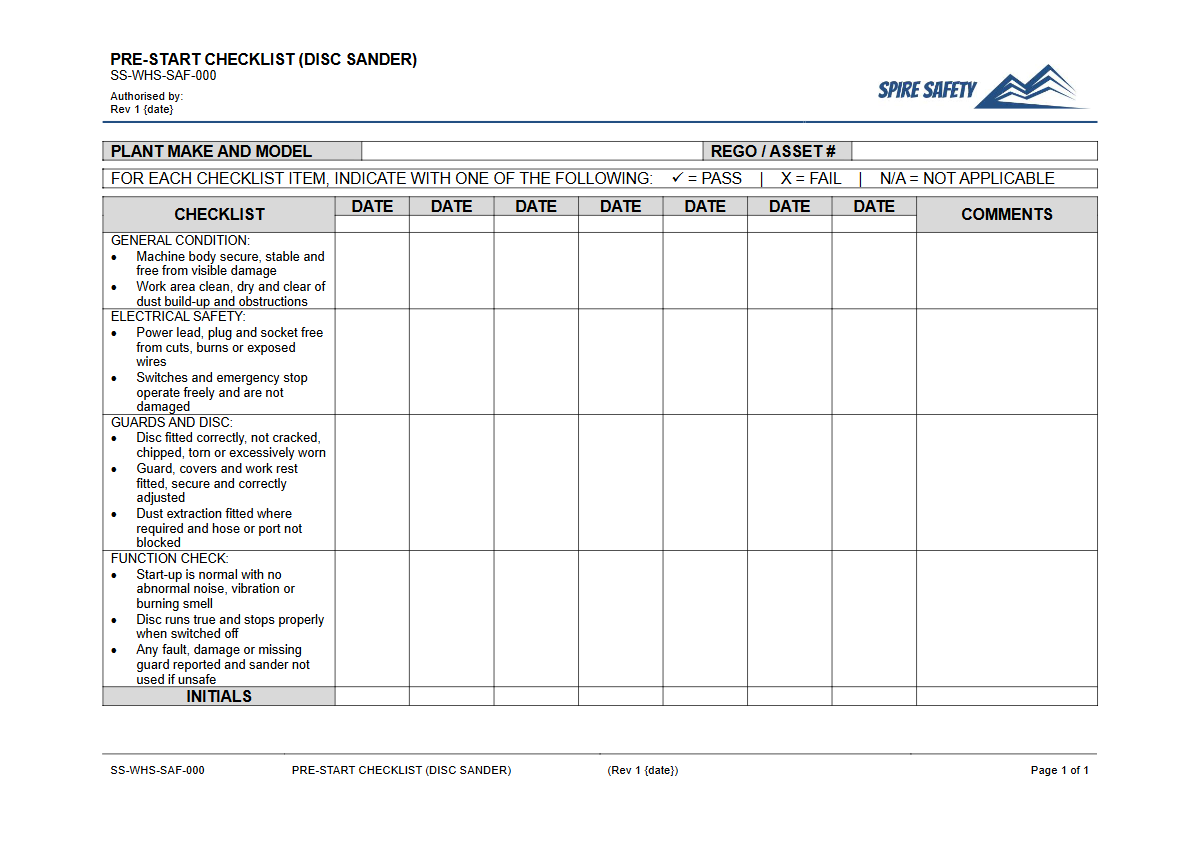
Download our free Pre-Start Checklist (Disc Sander) Template. This structured document helps formalise daily safety inspections and manage WHS risks.
Free Pre-Start Checklist (Disc Sander) Template
DOCX • 125 KB + PDF
Updated Oct 2026
No signup required
Purpose of the Free Pre-Start Checklist (Disc Sander) Template
Using a disc sander without proper checks can expose workers to significant risks, including entanglement, abrasions, and respiratory hazards from dust. This Free Pre-Start Checklist (Disc Sander) Template provides a structured starting point for formalising your daily equipment inspections.
By systematically checking the machine's condition before use, operators can identify and address potential faults, damage, or missing safety features, helping to ensure the sander is safe to operate. Integrating regular pre-start inspections is a fundamental component of developing robust WHS management systems, demonstrating a proactive approach to risk management.
The checklist encourages a consistent safety routine for all operators. It serves as a physical record that checks have been completed, which is invaluable for safety audits and incident investigations.
Standardising this process across all workshop equipment is key to building a strong safety culture. For instance, the principles applied here are similar to those in our free Pre-Start Checklist (Bench Grinder) Template, promoting a uniform approach to plant safety.
Video walkthrough
How to use the Free Pre-Start Checklist (Disc Sander) Template
This resource is available as a DOCX file for easy editing and a PDF for immediate use. The goal is to create a document that is perfectly aligned with your specific operational needs.
Effective customisation involves reviewing the provided checkpoints and adding or removing items to reflect the make and model of your disc sander, the materials being worked on (e.g., wood, metal, composites), and the unique environment of your workshop.
IMPORTANT: This is a template, not a finished document. We cannot know the specific hazards of your workplace, your exact model of disc sander, or the materials you work with.
You must customise this checklist to suit your unique operational environment. Always consult the manufacturer’s operating manual and relevant safety data sheets during this process.
When customising, consider specific hazards like airborne dust. If your operations generate significant dust or fumes, controls such as local exhaust ventilation (LEV) are critical.
You may need to add specific checks for these systems, similar to the process outlined in a Pre-Start Checklist for Fume Cabinets, to ensure they are functioning correctly before work commences. Once customised, the checklist should be made readily available to all operators at the point of use. For more templates and safety documents, you can browse our free WHS resources library.
When to use it
A pre-start check should be conducted before the first use of the disc sander on any given day or shift. This establishes a baseline of safety for the day's operations.
The checklist should also be completed if the equipment has been recently repaired, serviced, or relocated, as this can affect its operational integrity. Integrating this check into the daily workflow for all high-risk plant is a key safety behaviour. The same discipline should apply whether using a disc sander or other powerful equipment requiring a Pre-Start Checklist for Floor Saws.
Who should use it
The primary user of this checklist is the trained and competent worker tasked with operating the disc sander. This person is best placed to assess the immediate condition of the equipment.
However, responsibility for safety extends beyond the operator. Supervisors and managers must ensure these checks are being diligently performed, recorded, and that any identified faults are rectified before the equipment is used.
These records are essential evidence of your safety procedures and can be reviewed during WHS compliance auditing services to verify that processes are being followed.
Work Health and Safety (WHS) officers and advisors can also use this template to standardise safety procedures across a business. It provides a solid foundation for training and for building a consistent approach to plant risk management.
For businesses needing support in developing or refining these critical safety documents, our expert WHS consulting team can provide tailored guidance and support.
Common mistakes
Common mistakes to avoid
- Using the tool for a 'quick job' without performing any checks.
- Operating the sander with a cracked, torn, or unsuitable sanding disc.
- Removing or adjusting guards to get into tight spaces, exposing the moving disc.
- Failing to check or turn on the associated dust extraction system before starting work.
Legal references
Legal considerations
The following legal requirements may be relevant to this type of work.
- Work Health and Safety Act (Harmonised) — Provides the primary duties for protecting workers and other people from work health and safety risks.
- Work Health and Safety Regulations (Harmonised) — Sets out requirements supporting the management of workplace hazards and risks.
The following codes may be relevant to this type of work.
- Managing WHS Risks Code of Practice — Provides practical guidance on identifying hazards, assessing risks and applying effective controls.
- Work Health and Safety Consultation, Cooperation and Coordination Code of Practice — Provides practical guidance on consulting workers and coordinating with other duty holders.
- Managing the Work Environment and Facilities Code of Practice — Provides practical guidance on safe work environments, workplace facilities and related controls.
Did you know
Dust Hazards
Sanding can generate high concentrations of fine dust, including silica or wood dust, which are hazardous when inhaled. Effective dust extraction and appropriate respiratory protection are crucial controls.
High-Speed Risk
The abrasive disc on a sander can rotate at speeds over 2,000 RPM. Contact with an unguarded, moving disc can cause severe abrasions and friction burns in a fraction of a second.
FAQ
Frequently asked questions
01What are the most critical checks for a disc sander?
02How often should a disc sander pre-start check be performed?
03Who is responsible for completing the disc sander pre-start checklist?
04Can this template be used for other types of sanders?
Share this resource
Free Pre-Start Checklist (Disc Sander) Template
Browse Categories
How To Use It
- 1Download and open in Word or PDF.
- 2Replace the placeholders with your business details.
- 3Get it reviewed by a WHS specialist before rollout.
Need it customised?
Our WHS consultants can adapt this template to your site, run a gap analysis, or audit what you already have in place.
Book a Free Consultation WHS consulting servicesor call 1300 156 382