
Free Pre-Start Checklist (Dock Shelter) Template
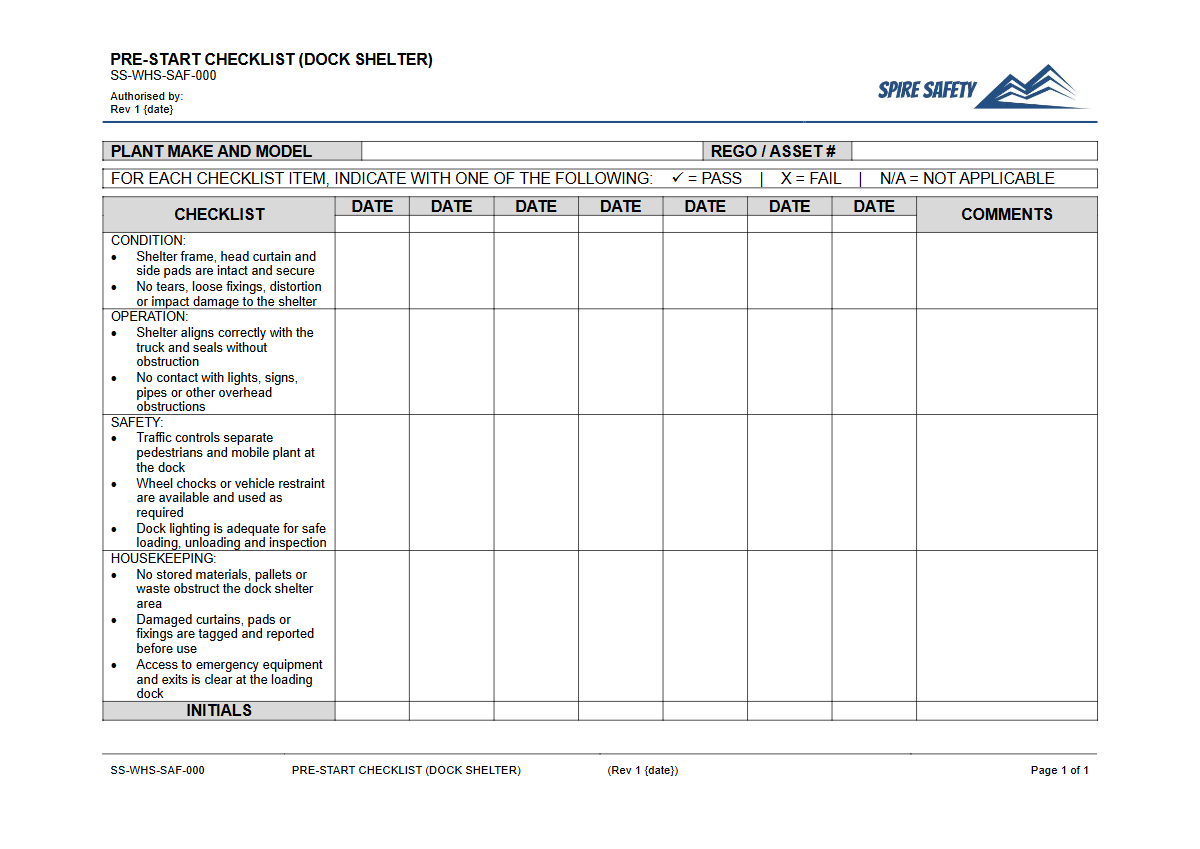
Download our free Pre-Start Checklist for Dock Shelters. This structured DOCX & PDF resource helps formalise daily inspections for loading bay safety.
Free Pre-Start Checklist (Dock Shelter) Template
DOCX • 125 KB + PDF
Updated Oct 2026
No signup required
Purpose of the Free Pre-Start Checklist (Dock Shelter) Template
Our free Pre-Start Checklist (Dock Shelter) Template provides a structured starting point for formalising daily safety inspections of your loading bay shelters and seals. Dock shelters are a critical interface between your building and transport vehicles, and their condition directly impacts safety, efficiency, and environmental control.
Regular inspections help identify damage, wear, or faults before they lead to serious incidents, such as personnel injury, product damage from weather exposure, pest ingress, or compromised building energy efficiency.
Implementing routine checks helps an organisation meet its primary duty of care under WHS laws. This template guides operators to systematically inspect key components, including the frame, seals, curtains, and mounting hardware.
Using this checklist consistently promotes a proactive safety culture, reduces the risk of costly emergency repairs, and creates a formal record of due diligence. To reinforce these principles across all equipment, consider using our Pre-Start Checks and Plant Maintenance toolbox talk to train your team.
Dock shelters are a key control for managing risks where vehicles interact with your facility. The process of inspecting them is one part of a broader system for managing traffic and loading operations safely.
For a more comprehensive look at managing vehicle-related risks, an example like a Safe Work Method Statement (SWMS) for Concrete Truck Operation shows how high-risk tasks are planned and controlled.
Video walkthrough
How to use the Free Pre-Start Checklist (Dock Shelter) Template
This resource is available as a DOCX file for easy customisation and a PDF for immediate use. The DOCX version allows you to add your company branding, site-specific details, and unique inspection points relevant to your particular model of dock shelter.
A structured approach ensures all operators are performing the same level of inspection every time.
Note: This document is a template and must be customised. We provide it as a starting point.
To be effective, you must adapt it to the specific models of dock shelter used at your workplace, your operational procedures, and the unique hazards identified in your own risk assessments.
To effectively implement the checklist:
- Download and Customise: Open the DOCX file and modify it to suit your organisation's needs. Add your logo, site name, and specific check items for your equipment.
- Train Your Team: Ensure all relevant workers (e.g., warehouse staff, forklift operators) are trained on how to conduct the inspection properly and what to do if they find a fault.
- Implement: Integrate the checklist into your daily start-up procedures for the loading dock area.
- Review and Action: Supervisors must ensure checklists are completed correctly and that any reported defects are actioned immediately. Faulty equipment should be tagged out of service until repaired.
- Integrate: Incorporate this process into your broader WHS management systems to ensure it is audited and reviewed regularly.
When to use a Dock Shelter Pre-Start Checklist
The checklist should be completed at scheduled intervals to ensure ongoing safety. Recommended times for use include:
- At the start of each day or shift: Before loading and unloading operations begin.
- After a suspected impact: If a vehicle has potentially struck the shelter.
- Following a significant weather event: Such as high winds or heavy storms that could cause damage.
- As part of a preventative maintenance schedule: To supplement more detailed mechanical inspections.
Who should use this Pre-Start Checklist
This checklist is designed for use by competent and trained personnel. This typically includes:
- Warehouse Personnel and Forklift Operators: The primary users who work in and around the loading dock.
- Designated Inspectors: Staff assigned the specific task of completing pre-start checks.
- Supervisors and Managers: Responsible for verifying that checks are completed, signing off, and actioning any maintenance requests.
- WHS Representatives: Who may use the completed records during safety meetings or as part of internal WHS compliance auditing.
Integrating Checklists into Your Safety Framework
A checklist is a tool, not a complete safety system. Its value is realised when it is part of a comprehensive safety framework that includes clear procedures, robust training, and active supervision.
Ensure there is a clear process for reporting and rectifying defects found during inspections. A culture where workers feel empowered to stop a task and report a hazard is essential for these checks to be effective. For guidance on building a more robust safety system, consider engaging professional WHS consulting services.
Common mistakes
Common mistakes to avoid
- "Pencil-whipping" the checklist without physically performing the inspection.
- Failing to immediately tag out and report faulty or damaged dock shelters.
- Not customising the generic template to include components or hazards specific to the workplace.
- Inadequate training for workers on how to properly identify and report defects.
Legal references
Legal considerations
The following legal requirements may be relevant to this type of work.
- Work Health and Safety Act (Harmonised) — Provides the primary duties for protecting workers and other people from work health and safety risks.
- Work Health and Safety Regulations (Harmonised) — Sets out requirements supporting the management of workplace hazards and risks.
The following codes may be relevant to this type of work.
- Managing WHS Risks Code of Practice — Provides practical guidance on identifying hazards, assessing risks and applying effective controls.
- Work Health and Safety Consultation, Cooperation and Coordination Code of Practice — Provides practical guidance on consulting workers and coordinating with other duty holders.
- Managing the Work Environment and Facilities Code of Practice — Provides practical guidance on safe work environments, workplace facilities and related controls.
Did you know
Loading Dock Dangers
The loading dock is consistently one of the most hazardous areas in any workplace. A significant percentage of all warehouse and factory accidents occur here, often involving vehicles, manual handling, and falls from height.
Energy Savings
A properly maintained dock shelter or seal can significantly reduce building energy costs by preventing conditioned air from escaping and outside temperatures, rain, and wind from entering.
FAQ
Frequently asked questions
01What should I look for when inspecting a dock shelter?
02How often should dock shelters be inspected?
03Who is responsible for repairing a damaged dock shelter?
04Is this pre-start checklist template enough for WHS compliance?
Share this resource
Free Pre-Start Checklist (Dock Shelter) Template
Browse Categories
How To Use It
- 1Download and open in Word or PDF.
- 2Replace the placeholders with your business details.
- 3Get it reviewed by a WHS specialist before rollout.
Need it customised?
Our WHS consultants can adapt this template to your site, run a gap analysis, or audit what you already have in place.
Book a Free Consultation WHS consulting servicesor call 1300 156 382