
Free Pre-Start Checklist (Dough Sheeter) Template
Formalise dough sheeter inspections with our free pre-start checklist. This DOCX & PDF template helps identify hazards before use. Download it today.
Free Pre-Start Checklist (Dough Sheeter) Template
DOCX • 125 KB + PDF
Updated Oct 2026
No signup required
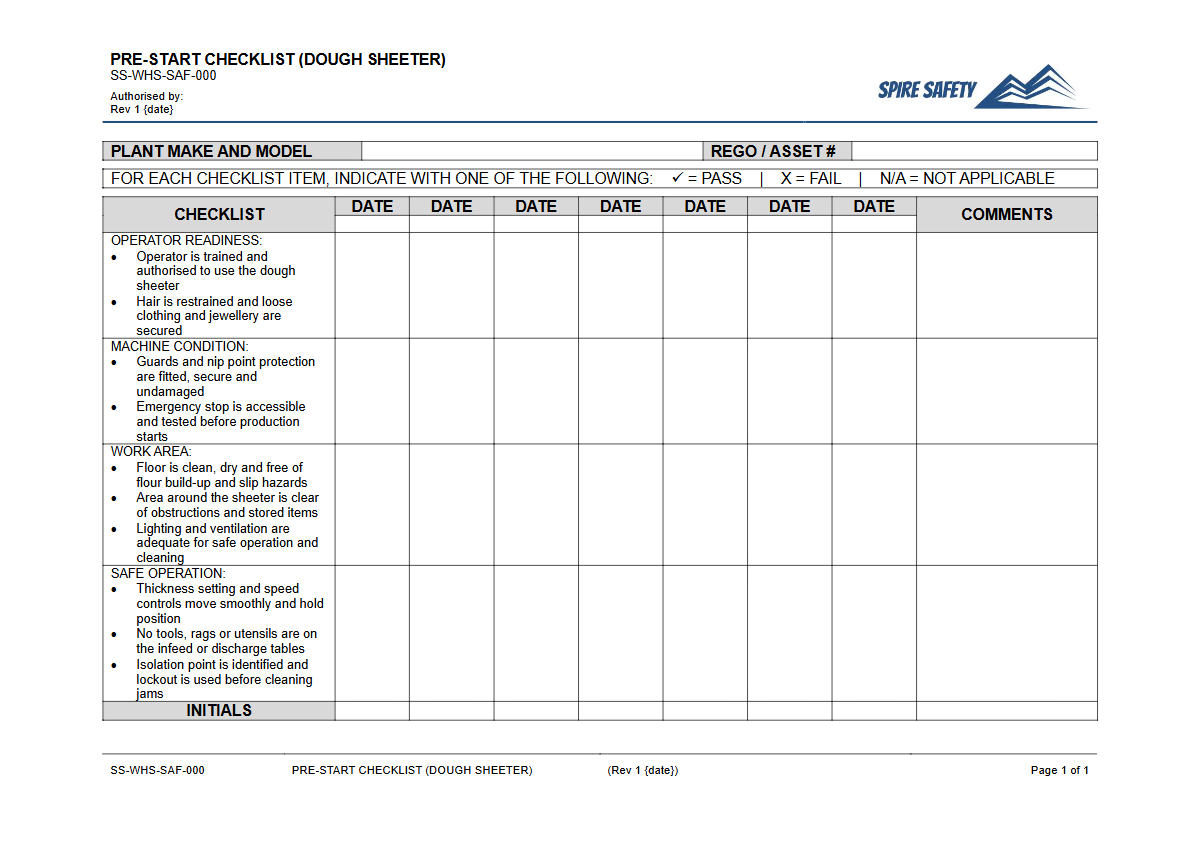
Operating machinery like a dough sheeter comes with significant safety risks, primarily from moving parts, rollers, and conveyors. A systematic pre-start inspection is a fundamental step in managing these risks.
This free Pre-Start Checklist (Dough Sheeter) Template provides a structured starting point for bakeries, restaurants, and food production facilities to formalise their daily equipment safety checks.
By implementing a consistent pre-start routine, organisations can identify potential faults or hazards before they lead to injury or equipment failure. This downloadable template, available in DOCX and PDF formats, is designed to be adapted to your specific operational needs, helping to foster a stronger safety culture and meet WHS obligations.
Video walkthrough
Purpose of the Free Pre-Start Checklist (Dough Sheeter) Template
The primary purpose of a dough sheeter pre-start checklist is to verify that the equipment is safe to operate before each use. It serves as a formal record that key safety features and operational components have been inspected.
This proactive approach helps to prevent incidents caused by mechanical failure, missing guards, or faulty emergency stops. A documented pre-start process is a core component of robust WHS management systems, providing tangible evidence of an organisation's commitment to safety.
Key objectives include:
- Hazard Identification: Systematically checking for common hazards such as damaged guards, exposed moving parts, or frayed electrical cords.
- Risk Control: Ensuring that safety controls, like emergency stop buttons and interlocking guards, are present and functional.
- Operator Accountability: Empowering operators to take ownership of their safety and the condition of their equipment.
- Maintenance Trigger: Acting as an early warning system to flag issues for the maintenance team before they escalate into major problems.
How to use the Free Pre-Start Checklist (Dough Sheeter) Template
Effectively integrating this checklist into your daily operations is key to its success. It should be treated as a practical safety tool, not just an administrative task.
Similar to our Pre-Start Checklist for a Coffee Grinder, this template is a starting point that requires site-specific information.
Follow these steps for implementation:
- Download: Choose between the DOCX file for easy editing or the PDF for immediate printing.
- Customise: This is the most critical step. Modify the checklist to match the specific make, model, and configuration of the dough sheeters used in your workplace. Add your company branding and specific safety procedures. Please note: This document is a template, not a finished product. We are not familiar with your specific machinery or operational environment. You must adapt this template to align with the manufacturer's instructions and your own risk assessments to ensure it is suitable for your business.
- Train: Ensure all operators are trained on how to conduct a thorough inspection using the customised checklist. They must understand what each item means and what to do if a fault is found.
- Implement: Make the checklist readily available at the location of the equipment. Establish a clear process for where completed checklists are stored and who reviews them.
When to use it
The pre-start checklist should be completed at the beginning of every shift or before the first use of the dough sheeter each day. This ensures that the equipment's condition is verified before any production begins.
If the machine is used by multiple operators across different shifts, a new check should be completed by each incoming operator. Consistency is vital; reinforce this routine through regular safety discussions, such as a Pre-Start Checks and Plant Maintenance Toolbox Talk. It should not be used retrospectively or filled out at the end of the day.
Who should use it
The primary user of the checklist is the trained and competent operator assigned to the dough sheeter. They have the most direct interaction with the equipment and are best placed to notice subtle changes or developing faults.
Supervisors and managers also have a crucial role. They are responsible for ensuring the pre-start system is being followed correctly, reviewing completed checklists for any reported faults or trends, and taking prompt action to address safety issues.
If you need assistance developing clear safety roles and responsibilities within your team, our WHS consulting services can provide tailored advice.
Benefits of a Consistent Pre-start Process
Implementing a formal pre-start check process provides numerous benefits beyond basic compliance.
- Reduced Downtime: Identifying minor issues early can prevent catastrophic failures, leading to fewer unplanned stoppages and more efficient production.
- Improved Safety Culture: It demonstrates a visible commitment from management to worker safety, encouraging employees to be more proactive about hazard reporting.
- Audit and Compliance Readiness: Regularly completed checklists provide a clear audit trail for regulators and can be a key part of your preparation for a WHS compliance audit.
- Extended Equipment Lifespan: A well-maintained machine is a longer-lasting machine. Regular checks help ensure that equipment is cared for properly, protecting your investment. You can find more templates to build out your safety system in our free WHS resources library.
Common mistakes
Common mistakes to avoid
- Using the checklist as a 'tick and flick' exercise without a proper physical inspection.
- Failing to immediately isolate and tag out a faulty machine, allowing it to be used.
- Not customising the template to match the specific make and model of the dough sheeter.
- Poor record-keeping, making it difficult to track maintenance issues or prove due diligence.
Legal references
Legal considerations
The following legal requirements may be relevant to this type of work.
- Work Health and Safety Act (Harmonised) — Provides the primary duties for protecting workers and other people from work health and safety risks.
- Work Health and Safety Regulations (Harmonised) — Sets out requirements supporting the management of workplace hazards and risks.
The following codes may be relevant to this type of work.
- Managing WHS Risks Code of Practice — Provides practical guidance on identifying hazards, assessing risks and applying effective controls.
- Work Health and Safety Consultation, Cooperation and Coordination Code of Practice — Provides practical guidance on consulting workers and coordinating with other duty holders.
- Managing the Work Environment and Facilities Code of Practice — Provides practical guidance on safe work environments, workplace facilities and related controls.
Did you know
Entanglement Hazard
Dough sheeters are a common source of serious hand and arm injuries in the food industry, primarily due to entanglement in the rollers. Proper, functioning safety guards are the most critical control.
Cleaning is a Safety Issue
Residue build-up can not only pose a food safety risk but may also interfere with the proper function of safety guards, sensors, and emergency stops. Regular cleaning is a vital part of the machine's overall safety.
FAQ
Frequently asked questions
01What is a pre-start checklist for a dough sheeter?
02Why can't I just use this template without changing it?
03How often should a dough sheeter pre-start check be completed?
04Who is responsible for ensuring the pre-start check is done?
Share this resource
Free Pre-Start Checklist (Dough Sheeter) Template
Browse Categories
How To Use It
- 1Download and open in Word or PDF.
- 2Replace the placeholders with your business details.
- 3Get it reviewed by a WHS specialist before rollout.
Need it customised?
Our WHS consultants can adapt this template to your site, run a gap analysis, or audit what you already have in place.
Book a Free Consultation WHS consulting servicesor call 1300 156 382