
Free Pre-Start Checklist (Drill Mill) Template
Download our Free Pre-Start Checklist (Drill Mill) Template (DOCX & PDF). Formalise equipment inspections and improve workshop safety. Get your template now.
Free Pre-Start Checklist (Drill Mill) Template
DOCX • 125 KB + PDF
Updated Oct 2026
No signup required
Purpose of the Free Pre-Start Checklist (Drill Mill) Template
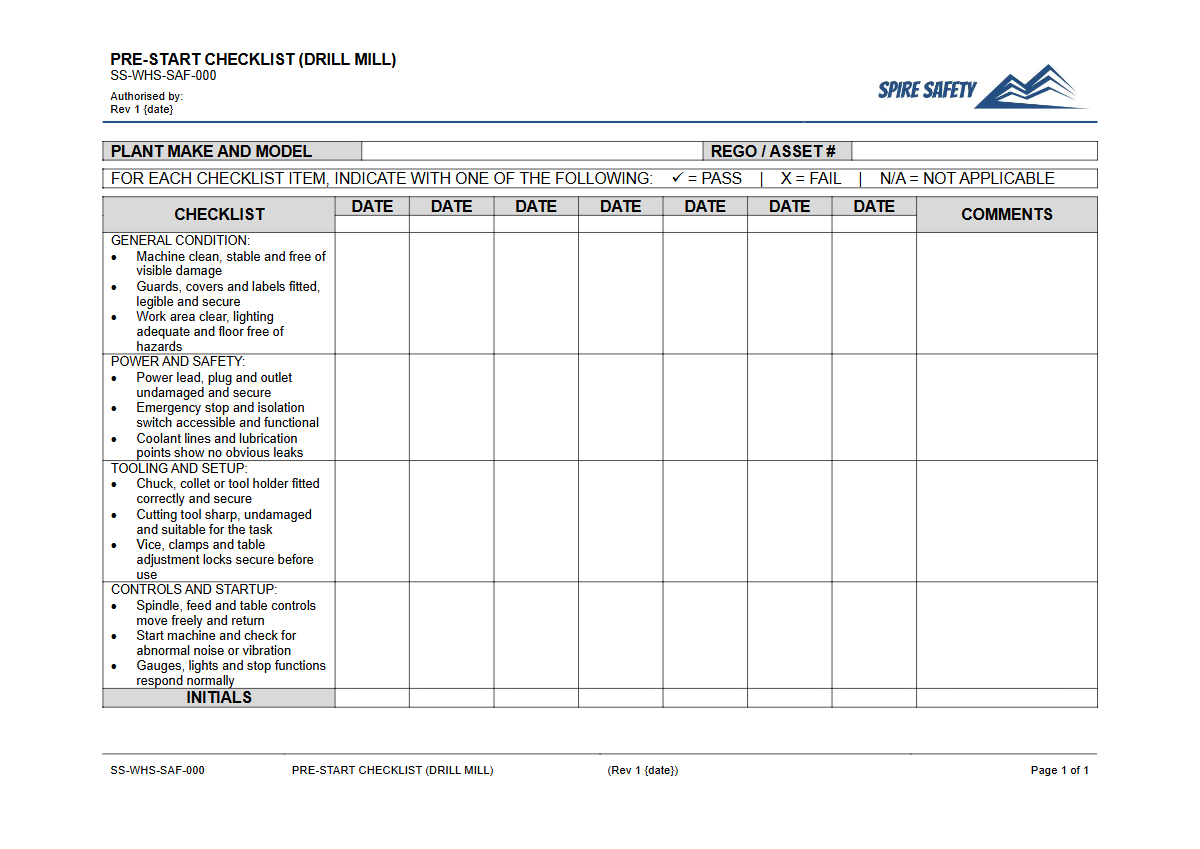
Strengthen your workshop safety procedures with our Free Pre-Start Checklist (Drill Mill) Template. This structured document, available in DOCX and PDF, provides a systematic way for operators to conduct essential safety and operational checks before using a drill mill.
Regularly performing these inspections helps identify potential hazards, prevent equipment failure, and reduce the risk of workplace incidents involving machinery.
The primary purpose of this Free Pre-Start Checklist (Drill Mill) Template is to formalise the process of verifying that the equipment is safe to use. It prompts operators to systematically inspect key components like guards, emergency stops, chuck keys, and the work area.
This formal record-keeping is a critical component of robust WHS management systems, demonstrating due diligence and supporting a proactive safety culture.
Video walkthrough
How to use the Free Pre-Start Checklist (Drill Mill) Template
To use the Free Pre-Start Checklist (Drill Mill) Template, simply download the file in your preferred format—DOCX for easy editing or PDF for printing. A pre-start checklist is an administrative control that relies on a physical inspection to be effective.
Operators must walk through each item, visually inspecting and physically testing components where necessary, such as E-stops.
Important: It is crucial that you customise this template for your specific workplace. You must review and adapt the checklist items to match the exact make and model of your drill mill, the types of tasks performed, and any unique environmental risks.
We provide this document as a structured starting point, but it is your organisation's responsibility to ensure it is fit-for-purpose for your operations.
Inspections should cover the mechanical integrity of the machine, electrical safety features, fluid levels, and the correct positioning of all guards. For larger or more complex drilling equipment, you may need a more detailed process, similar to the routine pre-start checks for drill rigs.
When to use it
A drill mill pre-start check should be completed by the operator at the beginning of every shift or before the equipment is used for the first time that day. It should also be performed if a new operator takes over during a shift, or if the machine has been recently serviced, repaired, or moved.
This routine helps catch issues that may have developed overnight or during previous use, preventing them from escalating into more serious faults or causing an incident.
Integrating this practice is a key part of managing plant and equipment risks effectively. If your workshop uses similar pedestal or bench-mounted equipment, our free Pre-Start Checklist for Drill Presses may also be a useful resource for your safety toolkit.
Who should use it
This checklist is designed to be used by competent and trained operators of the drill mill. The person operating the equipment is best placed to notice small changes in its performance or condition.
Supervisors should also be familiar with the checklist to oversee its correct use and to ensure that any reported issues are addressed promptly and effectively through a tag-out and maintenance procedure.
WHS personnel can use the completed checklists as part of safety performance monitoring, incident investigations, and during WHS compliance auditing activities. Ensuring that only trained personnel operate machinery and complete these checks is a fundamental WHS requirement.
For other types of processing equipment, you will need a different set of checks; for example, a specific pre-start checklist for granulators in a manufacturing context.
This template is just one of many tools we provide to help Australian businesses improve their workplace safety performance. For more downloadable templates and guides, you can browse our complete free WHS resources library.
Common mistakes
Common mistakes to avoid
- "Ticking and flicking" the checklist without performing the physical checks.
- Using a generic checklist that doesn't cover model-specific safety features.
- Failing to tag out and report faulty equipment identified during the check.
- Operators not receiving training on what they are checking for and why it is important.
Legal references
Legal considerations
The following legal requirements may be relevant to this type of work.
- Work Health and Safety Act (Harmonised) — Provides the primary duties for protecting workers and other people from work health and safety risks.
- Work Health and Safety Regulations (Harmonised) — Sets out requirements supporting the management of workplace hazards and risks.
The following codes may be relevant to this type of work.
- Managing WHS Risks Code of Practice — Provides practical guidance on identifying hazards, assessing risks and applying effective controls.
- Work Health and Safety Consultation, Cooperation and Coordination Code of Practice — Provides practical guidance on consulting workers and coordinating with other duty holders.
- Managing the Work Environment and Facilities Code of Practice — Provides practical guidance on safe work environments, workplace facilities and related controls.
Did you know
Entanglement Hazard
Contact with moving machine parts is a leading cause of serious injury in workshops. A drill mill's rotating spindle can easily entangle loose clothing, hair, or jewellery in less than a second.
FAQ
Frequently asked questions
01What is a pre-start checklist?
02Why is a specific checklist for a drill mill important?
03How often should our drill mill checklist be reviewed?
04Can I use this template for our workshop's lathe?
Share this resource
Free Pre-Start Checklist (Drill Mill) Template
Browse Categories
How To Use It
- 1Download and open in Word or PDF.
- 2Replace the placeholders with your business details.
- 3Get it reviewed by a WHS specialist before rollout.
Need it customised?
Our WHS consultants can adapt this template to your site, run a gap analysis, or audit what you already have in place.
Book a Free Consultation WHS consulting servicesor call 1300 156 382