
Free Pre-Start Checklist (Dish Steriliser) Template
Download our free Pre-Start Checklist (Dish Steriliser) Template in DOCX & PDF. This resource helps formalise daily equipment checks in your workplace.
Free Pre-Start Checklist (Dish Steriliser) Template
DOCX • 125 KB + PDF
Updated Oct 2026
No signup required
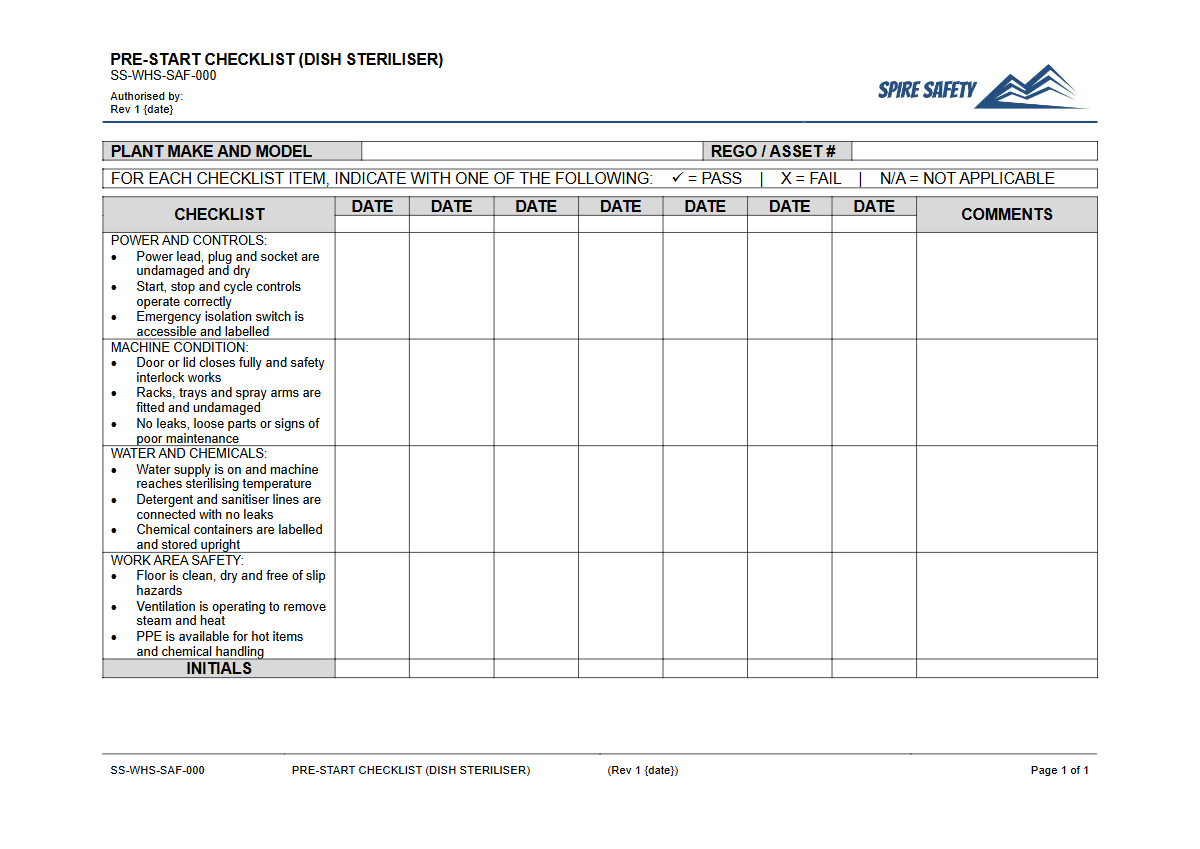
Purpose of the Free Pre-Start Checklist (Dish Steriliser) Template
This Free Pre-Start Checklist (Dish Steriliser) Template provides a structured format for workers to inspect commercial dish sterilising equipment before each shift or use. Regular pre-start checks are a fundamental part of proactive workplace safety, helping to identify potential hazards such as water leaks, electrical faults, or malfunctioning safety features before they lead to incidents, equipment damage, or ineffective sterilisation.
Formalising this process ensures that inspections are consistent, thorough, and documented, forming a crucial part of your operational health and safety records.
Using a standardised checklist helps embed a safety-first culture by making equipment inspection a non-negotiable part of daily operations. It supports compliance with Australian WHS duties by demonstrating a systematic approach to hazard identification and risk management for plant and equipment.
For a deeper understanding of why these checks are vital across all machinery, our toolbox talk on pre-start checks and plant maintenance provides excellent training material.
Integrating this checklist into your daily procedures is a practical step in maintaining a safe work environment. It serves as a key operational control within broader WHS management systems, providing tangible evidence that your organisation is actively managing risks associated with its equipment.
Video walkthrough
How to use the Free Pre-Start Checklist (Dish Steriliser) Template
This template is provided as a starting point and must be customised to your specific workplace. Before use, a competent person should review and adapt the checklist to reflect the exact make and model of your dish steriliser, your site-specific risks, and your organisation's procedures.
It is crucial that you edit the document to align with the manufacturer's operating manual and any unique environmental or operational factors at your facility.
Customisation Steps:
- Review and Edit: Add, remove, or modify checklist items to suit your specific dish steriliser model(s). Consider points like chemical levels (if applicable), water pressure gauges, door seals, and emergency stop functions.
- Consult Workers: Involve the workers who operate the equipment in the customisation process. They have hands-on experience and can provide valuable insights into potential issues or daily operational challenges.
- Training: Train all relevant operators on how to correctly complete the customised checklist, what each check involves, and the procedure for reporting faults or taking faulty equipment out of service.
- Integration: Incorporate the finalised checklist into your standard operating procedures (SOPs). You can find similar structured formats in other resources, like our free Pre-Start Checklist for Coffee Grinders.
When to use it
A dish steriliser pre-start checklist should be completed before the first use of the equipment on any given day or shift. This ensures the machine is safe and fully operational before being put to work.
It should also be used after any maintenance or repair work to verify that the equipment has been returned to a safe state. Documenting these checks provides a historical record that can be invaluable during safety investigations or WHS compliance auditing.
Who should use it
This checklist is designed for any worker tasked with operating a commercial dish steriliser. This typically includes kitchen staff, hospitality workers, healthcare facility employees, and cleaning personnel in various industries.
Supervisors and managers are responsible for ensuring these checks are completed correctly and that any identified issues are addressed promptly. In environments like hospitals or aged care, where hygiene is paramount, the process may also involve staff responsible for infection control.
For related training in these settings, an aged care manual handling toolbox talk can help address risks associated with loading and unloading the equipment.
This document is just one of many tools designed to help you build a safer workplace. For more templates and guides, browse through our extensive library of free WHS resources.
Common mistakes
Common mistakes to avoid
- Failing to customise the generic template for the specific machine model being used.
- Operators 'pencil-whipping' the checklist without physically performing the checks.
- Not immediately reporting minor faults, such as a slow leak, which can develop into major failures.
- Neglecting to train new staff on the procedure for both completing the checklist and reporting hazards.
Legal references
Legal considerations
The following legal requirements may be relevant to this type of work.
- Work Health and Safety Act (Harmonised) — Provides the primary duties for protecting workers and other people from work health and safety risks.
- Work Health and Safety Regulations (Harmonised) — Sets out requirements supporting the management of workplace hazards and risks.
The following codes may be relevant to this type of work.
- Managing WHS Risks Code of Practice — Provides practical guidance on identifying hazards, assessing risks and applying effective controls.
- Work Health and Safety Consultation, Cooperation and Coordination Code of Practice — Provides practical guidance on consulting workers and coordinating with other duty holders.
- Managing the Work Environment and Facilities Code of Practice — Provides practical guidance on safe work environments, workplace facilities and related controls.
Did you know
Temperature Hazards
Commercial dish sterilisers operate at extremely high temperatures (often above 82°C) to achieve sanitation. Steam and hot surfaces are significant burn hazards that pre-start checks on door seals and safety interlocks help mitigate.
Water Quality Matters
The effectiveness of a steriliser can be compromised by poor water quality. Hard water can cause lime scale build-up on heating elements, reducing efficiency and potentially leading to equipment failure.
FAQ
Frequently asked questions
01What is the primary purpose of a pre-start check for a dish steriliser?
02How often should dish steriliser pre-start checks be conducted?
03Who is responsible for completing the dish steriliser checklist?
04Can this template be used for different makes and models of dish sterilisers?
Share this resource
Free Pre-Start Checklist (Dish Steriliser) Template
Browse Categories
How To Use It
- 1Download and open in Word or PDF.
- 2Replace the placeholders with your business details.
- 3Get it reviewed by a WHS specialist before rollout.
Need it customised?
Our WHS consultants can adapt this template to your site, run a gap analysis, or audit what you already have in place.
Book a Free Consultation WHS consulting servicesor call 1300 156 382