
Free Pre-Start Checklist (Dock Plate) Template
Download our Free Pre-Start Checklist (Dock Plate) Template (DOCX & PDF) to formalise daily inspections and improve loading dock safety. Get started today.
Free Pre-Start Checklist (Dock Plate) Template
DOCX • 125 KB + PDF
Updated Oct 2026
No signup required
Purpose of the Free Pre-Start Checklist (Dock Plate) Template
A dock plate is a critical piece of equipment for bridging the gap between a loading dock and a vehicle, but it can also be a significant source of risk if not properly maintained and inspected. This Free Pre-Start Checklist (Dock Plate) Template provides a structured format for workers to conduct and record daily safety checks before use.
Regular inspections help identify defects like cracks, warping, or damaged locking mechanisms that could lead to catastrophic failure, preventing serious injuries from falls, crushing, or equipment rollovers. Formalising this process is a key step in managing risks within your loading dock environment.
Implementing consistent pre-start checks demonstrates a commitment to proactive safety management and helps your organisation meet its duties under Australian WHS legislation. By documenting these inspections, you create a clear record of due diligence, which is a fundamental part of any comprehensive WHS management system. This checklist helps standardise safety procedures, ensuring that every dock plate is verified as safe for use at the start of each shift, reducing the likelihood of incidents and operational downtime.
Video walkthrough
How to use the Free Pre-Start Checklist (Dock Plate) Template
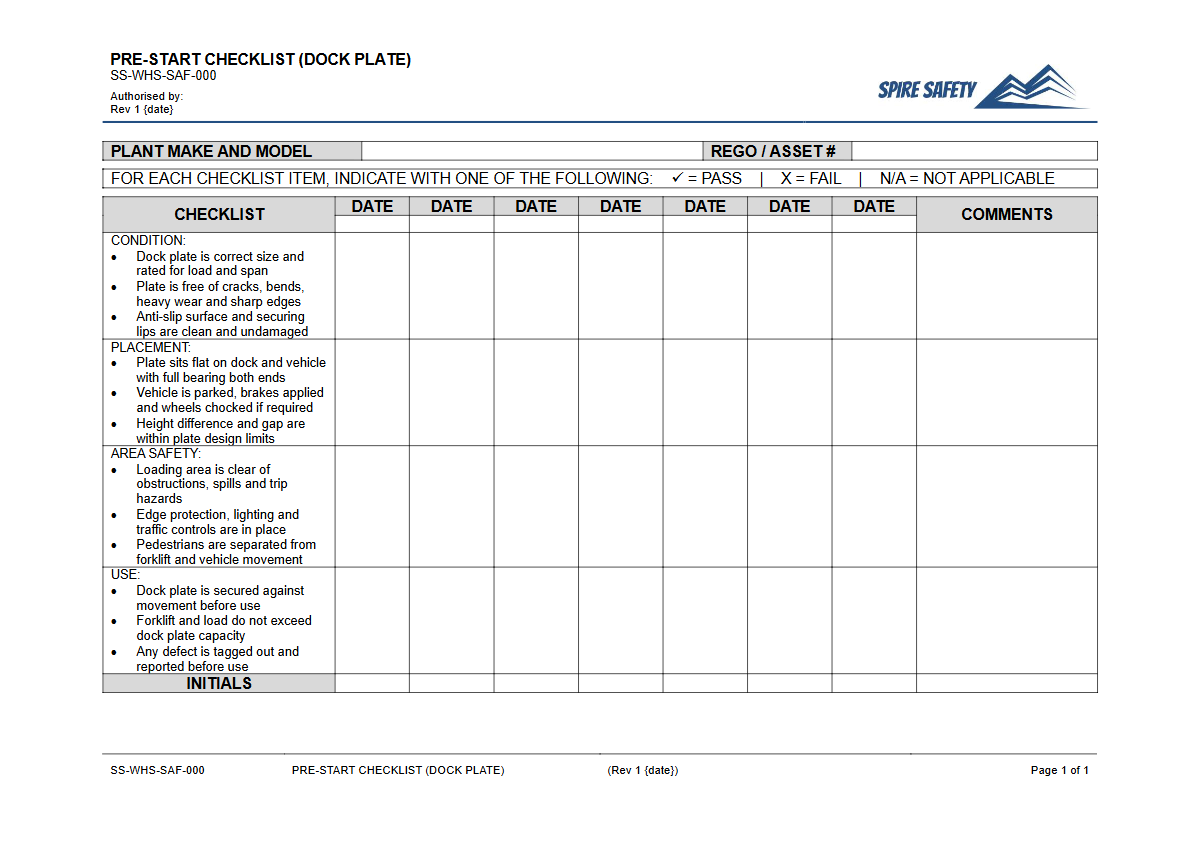
This resource is available as a fully editable DOCX file and a print-ready PDF. The checklist guides users through a systematic inspection of a dock plate's critical components.
Key areas covered include checking for cracks in welds, signs of metal fatigue or bending, the condition of the non-slip surface, the integrity of lifting handles or chains, and the functionality of locking legs or pins that secure it in place. The form includes space to record the date, equipment identifier, inspector's name, and any corrective actions required.
It is crucial to adapt this template to your specific operational context. We've designed this template as a starting point.
You must customise it to reflect the specific types of dock plates used (e.g., steel vs. aluminium, load capacities), the tasks performed, and the unique risks present in your workplace. Integrating these customised checks into your operational workflow ensures they are practical and effective, a key point often verified during regular WHS compliance audits.
When to use it
The dock plate pre-start checklist should be completed before the first use on every shift. In high-volume loading docks where equipment is used continuously by different teams, it may be practical to perform the check at the start of each operator's work period.
The principle is to verify the equipment's condition before it is subjected to a load. Documenting these checks provides a historical record that can be invaluable for maintenance planning, incident investigation, and demonstrating procedural compliance.
Consistent use of pre-start checks fosters a culture of safety and responsibility among workers. It reinforces the importance of equipment integrity and can be a valuable topic for ongoing safety discussions.
For further guidance on embedding this practice, consider using a Pre-Start Checks and Plant Maintenance Toolbox Talk to train your team on the 'why' behind the process, not just the 'how'.
Who should use it
This checklist should be used by any person responsible for placing or using a dock plate. This typically includes warehouse personnel, forklift operators, and truck drivers.
Supervisors and WHS officers are responsible for ensuring these checks are completed correctly and that any identified issues are addressed promptly. It is essential that all users are trained not only on how to fill out the checklist but also on how to recognise potential defects and understand the severe hazards associated with a faulty dock plate.
Documenting procedures for equipment use is essential, especially for high-risk activities common in logistics and transport environments. While a dock plate is simple, its use often intersects with mobile plant operations.
Having documented safety protocols, such as a SWMS for Concrete Truck Operations, demonstrates how specific procedures for different tasks contribute to a safer overall workplace.
Key Inspection Points for Dock Plates
When customising your checklist, ensure it prompts the user to inspect several critical safety elements. These inspection points form the core of an effective pre-start check and should be clearly outlined for the user.
- Structural Integrity: Look for any cracks, bends, or warping on the plate's surface and underside. Pay close attention to welds and seams, as these are common failure points.
- Load Capacity Markings: Ensure the manufacturer's plate showing the maximum load capacity is legible and attached. Never use a plate if its capacity is unknown or lower than the required load.
- Securing System: Check that locking legs, pins, or other mechanisms designed to prevent movement are present, undamaged, and function correctly.
- Surface Condition: The deck surface should be clean and provide adequate grip. Any anti-slip coating or tread should be intact and not worn smooth.
- Lifting Mechanisms: If the plate has handles, chains, or forklift loops, inspect them for damage, deformation, or excessive wear.
Each piece of equipment has unique inspection criteria that should be detailed in its documentation. For example, a Safe Operating Procedure (SOP) for a plate compactor would detail specific checks relevant only to that machine.
Your dock plate checklist should be equally specific to ensure nothing is overlooked. For more templates and safety documents, browse our complete free WHS resources library.
Common mistakes
Common mistakes to avoid
- Using a damaged or warped plate that does not sit flush.
- Failing to secure the plate correctly, allowing it to shift or slip during use.
- Exceeding the plate's stated maximum load capacity.
- Using a plate with insufficient overlap between the dock and the vehicle.
Legal references
Legal considerations
The following legal requirements may be relevant to this type of work.
- Work Health and Safety Act (Harmonised) — Provides the primary duties for protecting workers and other people from work health and safety risks.
- Work Health and Safety Regulations (Harmonised) — Sets out requirements supporting the management of workplace hazards and risks.
The following codes may be relevant to this type of work.
- Managing WHS Risks Code of Practice — Provides practical guidance on identifying hazards, assessing risks and applying effective controls.
- Work Health and Safety Consultation, Cooperation and Coordination Code of Practice — Provides practical guidance on consulting workers and coordinating with other duty holders.
- Managing the Work Environment and Facilities Code of Practice — Provides practical guidance on safe work environments, workplace facilities and related controls.
Did you know
Loading Dock Dangers
According to Safe Work Australia, the Transport, Postal & Warehousing industry has one of the highest rates of serious injury claims. A significant portion of these incidents occur in and around loading docks.
FAQ
Frequently asked questions
01What is the purpose of a dock plate pre-start checklist?
02How often should dock plates be inspected?
03Who is responsible for inspecting a dock plate?
04What are the main hazards associated with dock plates?
Share this resource
Free Pre-Start Checklist (Dock Plate) Template
Browse Categories
How To Use It
- 1Download and open in Word or PDF.
- 2Replace the placeholders with your business details.
- 3Get it reviewed by a WHS specialist before rollout.
Need it customised?
Our WHS consultants can adapt this template to your site, run a gap analysis, or audit what you already have in place.
Book a Free Consultation WHS consulting servicesor call 1300 156 382