
Free Pre-Start Checklist (Dock Leveller) Template
Download our free Pre-Start Checklist (Dock Leveller) Template (DOCX & PDF). A structured starting point for formalising daily equipment safety inspections.
Free Pre-Start Checklist (Dock Leveller) Template
DOCX • 125 KB + PDF
Updated Oct 2026
No signup required
Purpose of the Free Pre-Start Checklist (Dock Leveller) Template
This free Pre-Start Checklist (Dock Leveller) Template provides a structured framework for conducting safety inspections before operating a dock leveller. Its primary purpose is to help workers identify and document any potential faults, damage, or operational issues that could lead to an incident.
By formalising this process, organisations can proactively manage risks associated with crush injuries, falls from height, and equipment failure at the loading dock, one of the most hazardous areas in any warehouse or logistics facility.
Implementing regular pre-start checks is a critical component of a proactive safety culture. It transforms safety from a reactive task into a daily habit, ensuring that equipment is verified as safe for use at the beginning of every shift.
Integrating such procedures is a fundamental part of developing robust WHS management systems that protect workers and ensure operational continuity.
What this Pre-Start Checklist covers
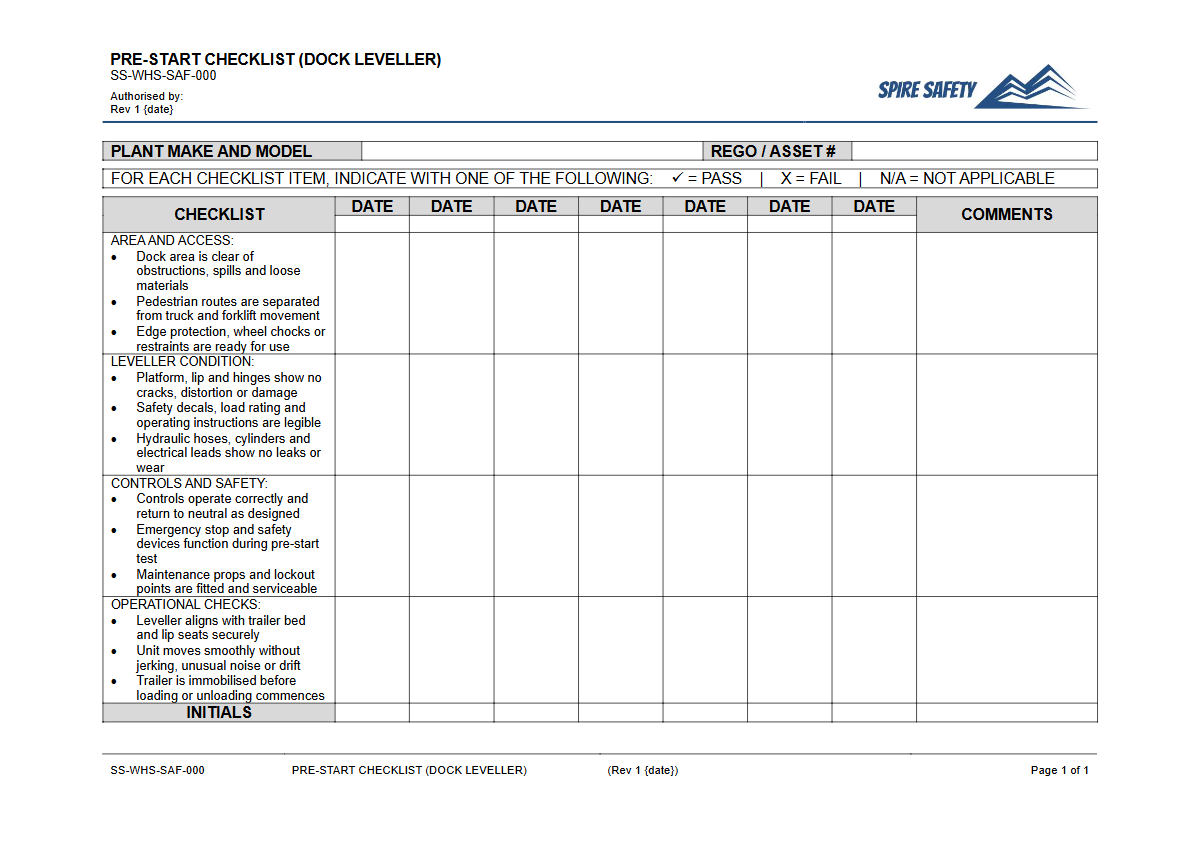
The template provides prompts to inspect key components and functions of a typical dock leveller, including:
- Structural Integrity: Checking for cracks, deformation, or damage to the deck, lip, and frame.
- Operational Controls: Ensuring push-button or pull-chain controls function correctly and are not damaged.
- Hydraulic/Mechanical Systems: Looking for leaks, unusual noises, or jerky movements in the lifting mechanism.
- Safety Features: Verifying that safety legs, barriers, and warning labels are in place and functional.
- General Area: Assessing the surrounding area for slip, trip, or fall hazards and ensuring adequate lighting.
Video walkthrough
How to use the Free Pre-Start Checklist (Dock Leveller) Template
Download the template in the format that suits your needs. The DOCX file is fully editable, allowing for extensive customisation, while the PDF version is ready for immediate printing and use.
The checklist is designed to be straightforward: the operator inspects each item listed, ticks whether it is satisfactory or requires attention, and adds comments as necessary before signing off.
Please note: This template provides a solid foundation, but it is not a complete, out-of-the-box solution. We have developed it as a starting point, and you must customise it to reflect the specific make and model of your dock leveller, your site conditions, and your organisation's unique risk profile.
If you need assistance with tailoring safety documentation for your workplace, consider engaging professional WHS consulting services.
When to use it
This Pre-Start Checklist should be completed by a competent operator at the beginning of each shift or before the first use of the dock leveller each day. It should also be used following any maintenance work, after a potential incident, or if there has been a significant change in operating conditions.
Consistent use helps create a reliable record of the equipment's condition over time, which is invaluable for maintenance planning and incident investigation.
Regular training on the importance of these checks is essential for ensuring they are completed diligently. You can reinforce these concepts with our Pre-Start Checks and Plant Maintenance Toolbox Talk Template to keep safety front of mind.
Completed checklists should be reviewed by a supervisor and retained as part of your safety records. These records provide tangible evidence that safety procedures are being followed, which is often a key focus during a WHS compliance auditing process.
Who should use it
The checklist is designed for use by trained and authorised dock leveller operators. The person performing the inspection must be deemed competent, meaning they have the knowledge and skill to identify the hazards associated with the equipment.
They must understand what they are looking for and recognise the significance of any defects they find.
Supervisors and managers also have a role in reviewing the completed checklists, ensuring any reported faults are addressed promptly, and confirming that non-operational or unsafe equipment is correctly tagged out and isolated. Managing the interaction between plant like dock levellers and visiting vehicles is a critical control, similar to the procedures outlined in a Safe Work Method Statement (Concrete Truck Operation) Template, where different pieces of a process must align for safety.
Ultimately, this document is a tool to empower operators to take ownership of their safety and the safety of those around them. For more tools to support your safety program, feel free to browse our complete free WHS resources library for a wide range of templates and guides.
Common mistakes
Common mistakes to avoid
- Using a generic checklist that doesn't match the specific make or model of the dock leveller.
- Operators 'pencil-whipping' the form—ticking boxes without performing the physical checks.
- Failing to remove faulty equipment from service and clearly tag it as 'out of order'.
- Inadequate training for operators on how to properly identify potential defects.
Legal references
Legal considerations
The following legal requirements may be relevant to this type of work.
- Work Health and Safety Act (Harmonised) — Provides the primary duties for protecting workers and other people from work health and safety risks.
- Work Health and Safety Regulations (Harmonised) — Sets out requirements supporting the management of workplace hazards and risks.
The following codes may be relevant to this type of work.
- Managing WHS Risks Code of Practice — Provides practical guidance on identifying hazards, assessing risks and applying effective controls.
- Work Health and Safety Consultation, Cooperation and Coordination Code of Practice — Provides practical guidance on consulting workers and coordinating with other duty holders.
- Managing the Work Environment and Facilities Code of Practice — Provides practical guidance on safe work environments, workplace facilities and related controls.
Did you know
Loading Dock Dangers
According to various safety studies, loading docks are one of the most dangerous areas in a workplace. A significant percentage of all warehouse and factory accidents occur here, with many involving falls or collisions between forklifts and personnel.
FAQ
Frequently asked questions
01What are the most common hazards associated with dock levellers?
02How often should a dock leveller be formally inspected?
03Is a pre-start checklist a legal requirement in Australia?
04What should happen if a fault is found during a pre-start check?
Share this resource
Free Pre-Start Checklist (Dock Leveller) Template
Browse Categories
How To Use It
- 1Download and open in Word or PDF.
- 2Replace the placeholders with your business details.
- 3Get it reviewed by a WHS specialist before rollout.
Need it customised?
Our WHS consultants can adapt this template to your site, run a gap analysis, or audit what you already have in place.
Book a Free Consultation WHS consulting servicesor call 1300 156 382