
Free Pre-Start Checklist (Cooling Pump) Template
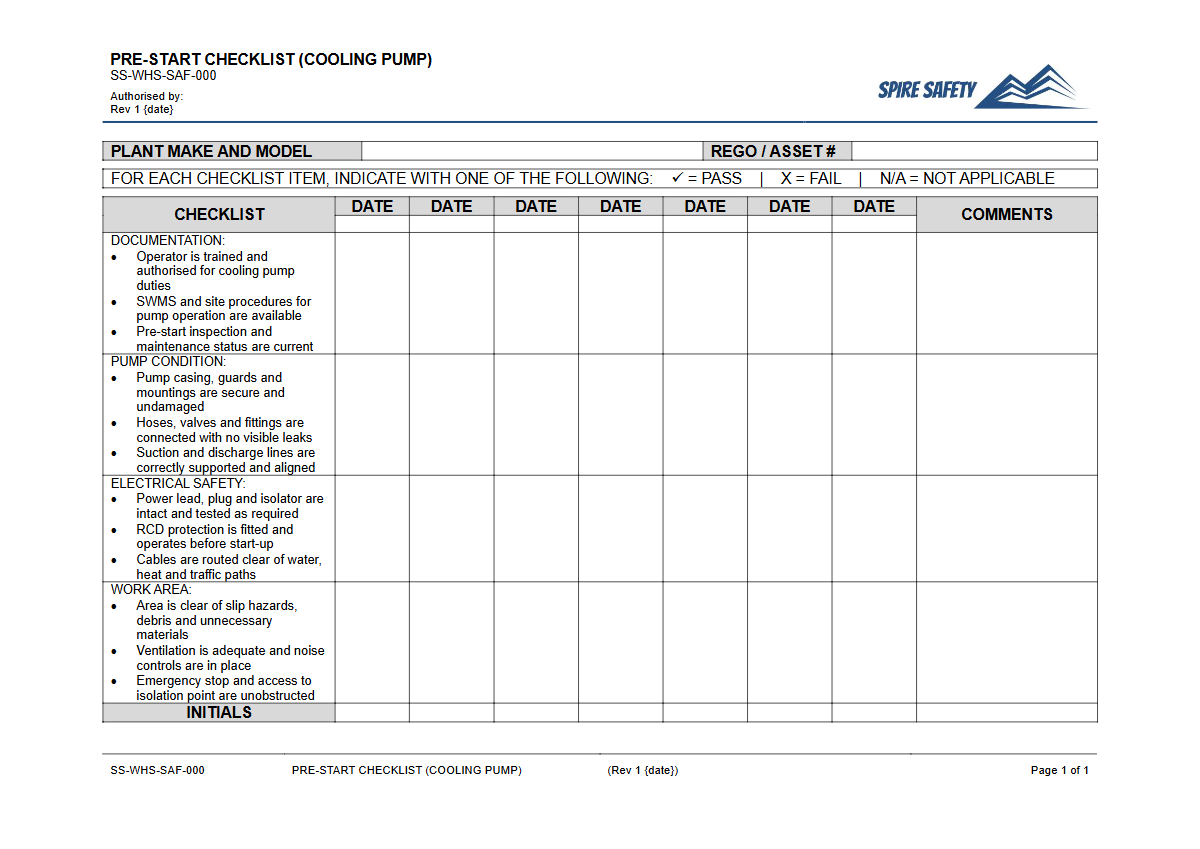
Download our Free Pre-Start Checklist (Cooling Pump) Template to formalise your equipment safety inspections.
Free Pre-Start Checklist (Cooling Pump) Template
DOCX • 125 KB + PDF
Updated Oct 2026
No signup required
Purpose of the Free Pre-Start Checklist (Cooling Pump) Template
A cooling pump is a critical component in many industrial, manufacturing, and commercial processes. Its failure can lead to equipment damage, costly downtime, and potential safety incidents.
This Free Pre-Start Checklist (Cooling Pump) Template provides a structured framework for operators to conduct systematic inspections before operating the equipment. Using a checklist formalises the inspection process, ensuring no critical safety or operational checks are missed.
It helps in the early identification of faults, leaks, or damage, allowing for proactive maintenance rather than reactive repairs. This practice not only enhances operator safety but also contributes to the overall reliability and longevity of the machinery, forming a key part of your daily safety and maintenance organisation.
Video walkthrough
How to use the Free Pre-Start Checklist (Cooling Pump) Template
This document is a foundational template designed for easy adaptation. It is provided in DOCX format, allowing you to add, remove, and edit checks to suit your specific equipment and operational context.
After downloading, review the checklist against the pump's manufacturer specifications, your site's specific hazards, and any past incident data. Customise the items to create a tool that is truly relevant to your workplace.
Important: We have provided a comprehensive starting point, but every workplace is unique. You must customise this checklist to address the specific models of cooling pumps you use and the unique environmental and operational risks of your site.
Once tailored, train all relevant operators and supervisors on its correct use. The process should be simple: inspect the item, tick the corresponding box, and immediately report any 'No' or 'Fail' items to a supervisor for action before starting the pump. For other machine-specific examples, you can review resources like our free Pre-Start Checklist for agitators.
When to use a Cooling Pump Pre-Start Checklist
A pre-start check should be conducted before the first use of the cooling pump on any given day or at the beginning of each shift in a 24-hour operation. This frequency ensures the equipment's condition is verified before it is put into service.
Additional checks are also recommended after the equipment has undergone maintenance or repairs, if it has been moved, or if it has been idle for an extended period. Integrating these checks into daily routines can be reinforced with regular safety discussions, such as a Pre-Start Checks and Plant Maintenance Toolbox Talk, to keep safety at the forefront of every operator's mind.
Who should use it
This Pre-Start Checklist should be completed by personnel who are trained, competent, and authorised to operate the cooling pump. This typically includes machine operators or maintenance technicians.
Supervisors also have a crucial role in overseeing the process, ensuring checks are completed correctly and that any identified faults are documented and addressed promptly. The checklist serves as a tool for the operator, but the responsibility for maintaining a safe system of work rests with the entire organisation.
The checks listed here should align with the steps outlined in a comprehensive Pump SOP (Safe Operating Procedure), which defines the complete process for safe operation.
Integrating Checklists into Your WHS System
A pre-start checklist is not a standalone document; it is an integral component of a broader safety management framework. It functions as a practical risk control measure identified through a thorough hazard assessment.
For a complete approach, this checklist should be used alongside documents like our free Water Pump Risk Assessment Template, which helps identify the hazards in the first place. These documents form part of the evidence that your organisation is proactively managing risks.
Effective implementation and record-keeping are key pillars of robust WHS management systems, demonstrating a commitment to workplace health and safety.
Auditing and Continuous Improvement
Completed pre-start checklists are valuable records. They should be collected and reviewed regularly by supervisors or safety managers.
Analysing this data can reveal recurring faults with specific pumps, gaps in maintenance schedules, or patterns of operator behaviour that may require further training. This review process is a form of continuous improvement that helps refine your safety procedures over time.
These records are also essential during safety inspections or audits, serving as tangible proof of due diligence. A regular review of these operational documents is a key activity in any formal WHS compliance auditing program, helping to verify that safety processes are not just documented, but actively implemented.
Common mistakes
Common mistakes to avoid
- Using a generic, non-specific checklist that doesn't match the actual pump model.
- Completing the checklist from memory without physically or visually inspecting each item.
- Failing to formally report and action identified defects, rendering the check pointless.
- Poor record-keeping, which prevents the tracking of recurring issues and makes it difficult to demonstrate due diligence.
Legal references
Legal considerations
The following legal requirements may be relevant to this type of work.
- Work Health and Safety Act (Harmonised) — Provides the primary duties for protecting workers and other people from work health and safety risks.
- Work Health and Safety Regulations (Harmonised) — Sets out requirements supporting the management of workplace hazards and risks.
The following codes may be relevant to this type of work.
- Managing WHS Risks Code of Practice — Provides practical guidance on identifying hazards, assessing risks and applying effective controls.
- Work Health and Safety Consultation, Cooperation and Coordination Code of Practice — Provides practical guidance on consulting workers and coordinating with other duty holders.
- Managing the Work Environment and Facilities Code of Practice — Provides practical guidance on safe work environments, workplace facilities and related controls.
Did you know
Pump Efficiency
Minor leaks or blockages in a cooling pump system, often caught during pre-start checks, can reduce hydraulic efficiency by over 10%, significantly increasing energy costs and mechanical wear over time.
Leading Indicators
Data from completed pre-start checklists acts as a powerful leading safety indicator. Analysing trends in reported faults can help predict potential failures and prevent serious incidents before they occur.
FAQ
Frequently asked questions
01What should be included in a cooling pump pre-start checklist?
02Is a digital pre-start checklist better than a paper one?
03How often should our cooling pump pre-start checklist be reviewed?
04Who is responsible for ensuring pre-start checks are completed?
Share this resource
Free Pre-Start Checklist (Cooling Pump) Template
Browse Categories
How To Use It
- 1Download and open in Word or PDF.
- 2Replace the placeholders with your business details.
- 3Get it reviewed by a WHS specialist before rollout.
Need it customised?
Our WHS consultants can adapt this template to your site, run a gap analysis, or audit what you already have in place.
Book a Free Consultation WHS consulting servicesor call 1300 156 382