
Free Pre-Start Checklist (Crawler Crane) Template
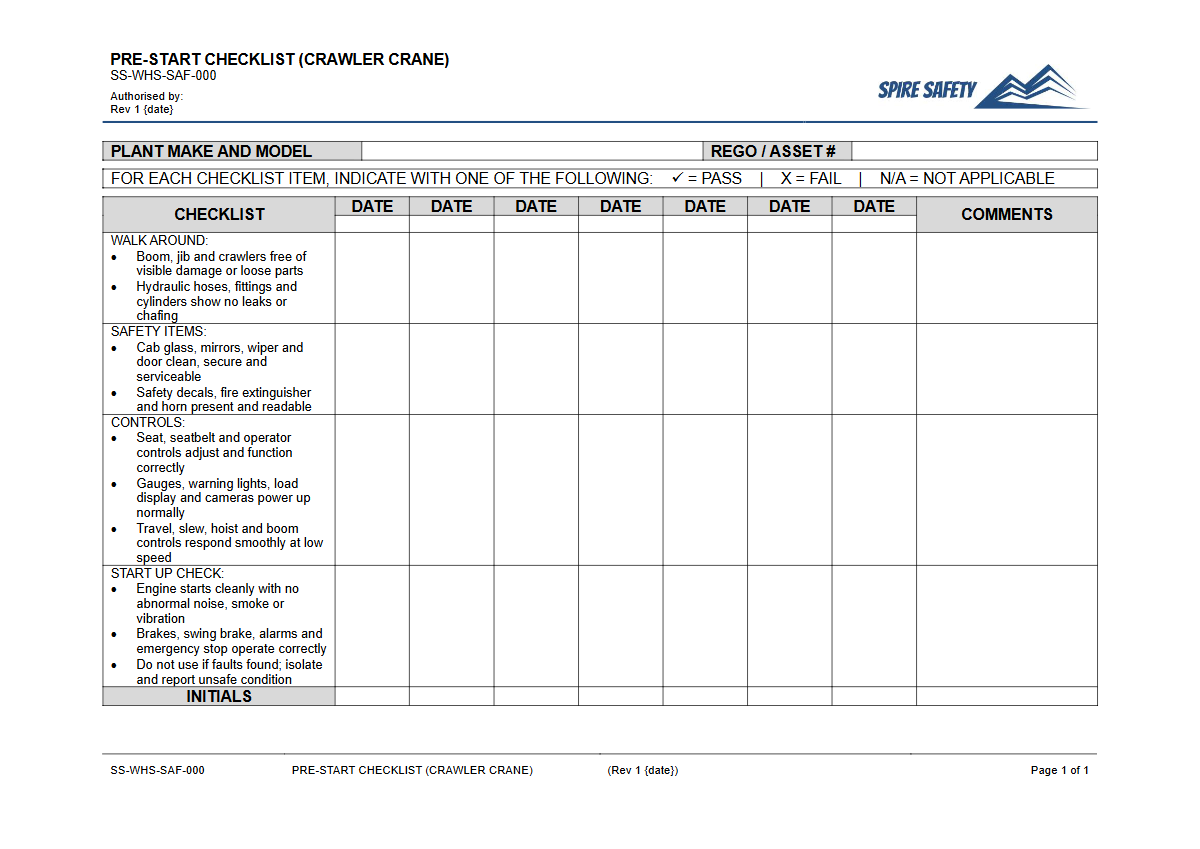
Formalise daily equipment inspections for crawler cranes. Download our free Pre-Start Checklist (Crawler Crane) Template, available in DOCX and PDF formats.
Free Pre-Start Checklist (Crawler Crane) Template
DOCX • 125 KB + PDF
Updated Oct 2026
No signup required
Purpose of the Free Pre-Start Checklist (Crawler Crane) Template
A crawler crane is a high-risk piece of plant that demands rigorous daily inspection. Our free Pre-Start Checklist (Crawler Crane) Template provides a structured framework to help operators identify potential faults or hazards before commencing work.
Using a pre-start checklist is a practical way to meet your duty of care under Australian WHS laws, helping to prevent equipment failure, property damage, and serious injury. Regular, documented checks form a critical component of proactive safety management.
This systematic inspection process helps ensure the crane is in a safe operating condition before it is used for any lift. It formalises the inspection routine, creating a record that the equipment was checked and deemed safe at the start of a shift.
Integrating such practices is a foundational element of effective WHS management systems, demonstrating a clear commitment to workplace safety and risk control.
Video walkthrough
How to use the Free Pre-Start Checklist (Crawler Crane) Template
This document is provided as a downloadable DOCX and PDF file. To implement it effectively in your workplace, follow these steps:
- Download: Choose the format that suits you best (DOCX for editing, PDF for printing as-is).
- Customise: It is essential to adapt this template to your specific needs. We cannot know the exact make, model, configuration, or attachments of your crawler crane, nor the specific hazards of your worksite. You must review and modify the checklist to include items relevant to your equipment and operational environment. This may involve consulting the manufacturer's manual and conducting a site-specific risk assessment.
- Train: Ensure all operators and supervisors are trained on how to use the customised checklist, what each item means, and the procedure for reporting defects.
- Implement: Make the completed checklist a mandatory step before any crawler crane operation. The operator should complete the checks, sign, and date the form before starting their shift.
Supervisors should periodically review completed checklists to ensure they are being filled out correctly and that any reported issues are being addressed promptly. These records provide valuable data for maintenance scheduling and can be a key source of evidence during WHS compliance audits.
When to use it
The Crawler Crane Pre-Start Checklist should be completed at the beginning of every shift before the crane is operated. It should also be completed any time the crane is assembled on-site, after a long period of inactivity, or after significant maintenance or repairs have been carried out.
The goal is to verify the crane's operational readiness and safety at that specific point in time, ensuring no damage or faults have occurred since its last use. This daily discipline is crucial for high-risk mobile plant, similar to the principle behind using a pre-start checklist for a forwarder in a forestry operation.
Who should use it
This Pre-Start Checklist must be completed by a person who is competent and authorised to operate the specific crawler crane. A 'competent person' is someone who has the required training, knowledge, experience, and any relevant high-risk work licences to operate the crane safely.
They must be familiar with the crane's controls, safety features, and potential failure points. It is not a task to be delegated to an apprentice or a trade assistant.
The Person Conducting a Business or Undertaking (PCBU) is ultimately responsible for ensuring that operators are competent and that these essential safety checks are performed correctly.
For organisations needing assistance in developing broader safety protocols or defining competency standards, our WHS consulting services can provide expert guidance. We can help you build robust systems that go beyond a single checklist.
Explore our entire free WHS resources library for more templates and tools to support your safety objectives.
Common mistakes
Common mistakes to avoid
- Using a generic 'crane' checklist that doesn't account for the specific features of a crawler crane (e.g., tracks, boom configuration).
- Failing to physically check ground conditions and the planned travel path before starting work.
- Ticking boxes without physically sighting and testing the component (a 'tick and flick' exercise).
- Not immediately reporting, isolating, and tagging out the crane when a serious defect is found.
Legal references
Legal considerations
The following legal requirements may be relevant to this type of work.
- Work Health and Safety Act (Harmonised) — Provides the primary duties for protecting workers and other people from work health and safety risks.
- Work Health and Safety Regulations (Harmonised) — Sets out requirements supporting the management of workplace hazards and risks.
The following codes may be relevant to this type of work.
- Managing WHS Risks Code of Practice — Provides practical guidance on identifying hazards, assessing risks and applying effective controls.
- Work Health and Safety Consultation, Cooperation and Coordination Code of Practice — Provides practical guidance on consulting workers and coordinating with other duty holders.
- Managing the Work Environment and Facilities Code of Practice — Provides practical guidance on safe work environments, workplace facilities and related controls.
Did you know
Ground Conditions
A significant portion of crawler crane incidents are not due to mechanical failure, but to inadequate ground preparation, leading to instability and tipping.
Soft Ground Specialists
Crawler cranes were originally developed in the early 20th century to solve the problem of moving heavy lifting equipment across the soft, unstable ground found in logging and construction sites.
FAQ
Frequently asked questions
01What's the difference between a pre-start check and a major inspection for a crawler crane?
02Can I use a digital app or software for this crawler crane pre-start checklist?
03Who is responsible for ensuring crawler crane pre-starts are done?
04How long should we keep completed crawler crane pre-start checklists?
Share this resource
Free Pre-Start Checklist (Crawler Crane) Template
Browse Categories
How To Use It
- 1Download and open in Word or PDF.
- 2Replace the placeholders with your business details.
- 3Get it reviewed by a WHS specialist before rollout.
Need it customised?
Our WHS consultants can adapt this template to your site, run a gap analysis, or audit what you already have in place.
Book a Free Consultation WHS consulting servicesor call 1300 156 382