
Free Pre-Start Checklist (Cream Whipper) Template
Download our free Pre-Start Checklist for cream whippers. This structured DOCX & PDF template helps formalise WHS checks for hospitality equipment.
Free Pre-Start Checklist (Cream Whipper) Template
DOCX • 125 KB + PDF
Updated Oct 2026
No signup required
Purpose of the Free Pre-Start Checklist (Cream Whipper) Template
This Free Pre-Start Checklist (Cream Whipper) Template provides a structured starting point for documenting safety inspections of commercial cream whippers. While seemingly simple, these devices are pressurised vessels that use nitrous oxide (N2O) chargers.
Improper use, damage, or poor maintenance can lead to serious hazards, including explosions, projectile parts, or high-pressure gas release, causing significant injuries.
Using this Pre-Start Checklist helps your organisation formalise the process of verifying that each unit is safe for operation before it is used. It prompts workers to actively look for signs of wear, damage, or incorrect assembly.
Systematically conducting and recording these checks demonstrates a proactive approach to managing workplace risks, aligning with the principles of Australian WHS legislation. It's a critical tool for any hospitality business aiming to protect its workers and patrons.
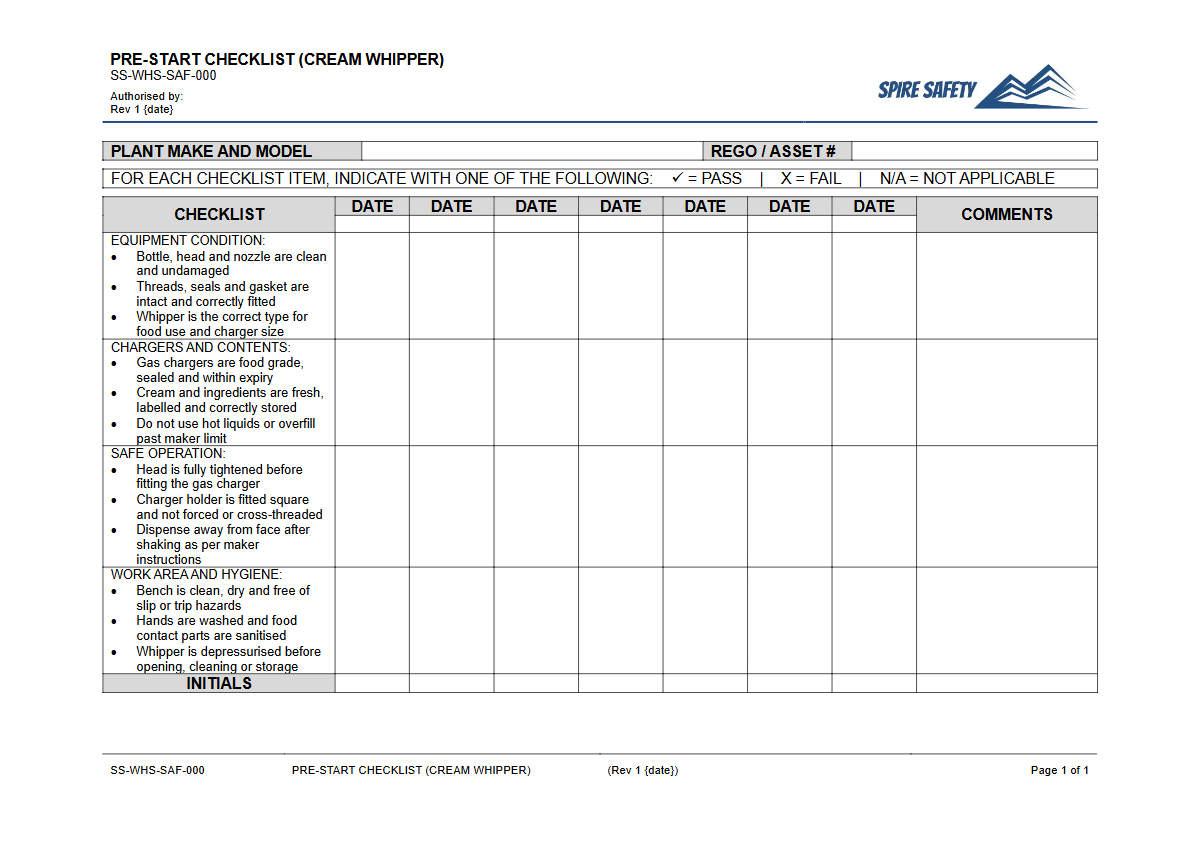
What this Pre-Start Checklist covers:
- Inspection of the canister for dents, cracks, or damage.
- Checking the head, valve, and seals for wear or degradation.
- Verification of cleanliness to prevent blockages.
- Confirmation of correct charger type and proper assembly.
- A sign-off area for operator accountability.
Implementing routine checks is the first step, but ensuring your team understands their importance is just as crucial. You can reinforce these concepts by running regular safety sessions using a resource like our Pre-Start Checks and Plant Maintenance Toolbox Talk to build a stronger safety culture.
Video walkthrough
How to use the Free Pre-Start Checklist (Cream Whipper) Template
This Pre-Start Checklist is provided as a DOCX file that can be easily edited and customised, as well as a print-ready PDF. The goal is to create a document that is perfectly aligned with your specific operational needs and equipment.
Important: This template is a guide and must be customised. We provide this document as a starting point, but you must adapt it to reflect the specific cream whipper models, tasks, chargers, and unique environment of your workplace.
Its effectiveness depends on your thorough customisation and implementation.
To get the most value, involve the workers who use the equipment daily in the customisation process. They often have the best practical insights into potential issues.
Once finalised, the checklist should be integrated into your daily opening procedures and become a non-negotiable part of your kitchen or bar operations. This process should be a component of your overall safety framework, which formalises how you manage health and safety across the board.
A robust framework can be established through dedicated WHS management systems that provide structure and clarity.
When to use a Cream Whipper Pre-Start Checklist
A Pre-Start Checklist should be completed at the beginning of each shift or day before the cream whipper is first used. It should also be performed if the equipment has been dropped, serviced, or assembled by a different team member.
The check takes only a minute but provides an essential, timely verification that the device remains in a safe condition. Regular checks help identify small issues before they can escalate into a critical failure during operation.
Who should use this Pre-Start Checklist
This checklist is designed for any person required to operate a commercial cream whipper. This typically includes:
- Baristas
- Chefs and cooks
- Kitchen hands and catering staff
- Bar and beverage attendants
Supervisors and managers are responsible for ensuring these checks are completed correctly and for providing adequate training on both the equipment and the checklist procedure. It's vital that any safety procedures are consistently applied across all relevant equipment. For instance, similar diligence is required for other common hospitality equipment, as outlined in our Free Pre-Start Checklist (Coffee Grinder) Template.
If you need assistance integrating this checklist into a broader safety program or require expert advice on managing specific hospitality risks, engaging external WHS consulting can provide valuable, tailored support for your business. For more tools to support your safety management efforts, feel free to browse our complete free WHS resources library.
Common mistakes
Common mistakes to avoid
- Using incorrect gas chargers (e.g., CO2 for soda siphons) which operate at different pressures and can damage the whipper.
- Over-tightening the head when screwing it onto the canister, which can damage the threads or the silicone gasket.
- Failing to thoroughly clean all components, especially the nozzle and valve, leading to blockages and potential pressure build-up.
- Continuing to use a canister that has been dropped or has visible dents, which compromises its structural integrity.
Legal references
Legal considerations
The following legal requirements may be relevant to this type of work.
- Work Health and Safety Act (Harmonised) — Provides the primary duties for protecting workers and other people from work health and safety risks.
- Work Health and Safety Regulations (Harmonised) — Sets out requirements supporting the management of workplace hazards and risks.
The following codes may be relevant to this type of work.
- Managing WHS Risks Code of Practice — Provides practical guidance on identifying hazards, assessing risks and applying effective controls.
- Work Health and Safety Consultation, Cooperation and Coordination Code of Practice — Provides practical guidance on consulting workers and coordinating with other duty holders.
- Managing the Work Environment and Facilities Code of Practice — Provides practical guidance on safe work environments, workplace facilities and related controls.
Did you know
A Small Pressure Vessel
Cream whipper chargers fill the canister with nitrous oxide (N2O), increasing the internal pressure to many times that of the surrounding atmosphere. This classifies the device as a small pressure vessel, requiring careful inspection and handling.
FAQ
Frequently asked questions
01Why is a pre-start check for a cream whipper necessary?
02What are the main hazards of a cream whipper?
03Can I use this template for any brand of cream whipper?
04How often should a cream whipper pre-start check be done?
Share this resource
Free Pre-Start Checklist (Cream Whipper) Template
Browse Categories
How To Use It
- 1Download and open in Word or PDF.
- 2Replace the placeholders with your business details.
- 3Get it reviewed by a WHS specialist before rollout.
Need it customised?
Our WHS consultants can adapt this template to your site, run a gap analysis, or audit what you already have in place.
Book a Free Consultation WHS consulting servicesor call 1300 156 382