
Free Pre-Start Checklist (Cryostat) Template
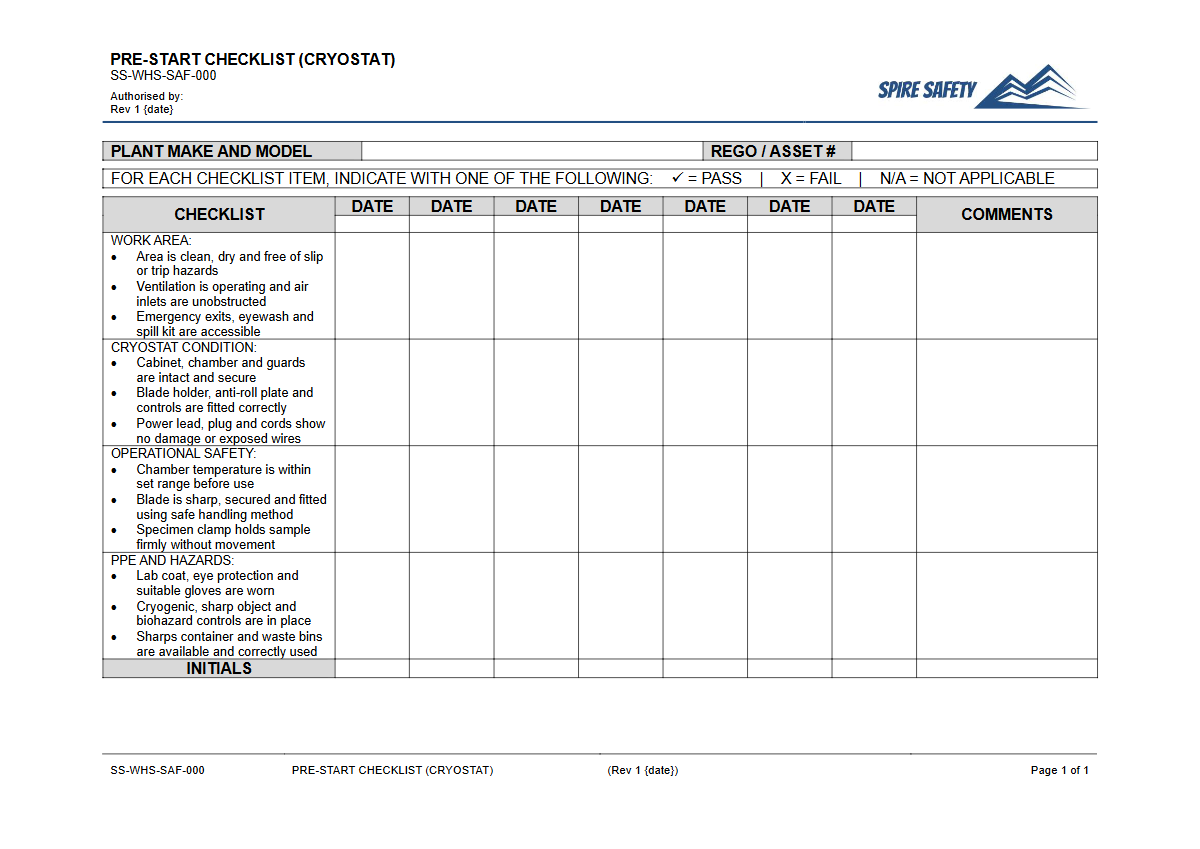
Download our free Pre-Start Checklist for Cryostats to formalise your lab equipment safety inspections. This template helps identify hazards before use.
Free Pre-Start Checklist (Cryostat) Template
DOCX • 125 KB + PDF
Updated Oct 2026
No signup required
Purpose of the Free Pre-Start Checklist (Cryostat) Template
This Free Pre-Start Checklist (Cryostat) Template provides a structured starting point for formalising the safety inspection of laboratory cryostats before they are used. Cryostats present a unique combination of hazards, including extremely sharp microtome blades, cryogenic temperatures, potential exposure to biological materials, and electrical risks.
Using a systematic checklist helps operators to proactively identify equipment damage, faults, or unsafe conditions before commencing work.
Implementing a routine pre-start check is a fundamental component of managing workplace risks. It minimises the chance of injury from blade contact, prevents equipment malfunction that could compromise samples, and ensures safety features like blade guards and locks are functional. Documenting these checks creates a clear record of due diligence, demonstrating a commitment to safety that forms a core part of effective WHS management systems.
Video walkthrough
How to use the Free Pre-Start Checklist (Cryostat) Template
This resource is available for download as a DOCX file, allowing for easy customisation, and as a PDF for straightforward printing and use. The checklist is designed as a foundational guide aligned with Australian WHS principles, but it is not a complete, out-of-the-box solution.
It requires careful adaptation to reflect the specific context of your workplace.
Important: Before implementing this checklist, it must be customised for your organisation. We recommend the Person Conducting a Business or Undertaking (PCBU) consults with workers who operate the cryostat, laboratory managers, and WHS personnel.
Review the checklist against the specific make and model of your equipment, the manufacturer’s operating manual, and any relevant Safe Work Procedures (SWPs). Add, remove, or modify items to ensure all site-specific hazards are covered.
Once customised, the checklist should be integrated into your daily operational procedures. Completed checklists should be filed as part of your safety records.
These records provide valuable data that can be reviewed during a WHS compliance audit to verify that safety processes are being consistently followed.
When to use it
A cryostat pre-start check should be completed by a trained operator at the beginning of any shift where the equipment will be used, or before the first use of the day. Consistency is crucial for building a strong safety culture and ensuring that no check is missed.
The checklist should also be used after any maintenance, repair, cleaning, or relocation of the unit to confirm it is safe to return to service and is functioning correctly.
Regularly reinforcing the importance of these checks is vital for maintaining high safety standards. Discussing the process and any findings can be an effective topic for safety meetings.
You can use our Pre-Start Checks and Plant Maintenance Toolbox Talk Template to facilitate these crucial conversations with your team.
Who should use it
This checklist is designed for use by trained and competent personnel who are authorised to operate the cryostat, such as laboratory technicians, medical scientists, pathologists, and researchers. The responsibility for conducting the check lies with the operator before they begin their task.
Supervisors or laboratory managers should periodically review the completed checklists to ensure they are being filled out correctly and that any reported defects are being addressed in a timely manner. WHS representatives may also use the aggregated data to identify trends in equipment faults or near misses.
Many laboratories and research facilities use a range of specialised equipment, each with unique risks. It's important that specific checklists are developed for each type of plant.
For example, a facility that also prepares samples might require a separate pre-start checklist for an agitator to manage its distinct hazards.
By embedding this practice into your operations, you contribute to a safer and more reliable working environment. For more templates and safety documents, you can explore our complete free WHS resources library.
Common mistakes
Common mistakes to avoid
- Using the generic template without customising it for the specific cryostat model and workplace hazards.
- Failing to consult the manufacturer's operating and safety manual for model-specific inspection points.
- Completing the checklist from memory without physically inspecting each item on the cryostat.
- Not taking immediate action to report, isolate, and tag faulty equipment identified during the check.
Legal references
Legal considerations
The following legal requirements may be relevant to this type of work.
- Work Health and Safety Act (Harmonised) — Provides the primary duties for protecting workers and other people from work health and safety risks.
- Work Health and Safety Regulations (Harmonised) — Sets out requirements supporting the management of workplace hazards and risks.
The following codes may be relevant to this type of work.
- Managing WHS Risks Code of Practice — Provides practical guidance on identifying hazards, assessing risks and applying effective controls.
- Work Health and Safety Consultation, Cooperation and Coordination Code of Practice — Provides practical guidance on consulting workers and coordinating with other duty holders.
- Managing the Work Environment and Facilities Code of Practice — Provides practical guidance on safe work environments, workplace facilities and related controls.
Did you know
Extreme Cold
Cryostats typically operate at temperatures between -20°C and -35°C, which is necessary to harden tissue sufficiently for it to be sectioned by the microtome blade.
Blade Safety
The microtome blade is one of the most significant hazards of a cryostat. Modern units incorporate safety features like blade guards, ejectors, and locking handwheels to minimise the risk of severe cuts.
FAQ
Frequently asked questions
01What is a cryostat pre-start checklist?
02Why is a pre-start check important for a cryostat?
03How often should a cryostat be inspected using the checklist?
04Who is responsible for customising this cryostat checklist template?
Share this resource
Free Pre-Start Checklist (Cryostat) Template
Browse Categories
How To Use It
- 1Download and open in Word or PDF.
- 2Replace the placeholders with your business details.
- 3Get it reviewed by a WHS specialist before rollout.
Need it customised?
Our WHS consultants can adapt this template to your site, run a gap analysis, or audit what you already have in place.
Book a Free Consultation WHS consulting servicesor call 1300 156 382