
Free Pre-Start Checklist (Cyclone) Template
Prepare your workplace for extreme weather with our Free Pre-Start Checklist (Cyclone) Template. Formalise your safety checks for equipment and facilities.
Free Pre-Start Checklist (Cyclone) Template
DOCX • 125 KB + PDF
Updated Oct 2026
No signup required
Purpose of the Free Pre-Start Checklist (Cyclone) Template
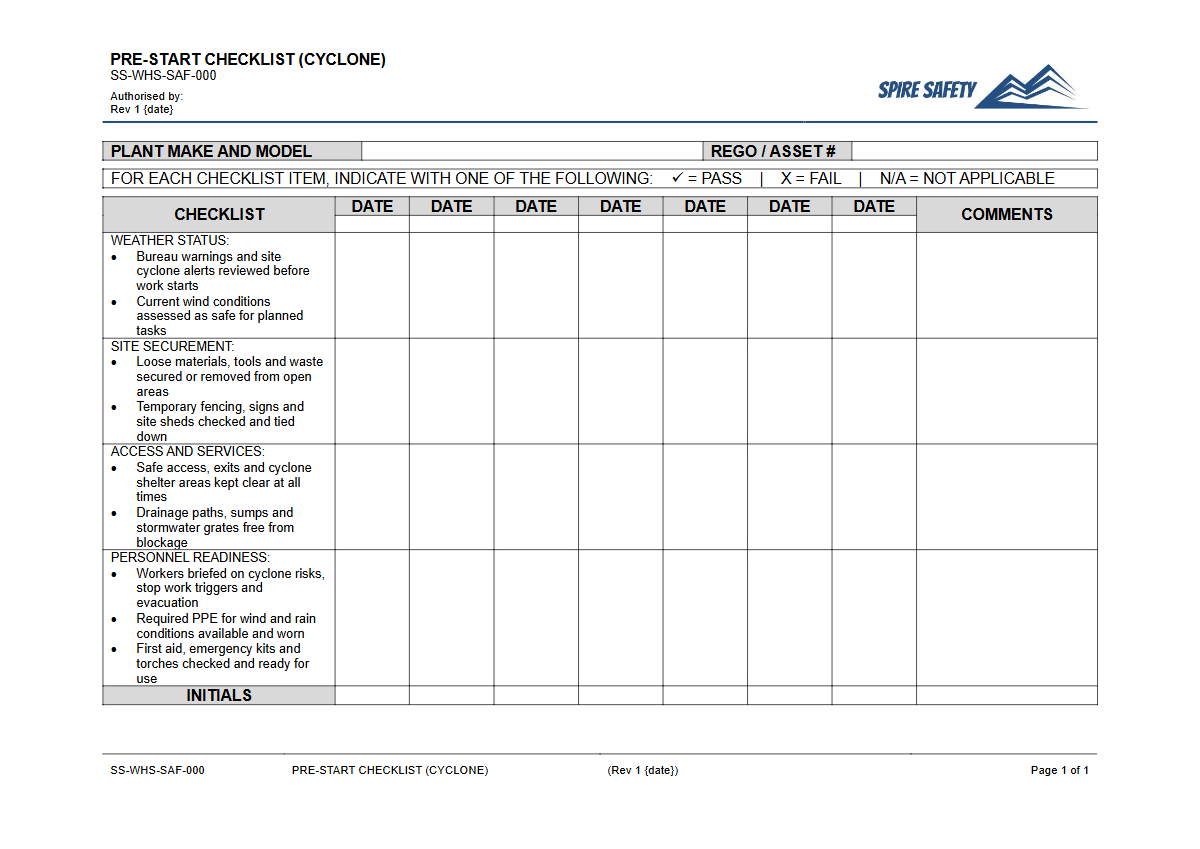
Operating in a region prone to cyclones requires a systematic approach to safety. This Free Pre-Start Checklist (Cyclone) Template provides a structured starting point for organisations to prepare their sites, equipment, and people for severe weather events.
The primary purpose is to move beyond ad-hoc preparations and formalise a repeatable, documented process for risk mitigation. By using a checklist, you can ensure that critical safety actions are not overlooked in the lead-up to a cyclone.
A documented pre-start process helps a Person Conducting a Business or Undertaking (PCBU) demonstrate due diligence in managing foreseeable risks. This template is designed to be integrated into broader WHS management systems, acting as a practical tool to implement policies related to emergency preparedness.
It prompts the inspection and securing of physical assets, verification of emergency supplies, and confirmation of communication protocols, creating a safer environment for everyone on site before, during, and after a storm.
Video walkthrough
How to use the Free Pre-Start Checklist (Cyclone) Template
This checklist is provided in both DOCX and PDF formats for your convenience. The DOCX file is fully editable, allowing you to adapt it to the unique context of your workplace.
To effectively implement the checklist, follow these steps:
- Download: Choose the format that best suits your needs.
- Review: Familiarise yourself with the sections covering site security, building integrity, equipment preparation, and personnel safety.
- Customise: Adapt the checklist to include site-specific items. This may involve adding details about particular machinery, unique structural features of your buildings, or specific outdoor areas that require attention. Just as you would use a specific Free Pre-Start Checklist (Agitator) Template for that machine, this cyclone checklist must be tailored to your specific environment.
- Train: Ensure all relevant personnel understand how and when to use the checklist.
- Implement: Integrate the checklist into your standard emergency response procedures.
Important Note: It is crucial to remember that this template is a starting point. We have designed it to be a comprehensive guide based on common WHS practice, but you must customise it to address the specific hazards, equipment, and procedures unique to your workplace and geographical location.
For complex operations or high-risk sites, engaging professional WHS consulting can help ensure your preparedness plan is robust and effective.
When to use it
The cyclone pre-start checklist should be used at several key moments. Its primary use is during the official cyclone watch and warning phases, as declared by the Bureau of Meteorology.
This is when designated personnel should conduct a thorough inspection of the workplace, actioning and signing off on each item.
Beyond immediate threats, the checklist serves as a valuable tool for annual preparedness reviews, typically conducted before the official start of the cyclone season. It can also be used during emergency drills to simulate a real-world response and identify gaps in your plan.
After an event, reviewing the completed checklists can provide valuable insights for your continuous improvement processes and can be a key document in any post-incident review or WHS compliance auditing activities.
Who should use it
This checklist is designed for use by individuals with responsibility for workplace safety and emergency management. This typically includes:
- Work Health and Safety (WHS) Managers and Officers
- Site Supervisors and Forepersons
- Emergency Wardens or members of an Emergency Control Organisation (ECO)
- Business owners and other PCBUs
While a manager or supervisor may oversee the process, the physical checks may be delegated to various team members responsible for different areas or equipment. It is vital that everyone involved is competent and understands the importance of each check.
While this document covers broad site preparedness, remember that specific plant still requires its own pre-operational checks, which might be documented using a resource like our Free Pre-Start Checklist (CNC Router) Template. Find more templates and safety documents in our free WHS resources library to build a comprehensive safety system.
Common mistakes
Common mistakes to avoid
- Forgetting to inspect and clear gutters and drains, leading to flooding.
- Not securing smaller, lighter objects in yards or on balconies, which can become dangerous projectiles.
- Failing to regularly test backup generators and communication equipment like satellite phones.
- Neglecting to train new staff members on the cyclone preparedness plan and their specific roles.
Legal references
Legal considerations
The following legal requirements may be relevant to this type of work.
- Work Health and Safety Act (Harmonised) — Provides the primary duties for protecting workers and other people from work health and safety risks.
- Work Health and Safety Regulations (Harmonised) — Sets out requirements supporting the management of workplace hazards and risks.
The following codes may be relevant to this type of work.
- Managing WHS Risks Code of Practice — Provides practical guidance on identifying hazards, assessing risks and applying effective controls.
- Work Health and Safety Consultation, Cooperation and Coordination Code of Practice — Provides practical guidance on consulting workers and coordinating with other duty holders.
- Managing the Work Environment and Facilities Code of Practice — Provides practical guidance on safe work environments, workplace facilities and related controls.
Did you know
Cyclone Categories
In Australia, tropical cyclones are categorised on a scale from 1 (weakest) to 5 (most severe) based on their maximum mean wind speed. A Category 5 cyclone has wind gusts exceeding 280 km/h.
Naming Conventions
The Bureau of Meteorology pre-determines a list of names for tropical cyclones, alternating between male and female names. The first cyclone of the season gets the first name on the list for that year.
FAQ
Frequently asked questions
01What should be included in a cyclone pre-start checklist?
02How often should cyclone preparedness checks be conducted?
03Who is responsible for completing a cyclone pre-start checklist?
04Is this cyclone checklist template sufficient for our legal WHS obligations?
Share this resource
Free Pre-Start Checklist (Cyclone) Template
Browse Categories
How To Use It
- 1Download and open in Word or PDF.
- 2Replace the placeholders with your business details.
- 3Get it reviewed by a WHS specialist before rollout.
Need it customised?
Our WHS consultants can adapt this template to your site, run a gap analysis, or audit what you already have in place.
Book a Free Consultation WHS consulting servicesor call 1300 156 382