
Free Pre-Start Checklist (Crane Truck) Template
Download our Free Pre-Start Checklist (Crane Truck) Template. This structured DOCX & PDF helps operators formalise daily safety inspections.
Free Pre-Start Checklist (Crane Truck) Template
DOCX • 125 KB + PDF
Updated Oct 2026
No signup required
Purpose of the Free Pre-Start Checklist (Crane Truck) Template
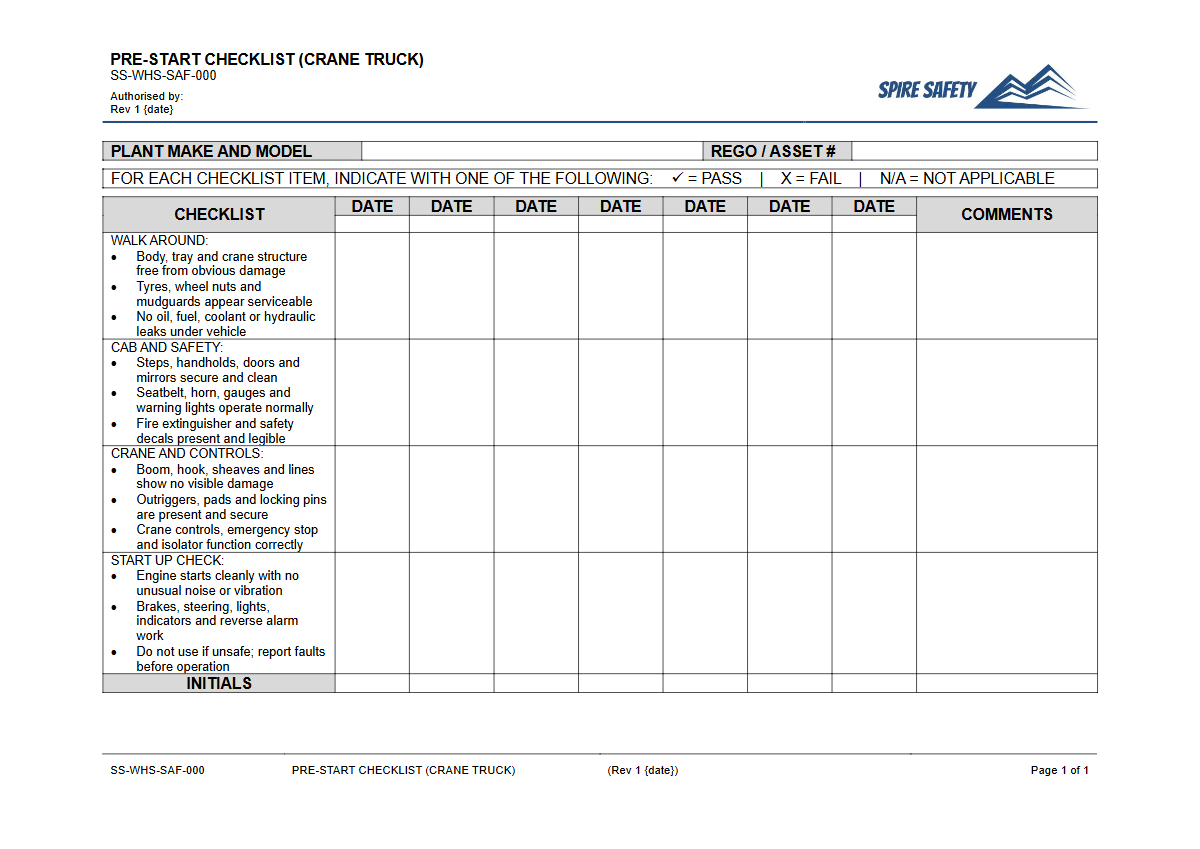
This Free Pre-Start Checklist (Crane Truck) Template provides a structured framework for operators to conduct thorough, routine inspections of vehicle-mounted cranes before operation. Using a checklist formalises the process of identifying potential faults, mechanical issues, or damage that could lead to an incident.
It helps a Person Conducting a Business or Undertaking (PCBU) demonstrate due diligence in managing risks associated with high-risk plant.
A consistent pre-start inspection process is a fundamental component of proactive safety management. It ensures equipment is safe to use at the start of every shift, helps prevent costly breakdowns, and extends the operational life of the asset.
Documenting these checks creates a verifiable record of safety practices, which is crucial for demonstrating that safety processes are being followed. These records are an essential part of effective WHS management systems and provide valuable data for maintenance scheduling and trend analysis.
Regular checks also help to reinforce safe operator behaviour and maintain a high level of hazard awareness on site. Beyond crane trucks, systematic inspections are vital for all lifting equipment; a similar process using a pre-start checklist for bin lifters can help manage risks in waste management operations.
Video walkthrough
How to use the Free Pre-Start Checklist (Crane Truck) Template
Our pre-start checklist is designed to be a practical starting point for your organisation. After downloading the DOCX or PDF file, you can integrate it into your daily operational workflow.
The checklist guides the operator through a logical sequence of visual and functional checks covering critical components like the vehicle, crane structure, hydraulics, wire ropes, hooks, and safety systems.
The operator should methodically inspect each item, marking it as satisfactory or noting any defects. Any identified faults must be reported immediately according to your site's procedures, and the crane truck should be tagged out of service until it is assessed and repaired by a competent person.
Completed checklists should be signed, dated, and submitted to a supervisor for review and filing.
Important: This document is a general template. We recommend you customise it to reflect the specific make and model of your crane truck, its unique configuration, attachments, typical site conditions, and your organisation's specific operational procedures.
Similar customisation is required for other heavy equipment, such as when adapting a pre-start checklist for forwarders in the forestry industry.
When to use it
A pre-start check should be conducted before the first use of the crane truck on any given day or at the beginning of each shift. If the crane is used by multiple operators in a single day, it is good practice for each new operator to perform their own check to verify its condition before they take control.
The checklist should be used consistently as part of the daily routine, not just intermittently. This regular use ensures that any changes in the equipment's condition are caught early.
The records generated by these checks are often examined during internal or external WHS compliance audits to verify that safety procedures are being implemented as required.
Who should use it
The pre-start checklist should be completed by a competent person who has received the necessary training and instruction to operate the specific crane truck. This is typically the designated operator for the shift.
They must have a thorough understanding of the equipment's functions and be able to recognise signs of wear, damage, or malfunction.
Supervisors and managers also have a role. They are responsible for ensuring that operators are trained and competent to perform the checks, that the system is being followed correctly, and that any reported faults are addressed in a timely manner.
If you need assistance developing roles, responsibilities, and safe work procedures for your workplace, consider engaging with professional WHS consulting services. You can explore a wide range of similar templates in our free WHS resources library to support your safety management system.
Common mistakes
Common mistakes to avoid
- Treating the check as a 'tick and flick' exercise without physically inspecting the items.
- Failing to immediately tag out and report faulty or damaged equipment.
- Using a generic checklist that doesn't cover the specific features or attachments of the crane.
- Poor record-keeping, making it difficult to track recurring faults or prove due diligence.
Legal references
Legal considerations
The following legal requirements may be relevant to this type of work.
- Work Health and Safety Act (Harmonised) — Provides the primary duties for protecting workers and other people from work health and safety risks.
- Work Health and Safety Regulations (Harmonised) — Sets out requirements supporting the management of workplace hazards and risks.
The following codes may be relevant to this type of work.
- Managing WHS Risks Code of Practice — Provides practical guidance on identifying hazards, assessing risks and applying effective controls.
- Work Health and Safety Consultation, Cooperation and Coordination Code of Practice — Provides practical guidance on consulting workers and coordinating with other duty holders.
- Managing the Work Environment and Facilities Code of Practice — Provides practical guidance on safe work environments, workplace facilities and related controls.
Did you know
Major Inspections
Beyond daily checks, Australian Standards mandate that mobile cranes undergo a major inspection at set intervals (e.g., 10 years) to assess their continued safe operation and structural integrity.
FAQ
Frequently asked questions
01What key items should a crane truck pre-start checklist cover?
02Is a paper pre-start checklist still acceptable?
03How often must a crane truck pre-start be done?
04What happens if a fault is found during the pre-start inspection?
Share this resource
Free Pre-Start Checklist (Crane Truck) Template
Browse Categories
How To Use It
- 1Download and open in Word or PDF.
- 2Replace the placeholders with your business details.
- 3Get it reviewed by a WHS specialist before rollout.
Need it customised?
Our WHS consultants can adapt this template to your site, run a gap analysis, or audit what you already have in place.
Book a Free Consultation WHS consulting servicesor call 1300 156 382