
Free Pre-Start Checklist (Cooling Tower) Template
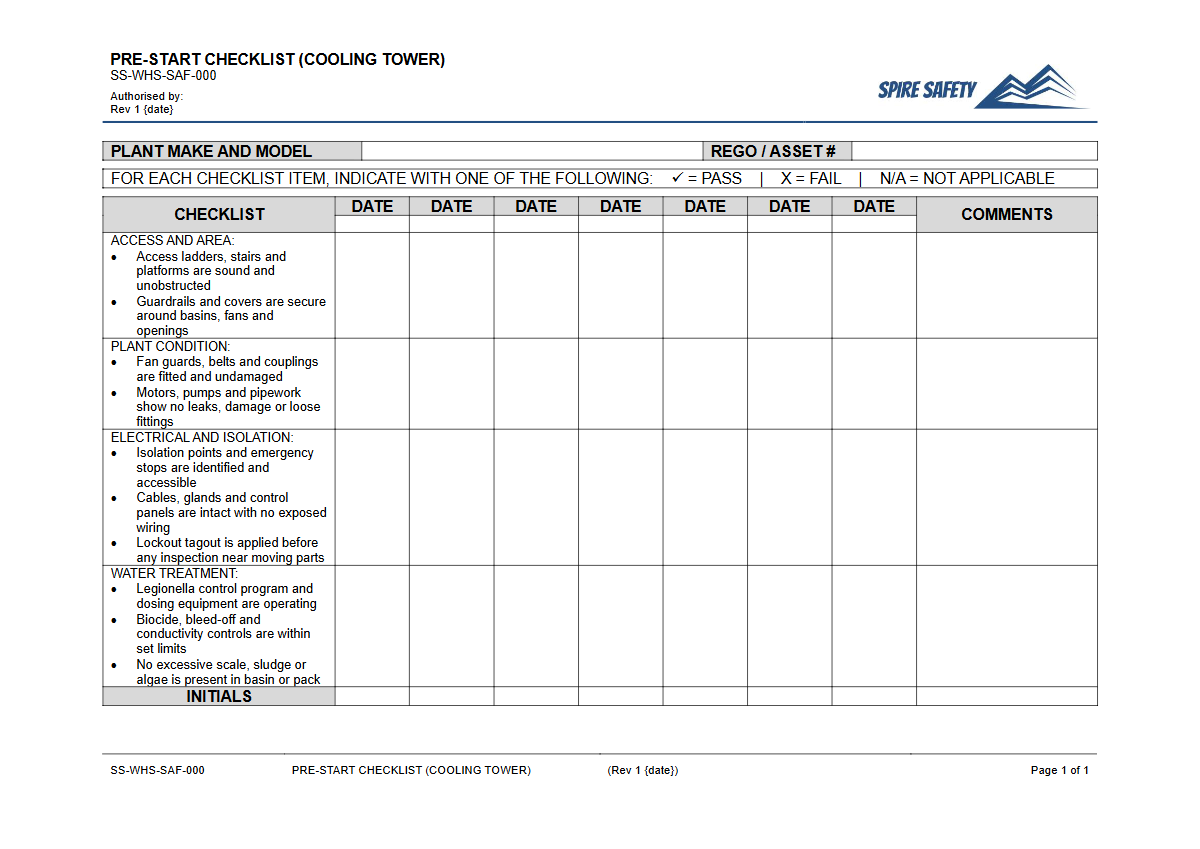
Download our free Pre-Start Checklist (Cooling Tower) Template. This DOCX & PDF resource helps formalise daily safety inspections and manage WHS risks.
Free Pre-Start Checklist (Cooling Tower) Template
DOCX • 125 KB + PDF
Updated Oct 2026
No signup required
Purpose of the Free Pre-Start Checklist (Cooling Tower) Template
Cooling towers present significant health and safety risks if not managed correctly, most notably the risk of Legionella bacteria growth, but also hazards associated with moving parts, water treatment chemicals, and structural integrity. This Free Pre-Start Checklist (Cooling Tower) Template provides a structured starting point for organisations to formalise their daily inspection process.
Using this checklist helps operators and maintenance personnel systematically verify that safety controls are in place and the equipment is safe to operate before each use.
Implementing regular, documented checks demonstrates safety diligence and forms a crucial component of your overall site safety procedures. This process helps in the early identification of faults, preventing potential equipment failure, reducing the risk of disease outbreak, and ensuring a safer working environment.
Formal pre-start checks are a fundamental part of effective WHS management systems, providing a practical tool to meet your duty of care.
Video walkthrough
How to use the Free Pre-Start Checklist (Cooling Tower) Template
This template is provided in both DOCX and PDF formats for your convenience. The DOCX version is fully editable, allowing for comprehensive customisation to suit the specific make, model, and configuration of the cooling towers at your workplace, as well as your operational context and risk profile.
To effectively implement the checklist:
- Download the template and add your company branding and specific site details.
- Review and adapt the checklist items to align with the manufacturer’s instructions and your own risk assessments. Consider adding or removing checks specific to your equipment.
- Train all relevant personnel, including operators and supervisors, on how to correctly complete the checklist and the procedures to follow if a fault or non-conformance is identified.
- Integrate the completed checklists into your record-keeping system as evidence of your safety management activities. A good way to introduce this process is with a dedicated Pre-Start Checks and Plant Maintenance Toolbox Talk.
Important: This is a template only. We are not familiar with your unique operational environment.
You must review, edit, and customise this document to ensure it is suitable for the specific plant, tasks, and risks present in your workplace.
When to use it
A pre-start checklist for a cooling tower should be completed before the equipment is started for the first time each day or at the beginning of each shift. It is also critical to perform these checks after any period of shutdown, following maintenance or repair work, or after an extreme weather event that could have affected the tower's integrity or operation.
This regular frequency ensures that the equipment's condition is consistently monitored and that any developing issues are caught before they escalate.
Who should use it
The pre-start check must be carried out by a person who is competent to do so. This typically means an authorised operator or a maintenance technician who has received specific training on the cooling tower system.
They must be able to recognise potential defects or hazards and understand the immediate actions required if a fault is found. Supervisors should also be familiar with the checklist to effectively oversee the process and verify its completion.
Competency can be formally confirmed using tools like a Verification of Competency for a tower crane, adapted for your specific plant.
Key Inspection Areas for a Cooling Tower
While your customised checklist will be more detailed, key areas for inspection should always include:
- Water System: Check water levels, look for leaks, and verify that water treatment dosing systems are operational.
- Mechanical Components: Inspect the fan, motor, and gearbox for unusual noises, vibration, or signs of wear. Ensure machine guards are secure.
- Structural Integrity: Check the basin, fill, and casing for damage, corrosion, or blockages.
- Drift Eliminators: Ensure they are clean, in good condition, and correctly fitted to minimise aerosol drift.
- Access and Surrounds: Verify that access ladders and platforms are secure and that the surrounding area is clear of obstructions and slip hazards.
Each piece of plant requires its own set of checks, which should be formalised in a dedicated procedure, similar to a Lighting Tower SOP (Safe Operating Procedure).
Integrating Checklists into Your Safety System
A pre-start checklist is not a stand-alone solution. It is a tool that supports your broader WHS framework.
The information gathered from these checks should be used to inform your maintenance schedules, trigger corrective actions, and provide insights during safety reviews. Regularly reviewing completed checklists helps identify recurring faults or trends that may indicate a deeper issue with the equipment or process.
This data is invaluable during periodic WHS compliance auditing to verify that control measures are being consistently applied and are effective.
By embedding this practice into your daily operations, you create a proactive safety culture where potential issues are identified and addressed before they can cause harm. Explore our free WHS resources library for more templates to support your safety management system.
Common mistakes
Common mistakes to avoid
- Failing to customise the template for the specific cooling tower model and site risks.
- Operators 'pencil-whipping' the checklist without performing a thorough physical inspection.
- Not taking immediate corrective action when a fault or defect is identified during the check.
- Using untrained or unauthorised personnel to conduct the pre-start inspection.
Legal references
Legal considerations
The following legal requirements may be relevant to this type of work.
- Work Health and Safety Act (Harmonised) — Provides the primary duties for protecting workers and other people from work health and safety risks.
- Work Health and Safety Regulations (Harmonised) — Sets out requirements supporting the management of workplace hazards and risks.
The following codes may be relevant to this type of work.
- Managing WHS Risks Code of Practice — Provides practical guidance on identifying hazards, assessing risks and applying effective controls.
- Work Health and Safety Consultation, Cooperation and Coordination Code of Practice — Provides practical guidance on consulting workers and coordinating with other duty holders.
- Managing the Work Environment and Facilities Code of Practice — Provides practical guidance on safe work environments, workplace facilities and related controls.
Did you know
A Bacterial namesake
Legionnaires' disease was named after an outbreak in 1976 among people who attended an American Legion convention in Philadelphia. The source of the outbreak was later traced back to the bacterium Legionella pneumophila, which had spread through the hotel's air conditioning system's cooling tower.
Evaporation at Work
Cooling towers work on the principle of evaporative cooling. By evaporating a small portion of the water circulating through the unit, they can significantly cool the rest of the water, releasing waste heat from a process or building into the atmosphere.
FAQ
Frequently asked questions
01What is the primary health risk associated with cooling towers?
02How often should a cooling tower pre-start check be performed?
03Is this Pre-Start Checklist template a legal document?
04Who is considered a 'competent person' to conduct a cooling tower inspection?
Share this resource
Free Pre-Start Checklist (Cooling Tower) Template
Browse Categories
How To Use It
- 1Download and open in Word or PDF.
- 2Replace the placeholders with your business details.
- 3Get it reviewed by a WHS specialist before rollout.
Need it customised?
Our WHS consultants can adapt this template to your site, run a gap analysis, or audit what you already have in place.
Book a Free Consultation WHS consulting servicesor call 1300 156 382