
Free Pre-Start Checklist (Core Drill) Template
Download our Free Pre-Start Checklist (Core Drill) Template. This structured DOCX & PDF helps formalise daily equipment checks and manage WHS risks.
Free Pre-Start Checklist (Core Drill) Template
DOCX • 125 KB + PDF
Updated Oct 2026
No signup required
Purpose of the Free Pre-Start Checklist (Core Drill) Template
A core drill is a powerful piece of equipment used in construction and trade services for creating precise holes in concrete, masonry, and stone. The risks associated with its use, including electric shock, excessive vibration, noise, and exposure to silica dust, are significant.
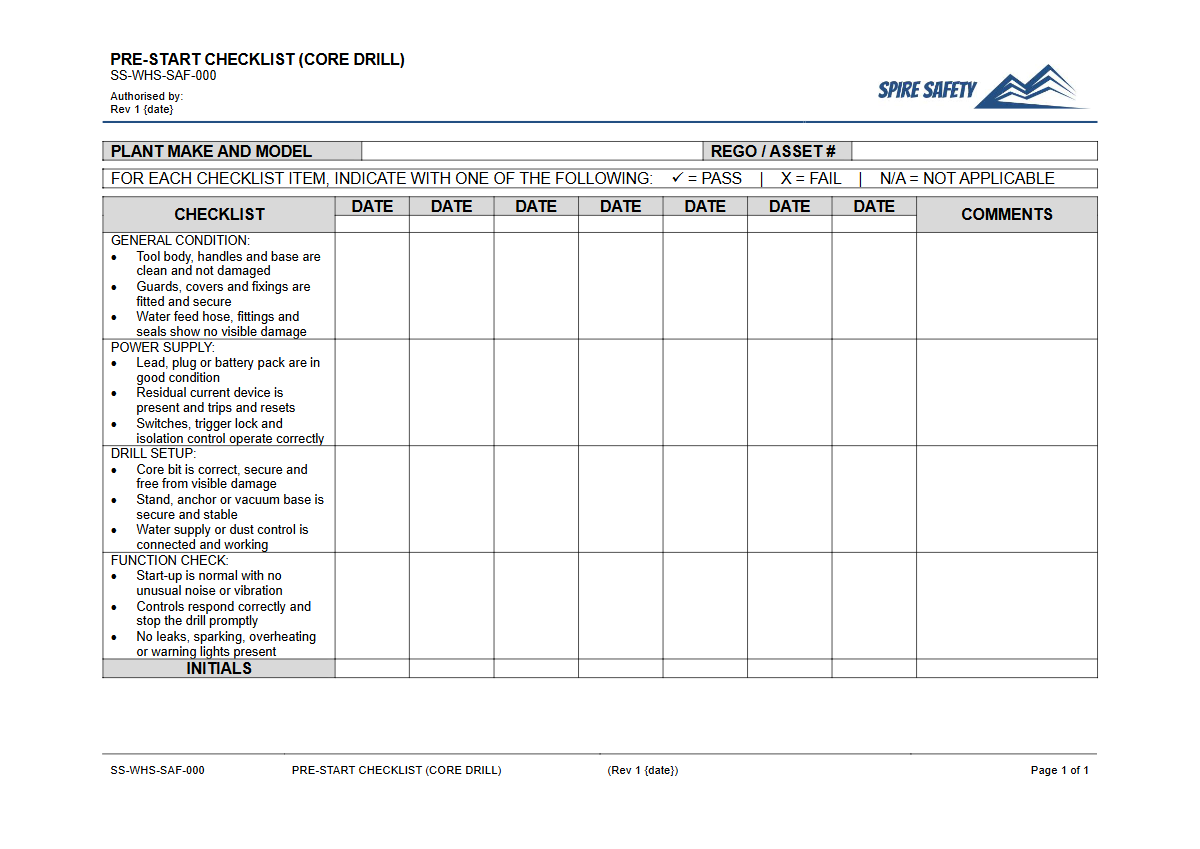
This Free Pre-Start Checklist (Core Drill) Template provides a structured framework for operators to conduct thorough, consistent safety inspections before commencing work. Using a pre-start checklist is a practical way to identify potential faults or hazards, ensure safety controls are functional, and document the equipment's fitness for use.
It serves as a critical component of a safe system of work, helping Persons Conducting a Business or Undertaking (PCBU) meet their WHS duties.
Formalising this process helps create a safety-conscious culture where equipment checks are not overlooked. The checklist prompts operators to inspect key components like power cords, residual current devices (RCDs), water-feed systems for dust suppression, guards, and handles.
For organisations managing multiple types of drilling equipment, it can be useful to standardise procedures across similar plant, such as by using our Free Pre-Start Checklist (Drill Press) Template for fixed workshop machinery.
Video walkthrough
How to use the Free Pre-Start Checklist (Core Drill) Template
This template is designed for immediate use and customisation. After downloading the DOCX or PDF file, you should adapt it to your specific operational needs.
This involves adding your company name and logo, and more importantly, tailoring the checklist items to the exact makes and models of core drills used by your team. Different models have unique features, controls, and maintenance requirements that a generic checklist might miss.
Integrate the customised checklist into your daily operational procedures. Ensure all operators are trained not just on how to use the core drill, but also on the importance and proper completion of the pre-start inspection.
The completed forms should be collected and stored as part of your safety records. These records are invaluable for demonstrating due diligence, tracking equipment condition over time, and identifying recurring issues. Incorporating such documents is a cornerstone of robust WHS management systems.
Please note: This document is a template and a starting point. We recommend you customise it to address the specific equipment, tasks, and hazards present in your unique work environment to ensure it is fit for purpose.
When to use it
A core drill pre-start check should be completed by the operator at the beginning of every shift or before the equipment is used for the first time each day. It should also be performed if a new operator takes over the drill mid-shift.
The goal is to catch any defects or damage that may have occurred during transport, storage, or previous use before the equipment is energised. Consistency is key; the checklist should be a non-negotiable part of the daily routine for anyone operating a core drill. This process is similar for other heavy-duty equipment, like that covered in our Free Pre-Start Checklist (Drill Rig) Template.
Who should use it
The pre-start checklist should be completed by a worker who is competent to operate the core drill. Competency involves more than just knowing how to drill a hole; it means the person has received adequate information, training, and instruction on the specific model, its hazards, and the control measures required to use it safely.
Supervisors and safety officers should also be familiar with the checklist to verify that inspections are being completed correctly and to follow up on any reported faults. Regular reviews of completed checklists can highlight gaps in training or recurring mechanical problems, which can be a focus area for future WHS compliance auditing.
If your organisation faces complex safety challenges or requires assistance in developing comprehensive safety procedures, engaging external experts can provide clarity and direction. Spire Safety offers WHS consulting services to help businesses refine their safety systems and ensure they are practical and effective. For more ready-to-use templates and guides, feel free to browse our complete free WHS resources library.
Common mistakes
Common mistakes to avoid
- Using a generic checklist without customising it for the specific drill model and task.
- Performing a 'tick and flick' exercise without physically and visually checking each item.
- Failing to immediately tag out and remove faulty equipment from service.
- Overlooking checks on critical safety features like RCDs, water suppression systems, or emergency stops.
Legal references
Legal considerations
The following legal requirements may be relevant to this type of work.
- Work Health and Safety Act (Harmonised) — Provides the primary duties for protecting workers and other people from work health and safety risks.
- Work Health and Safety Regulations (Harmonised) — Sets out requirements supporting the management of workplace hazards and risks.
The following codes may be relevant to this type of work.
- Managing WHS Risks Code of Practice — Provides practical guidance on identifying hazards, assessing risks and applying effective controls.
- Work Health and Safety Consultation, Cooperation and Coordination Code of Practice — Provides practical guidance on consulting workers and coordinating with other duty holders.
- Managing the Work Environment and Facilities Code of Practice — Provides practical guidance on safe work environments, workplace facilities and related controls.
Did you know
Silica Dust Hazard
Respirable crystalline silica dust, generated when core drilling through concrete or masonry, is a significant occupational health risk. An effective water-feed system is a primary control measure to suppress dust at the source.
Vibration Risk
Hand-Arm Vibration Syndrome (HAVS) is a permanent and debilitating condition caused by frequent exposure to vibration. Checking that a core drill's anti-vibration features are intact and functioning is a critical part of the pre-start inspection.
FAQ
Frequently asked questions
01What is a core drill pre-start checklist for?
02Is using a pre-start checklist a legal requirement in Australia?
03What are the main hazards associated with core drills?
04How often should I inspect a core drill?
Share this resource
Free Pre-Start Checklist (Core Drill) Template
Browse Categories
How To Use It
- 1Download and open in Word or PDF.
- 2Replace the placeholders with your business details.
- 3Get it reviewed by a WHS specialist before rollout.
Need it customised?
Our WHS consultants can adapt this template to your site, run a gap analysis, or audit what you already have in place.
Book a Free Consultation WHS consulting servicesor call 1300 156 382