
Free Pre-Start Checklist (Jackhammer) Template
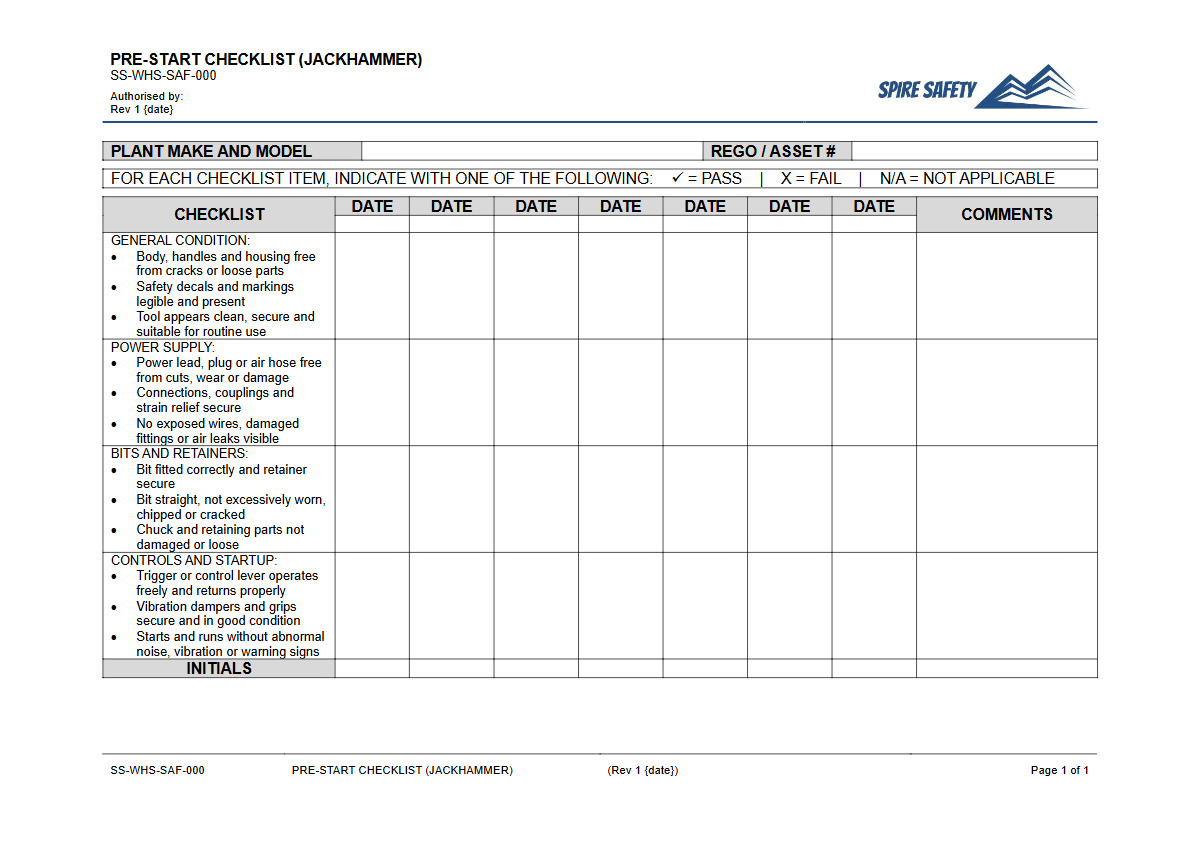
Download our free Pre-Start Checklist (Jackhammer) Template to formalise daily equipment checks and manage WHS risks. Get your structured DOCX & PDF now.
Free Pre-Start Checklist (Jackhammer) Template
DOCX • 125 KB + PDF
Updated Oct 2026
No signup required
Purpose of the Free Pre-Start Checklist (Jackhammer) Template
Operating a jackhammer introduces significant workplace hazards, including hand-arm vibration, noise, airborne contaminants like silica dust, and ergonomic strains. This Free Pre-Start Checklist (Jackhammer) Template provides a structured framework for operators to conduct thorough, documented inspections before each use.
Formalising this process helps identify and control risks, prevent equipment failure, and ensure the machinery is in safe working order. Integrating such checklists is a fundamental component of a robust WHS management system, demonstrating a proactive approach to safety and due diligence.
Key Benefits
- Hazard Identification: Systematically checks for common faults, damage, or wear that could lead to injury.
- Operator Accountability: Creates a clear record that the operator has inspected the equipment and deemed it safe for use.
- Maintenance Trigger: Serves as an early warning system, highlighting minor issues before they escalate into major failures or non-compliance.
- Documentation: Provides tangible evidence of safety procedures being followed, which is crucial during incident investigations or safety audits.
Video walkthrough
How to use the Free Pre-Start Checklist (Jackhammer) Template
This document is a template designed as a starting point. It requires customisation to align with the specific jackhammer models (e.g., pneumatic, electric, hydraulic) used in your workplace, the tasks being performed, and your operational risks.
First, download the template in your preferred format (DOCX for easy editing or PDF). Then, review and adapt the checklist items with a competent person familiar with both the equipment and the relevant safety standards.
Important Note: This is a generic template that must be customised. We recommend a person with appropriate knowledge of your plant, equipment, and WHS risks review and approve the final document.
The checklist should incorporate the manufacturer’s specific operating and maintenance instructions. For complex environments or high-risk work, engaging expert WHS consulting can help ensure your safety documentation is comprehensive and effective.
When to use a Jackhammer Pre-Start Checklist
A pre-start check should be completed by the operator at the beginning of each shift or before the jackhammer is used for the first time that day. For equipment subjected to heavy use or harsh conditions, an additional check may be warranted after a break or if the equipment is transferred between operators.
The completed checklists should be stored in accordance with your organisation's record-keeping policies. Regular reviews of these records can help identify recurring faults or patterns of damage, informing your maintenance schedules and procurement decisions. The effectiveness of this process can be verified through regular WHS compliance auditing.
Who should use it
The pre-start checklist must be completed by a worker who is competent to operate the jackhammer. Competence is defined by a combination of training, skill, and experience.
The Person Conducting a Business or Undertaking (PCBU) is responsible for ensuring that workers are provided with adequate information, training, and instruction on how to safely operate the plant and how to conduct a proper pre-start inspection. The same principles of pre-use inspection apply to other high-risk construction equipment, as detailed in resources like our Pre-Start Checklist for Floor Saws.
Integrating with Other Safety Procedures
A pre-start checklist does not exist in isolation. It should function as part of a wider safety framework that includes:
- Safe Work Method Statements (SWMS): For high-risk construction work involving a jackhammer, a SWMS will be required to outline the hazards and control measures for the task.
- Operator Training and Competency Records: The pre-start is a check on the equipment; records must also be kept to verify the operator's competence.
- Maintenance and Repair Logs: Any faults identified during the pre-start check must be reported and documented. The equipment should be tagged out of service and the issue recorded in a maintenance log for action by a qualified person.
This systematic approach is essential for managing all types of workplace equipment, from heavy machinery to workshop tools. For instance, a similar inspection process is vital for tools that present different hazards, which is why we also provide resources like our Pre-Start Checklist (Bench Grinder) Template. You can explore our full range of document templates in our free WHS resources library to support your safety programs.
Common mistakes
Common mistakes to avoid
- Ticking boxes on the checklist without physically inspecting the item.
- Failing to report minor faults, which can escalate into major safety issues.
- Neglecting to remove a faulty jackhammer from service and tag it appropriately.
- Using a generic checklist that doesn't match the specific model or type of jackhammer.
Legal references
Legal considerations
The following legal requirements may be relevant to this type of work.
- Work Health and Safety Act (Harmonised) — Provides the primary duties for protecting workers and other people from work health and safety risks.
- Work Health and Safety Regulations (Harmonised) — Sets out requirements supporting the management of workplace hazards and risks.
The following codes may be relevant to this type of work.
- Managing WHS Risks Code of Practice — Provides practical guidance on identifying hazards, assessing risks and applying effective controls.
- Work Health and Safety Consultation, Cooperation and Coordination Code of Practice — Provides practical guidance on consulting workers and coordinating with other duty holders.
- Managing the Work Environment and Facilities Code of Practice — Provides practical guidance on safe work environments, workplace facilities and related controls.
Did you know
Vibration Risk
Hand-Arm Vibration Syndrome (HAVS) is a serious and disabling condition caused by prolonged exposure to vibration. It can cause permanent damage to nerves, blood vessels, and joints in the hands and arms.
Invention
The first patent for a pneumatic tool, a forerunner to the modern jackhammer, was granted to Samuel W. Mower in 1849. However, the first commercially successful tool was developed by Charles Brady King in the 1890s.
FAQ
Frequently asked questions
01What are the main hazards of using a jackhammer?
02How often should a jackhammer pre-start check be done?
03Who is responsible for providing training on jackhammer use?
04Can this template be used for other types of demolition equipment?
Share this resource
Free Pre-Start Checklist (Jackhammer) Template
Browse Categories
How To Use It
- 1Download and open in Word or PDF.
- 2Replace the placeholders with your business details.
- 3Get it reviewed by a WHS specialist before rollout.
Need it customised?
Our WHS consultants can adapt this template to your site, run a gap analysis, or audit what you already have in place.
Book a Free Consultation WHS consulting servicesor call 1300 156 382