
Free Pre-Start Checklist (Ironing Press) Template
Download our free Pre-Start Checklist (Ironing Press) Template.
Free Pre-Start Checklist (Ironing Press) Template
DOCX • 125 KB + PDF
Updated Oct 2026
No signup required
Purpose of the Free Pre-Start Checklist (Ironing Press) Template
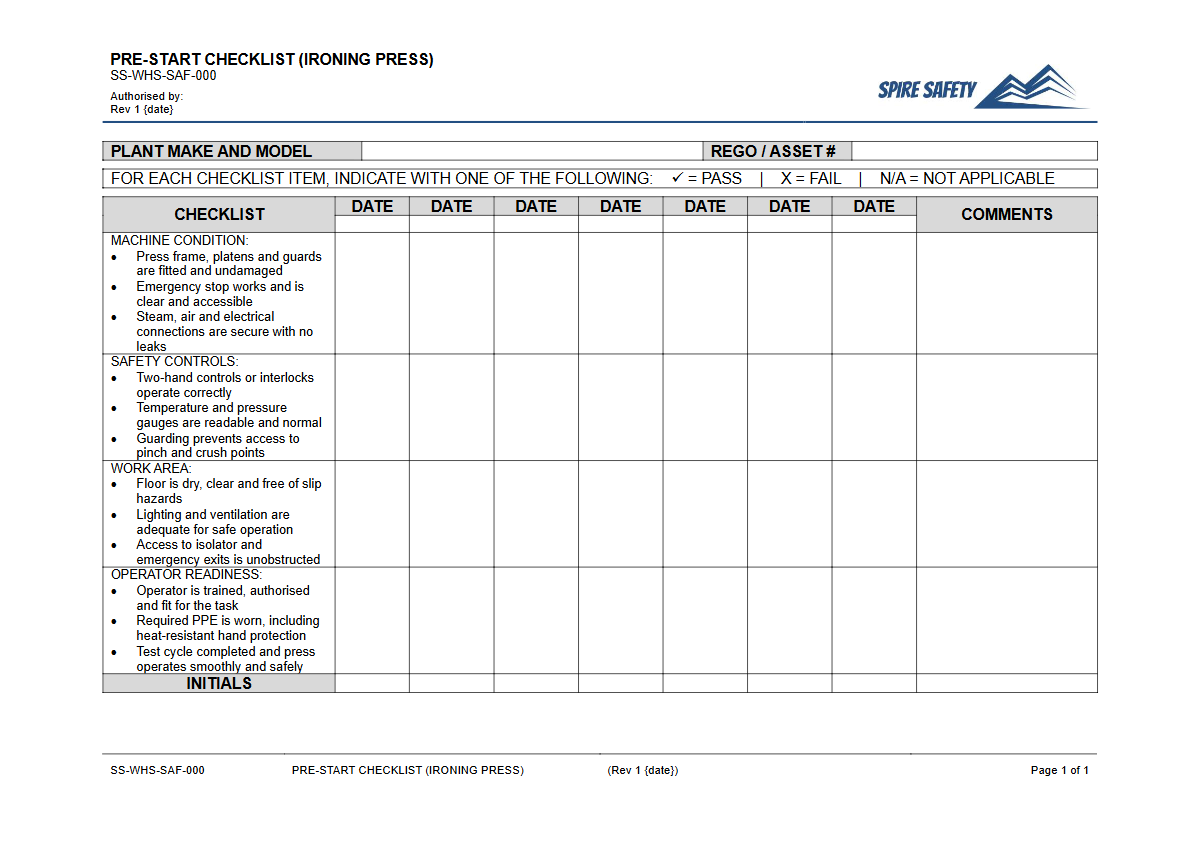
The primary purpose of this checklist is to provide a formal record that an ironing press was in a safe condition at the beginning of a shift. Ironing presses pose significant risks, including severe burns from heated surfaces, crushing injuries from the pressing mechanism, and electrical hazards.
A systematic check helps ensure that safety guards, emergency stops, temperature controls, and electrical components are functioning correctly. By documenting these checks, a Person Conducting a Business or Undertaking (PCBU) can demonstrate due diligence in managing plant-related risks.
While this checklist is for pre-operational checks, a comprehensive safety approach also requires documented safe work processes, such as those found in a free Hydraulic Press SOP (Safe Operating Procedure) Template, which can be adapted for similar machinery.
Regularly completing this Pre-Start Checklist also contributes to a proactive safety culture. It encourages operators to be actively involved in their own safety and helps in the early detection of wear and tear, which can prevent costly breakdowns and extend the life of the equipment.
These documented checks are invaluable during incident investigations or WHS compliance audits as evidence of risk management practices.
Video walkthrough
How to use the Free Pre-Start Checklist (Ironing Press) Template
Using this template effectively involves more than just downloading and printing it. Follow these steps to integrate it into your safety management system:
- Download and Customise: The template is a general guide. You must adapt it to the specific make and model of the ironing press(es) in your workplace, considering unique features, attachments, and known risks. Important Note: We provide this template as a starting point. It is your responsibility to ensure it is customised to reflect the specific hazards and control measures relevant to your site and equipment.
- Train Your Team: Operators must be trained on how to properly conduct each check. Explain the 'why' behind each item, what to look for, and the procedure for reporting faults. A practical way to deliver this training is through a hands-on session, which can be documented using a Pre-Start Checks and Plant Maintenance Toolbox Talk Template.
- Implement and Monitor: Make the checklists readily available at the location of the equipment. Supervisors should periodically monitor that checks are being completed thoroughly and not just "ticked and flicked."
- Review and Update: The checklist should be reviewed regularly and updated whenever there are changes to the equipment, procedures, or after an incident occurs.
When to use it
This Pre-Start Checklist should be completed before the first use of the ironing press on any given day or at the beginning of each new operator's shift. This ensures that the equipment's condition is verified before it is put into operation, minimising the risk of an incident occurring due to a pre-existing fault.
Completing the checklist should be a non-negotiable step in the daily workflow. These daily checks are a practical component of broader WHS management systems, which provide the overarching framework for safety governance in an organisation.
Who should use it
The checklist is designed to be completed by the competent operator assigned to use the ironing press. This individual has the most direct interaction with the equipment and is best placed to notice any changes or potential issues.
Verifying that an operator is competent to both use the machinery and conduct the checks is a critical WHS duty. While this template focuses on the equipment, other documents like our Free Drill Press VOC (Verification of Competency) Template provide a framework for assessing operator skill, which can be adapted for various types of plant.
Supervisors and Managers
Supervisors or managers have a responsibility to ensure the checks are being performed correctly and consistently. They should review completed checklists, identify any recurring faults that may indicate a need for more significant maintenance, and ensure that any reported issues are addressed promptly and effectively before the equipment is returned to service.
Maintenance Personnel
Maintenance staff will be involved when a fault is identified that requires repair. The completed checklist provides them with valuable information about the nature of the fault, helping to diagnose and resolve the issue more efficiently.
They are also responsible for signing off that the equipment is safe to use following a repair.
Common mistakes
Common mistakes to avoid
- Using a generic checklist that doesn't cover model-specific features or known hazards.
- Operators 'pencil-whipping' the checklist without physically inspecting the items.
- Failing to take faulty equipment out of service immediately after a failed check.
- Poor record-keeping, making it difficult to track recurring faults or demonstrate due diligence.
Legal references
Legal considerations
The following legal requirements may be relevant to this type of work.
- Work Health and Safety Act (Harmonised) — Provides the primary duties for protecting workers and other people from work health and safety risks.
- Work Health and Safety Regulations (Harmonised) — Sets out requirements supporting the management of workplace hazards and risks.
The following codes may be relevant to this type of work.
- Managing WHS Risks Code of Practice — Provides practical guidance on identifying hazards, assessing risks and applying effective controls.
- Work Health and Safety Consultation, Cooperation and Coordination Code of Practice — Provides practical guidance on consulting workers and coordinating with other duty holders.
- Managing the Work Environment and Facilities Code of Practice — Provides practical guidance on safe work environments, workplace facilities and related controls.
Did you know
Heat and Pressure
Commercial ironing presses can reach temperatures over 200°C and exert significant force, making them a major source of burn and crush injuries in laundry and textile industries.
Guarding is Key
Inadequate or missing machine guarding is one of the most frequently cited safety breaches during regulatory inspections involving press-type machinery.
FAQ
Frequently asked questions
01What are the key hazards of an industrial ironing press?
02Is a digital pre-start checklist acceptable in Australia?
03How often should an ironing press be professionally serviced?
04What should an operator do if they find a fault during a pre-start check?
Share this resource
Free Pre-Start Checklist (Ironing Press) Template
Browse Categories
How To Use It
- 1Download and open in Word or PDF.
- 2Replace the placeholders with your business details.
- 3Get it reviewed by a WHS specialist before rollout.
Need it customised?
Our WHS consultants can adapt this template to your site, run a gap analysis, or audit what you already have in place.
Book a Free Consultation WHS consulting servicesor call 1300 156 382