
Free Pre-Start Checklist (Irrigation Pump) Template
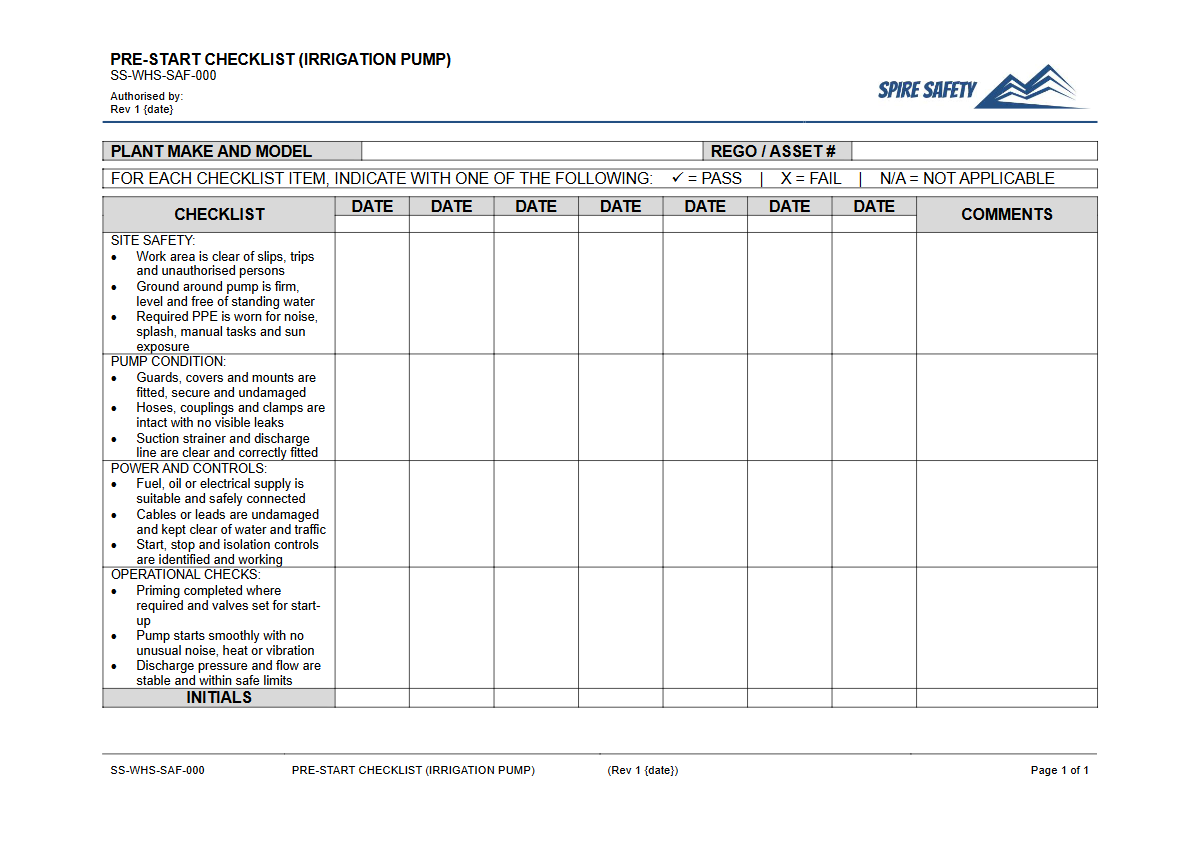
Download our free Pre-Start Checklist (Irrigation Pump) Template to formalise daily equipment checks. This structured DOCX & PDF helps ensure safe operation.
Free Pre-Start Checklist (Irrigation Pump) Template
DOCX • 125 KB + PDF
Updated Oct 2026
No signup required
Purpose of the Free Pre-Start Checklist (Irrigation Pump) Template
Regularly inspecting agricultural and industrial equipment is a cornerstone of a safe workplace. This Free Pre-Start Checklist (Irrigation Pump) Template provides a structured format for operators to verify the condition of an irrigation pump before use.
Consistent checks help identify potential faults, mechanical issues, or electrical hazards before they can cause injury or costly equipment failure. Using a formal checklist helps embed a safety-first routine, ensuring that critical components like guards, wiring, hoses, and emergency stops are in safe working order every time.
The primary goal is to formalise the process of risk identification at the operator level. By documenting these daily checks, you create a record of due diligence and gain valuable insights into the equipment's condition over time.
This process is a practical step in fulfilling your duty of care and is a fundamental component of a proactive safety culture. A thorough pre-start check is also the first step in a broader hazard management process, which should also include a comprehensive water pump risk assessment to identify and control all associated risks.
Video walkthrough
How to use the Free Pre-Start Checklist (Irrigation Pump) Template
This template is provided as a downloadable DOCX and PDF file designed for immediate use. After downloading, add your company name, logo, and other site-specific details.
The most critical step is to review and adapt the checklist items to match the specific make, model, and configuration of your irrigation pump, whether it is electric, diesel, or petrol-powered. Different pumps have unique components and failure points that must be addressed.
Important: This is a template only. We have provided a solid foundation based on common safety practices, but you must customise it to suit the unique hazards of your specific equipment and operating environment.
Integrating this checklist into a safe operating procedure (SOP) for pumps will ensure the inspection process is clearly defined and consistently followed by all operators.
When to use it
A pre-start checklist for an irrigation pump should be completed before the first use on any given day or at the beginning of an operator's shift. For pumps that run continuously, checks may be scheduled at regular intervals as determined by your risk assessment.
The goal is to catch issues early. Consistent, routine inspections are far more effective at preventing incidents than periodic, infrequent maintenance alone.
This habit is best reinforced through regular training and communication.
To further embed this behaviour, consider running sessions with your team to explain the 'why' behind each checkpoint. Our Pre-Start Checks and Plant Maintenance toolbox talk template can provide a useful structure for these important safety conversations, helping workers understand that these checks are not just a paperwork exercise but a critical safety function.
Who should use it
The pre-start check should be conducted by a person who is trained and competent in the safe operation of the specific irrigation pump. This is typically the operator assigned to use the equipment for that shift.
The operator must have sufficient knowledge to recognise potential defects or hazards, such as worn hoses, frayed electrical cords, or unusual noises. The results of the check should be reported to a supervisor, particularly if any faults are found that would make the pump unsafe to operate.
Ensuring that operators are competent is a key part of your safety obligations. This checklist forms one small part of your broader WHS management system, which should also encompass training records, maintenance logs, and incident reporting procedures to provide a complete picture of plant safety. The effectiveness of these procedures can be verified through periodic WHS compliance audits.
What to include in your checklist
When customising your checklist, consider including sections that cover the following key areas:
- General Condition: Check for signs of damage, leaks (fuel, oil, or water), or corrosion on the pump housing and frame.
- Guarding: Ensure all guards for moving parts (e.g., belts, pulleys, drive shafts) are in place, secure, and undamaged.
- Electrical Components (if applicable): Inspect power cords for damage, ensure plugs and sockets are in good condition, and check that residual current devices (RCDs) are tested and functioning.
- Fuel & Fluid Levels (if applicable): Check fuel, oil, and coolant levels for diesel or petrol engines.
- Hoses & Fittings: Look for cracks, bulges, or abrasion on suction and discharge hoses. Ensure all couplings and fittings are secure.
- Controls & Emergency Stop: Verify that all operating controls and emergency stop mechanisms are clearly labelled and function correctly.
- Work Area: Check the surrounding area for slip or trip hazards, ensure adequate lighting, and confirm the pump is on stable, level ground.
These checks should work in harmony with the instructions outlined in your SOP for the broader irrigation system to ensure a holistic approach to safety on site. For a wider selection of safety documents, explore our complete free WHS resources library.
Common mistakes
Common mistakes to avoid
- "Pencil-whipping" the checklist without physically inspecting each item.
- Failing to customise the generic template for the specific pump model and work environment.
- Neglecting to remove a faulty pump from service immediately after a failed check.
- Forgetting to check the surrounding area for slip, trip, and electrical hazards before starting the pump.
Legal references
Legal considerations
The following legal requirements may be relevant to this type of work.
- Work Health and Safety Act (Harmonised) — Provides the primary duties for protecting workers and other people from work health and safety risks.
- Work Health and Safety Regulations (Harmonised) — Sets out requirements supporting the management of workplace hazards and risks.
The following codes may be relevant to this type of work.
- Managing WHS Risks Code of Practice — Provides practical guidance on identifying hazards, assessing risks and applying effective controls.
- Work Health and Safety Consultation, Cooperation and Coordination Code of Practice — Provides practical guidance on consulting workers and coordinating with other duty holders.
- Managing the Work Environment and Facilities Code of Practice — Provides practical guidance on safe work environments, workplace facilities and related controls.
Did you know
Water Pressure Hazard
High-pressure water from a damaged hose or fitting can inject fluid under the skin, causing severe injuries that require immediate medical attention.
Maintenance Link
Consistently completed pre-start checklists provide valuable data for your preventive maintenance program, helping you predict and prevent equipment failures before they happen.
FAQ
Frequently asked questions
01Why are pre-start checks for irrigation pumps important?
02What should I do if I find a fault during a pre-start check?
03How often should an irrigation pump pre-start check be performed?
04Does this template cover all types of irrigation pumps?
Share this resource
Free Pre-Start Checklist (Irrigation Pump) Template
Browse Categories
How To Use It
- 1Download and open in Word or PDF.
- 2Replace the placeholders with your business details.
- 3Get it reviewed by a WHS specialist before rollout.
Need it customised?
Our WHS consultants can adapt this template to your site, run a gap analysis, or audit what you already have in place.
Book a Free Consultation WHS consulting servicesor call 1300 156 382