
Free Pre-Start Checklist (Induction Hob) Template
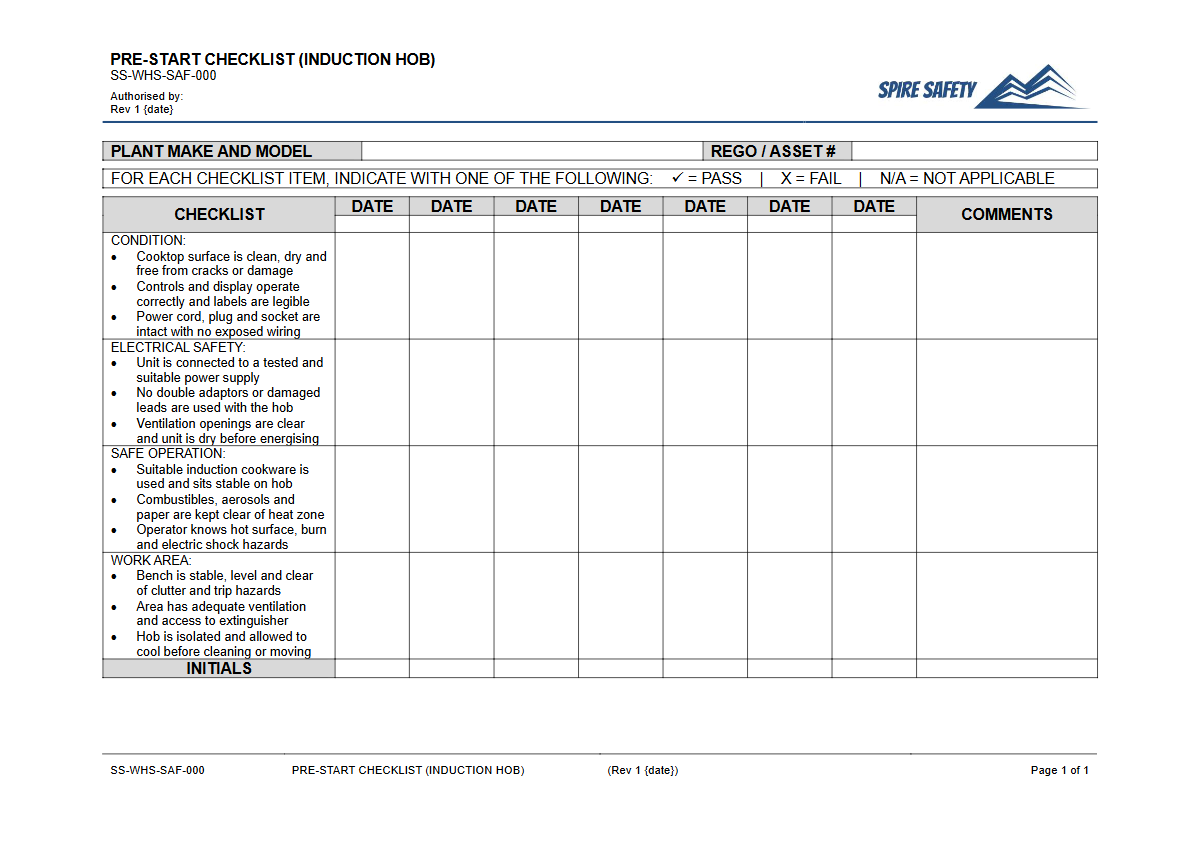
Formalise daily kitchen equipment inspections with our Free Pre-Start Checklist (Induction Hob) Template. Aligned with Australian WHS standards. Download now.
Free Pre-Start Checklist (Induction Hob) Template
DOCX • 125 KB + PDF
Updated Oct 2026
No signup required
Purpose of the Free Pre-Start Checklist (Induction Hob) Template
Operating any form of cooking equipment in a commercial environment carries inherent risks. This Free Pre-Start Checklist (Induction Hob) Template provides a structured starting point for formalising daily safety inspections of your induction cooktops.
Regular, documented checks are a critical component of any workplace safety program, helping to identify potential hazards such as electrical faults, damaged cooking surfaces, or malfunctioning controls before they can cause injury or property damage. By integrating this checklist into your daily routine, you create a verifiable record of due diligence and promote a proactive safety culture among kitchen staff.
Implementing consistent pre-start checks helps ensure equipment is safe and ready for use, minimising downtime and reducing the risk of incidents like burns or electrical shocks. These procedures form a fundamental part of more comprehensive WHS management systems, demonstrating a commitment to providing a safe working environment as required by Australian WHS legislation.
This template helps you standardise that process, ensuring every operator performs the same essential checks every time.
Video walkthrough
How to use the Free Pre-Start Checklist (Induction Hob) Template
This template is provided in both DOCX and PDF formats to suit your operational needs. The DOCX version is fully editable, allowing for customisation to your specific equipment and workplace environment.
The PDF is ideal for printing and immediate use once you have finalised your checklist content.
Follow these steps to effectively implement the checklist:
- Download: Select the DOCX or PDF version of the template.
- Customise: Add your company name and logo. Review each checklist item and adapt it to match the specific make and model of your induction hob(s). Add or remove checks based on the manufacturer's recommendations and a workplace-specific risk assessment.
- Train: Ensure all relevant workers (e.g., chefs, kitchen hands) are trained on why the checks are important and how to complete each item correctly.
- Implement: Integrate the checklist into your daily opening procedures or at the start of each shift. Store completed checklists in a designated location for record-keeping and review.
- Review: Periodically review completed checklists to identify recurring faults or patterns that may indicate a need for maintenance or replacement.
Please note: We have created this document as a template to get you started. It is essential that you customise it to reflect the specific hazards, risks, and equipment in your workplace.
A generic document will not be sufficient to meet your safety duties.
When to use an Induction Hob Pre-Start Checklist
A pre-start checklist for an induction hob should be completed before its first use each day or at the beginning of every shift in a multi-shift operation. This frequency ensures that the equipment's condition is verified before it is exposed to the demands of a busy service period.
Conducting checks at the start of the day allows any identified faults to be reported and rectified before they can disrupt operations or create a hazard. Reinforcing this habit can be achieved with a dedicated Pre-Start Checks and Plant Maintenance Toolbox Talk to brief all staff on their responsibilities.
Who should use this Pre-Start Checklist
The person responsible for completing the pre-start checklist is typically the worker who will be operating the induction hob during the shift. This could be a chef, cook, or kitchen hand.
Empowering the direct user to conduct the check promotes ownership and a greater awareness of equipment condition. It is also good practice for a supervisor or manager to periodically review the completed checklists to ensure they are being filled out correctly and that any reported issues are being addressed promptly.
Ensuring staff understand how to use equipment safely is a key part of their initial training. Discussing the importance of WHS inductions with your team helps contextualise why procedures like pre-start checks are not just paperwork, but vital safety actions.
This checklist can serve as a practical tool during the induction and onboarding process for new kitchen staff. For businesses looking to improve their safety frameworks but unsure where to begin, engaging with specialist WHS consulting can provide tailored guidance and support.
Common mistakes
Common mistakes to avoid
- Using a generic checklist without customising it for the specific hob model.
- Ticking boxes without physically inspecting each item ('pencil-whipping').
- Failing to immediately tag out and report faulty equipment.
- Not retaining completed checklists as a record of inspection and maintenance history.
Legal references
Legal considerations
The following legal requirements may be relevant to this type of work.
- Work Health and Safety Act (Harmonised) — Provides the primary duties for protecting workers and other people from work health and safety risks.
- Work Health and Safety Regulations (Harmonised) — Sets out requirements supporting the management of workplace hazards and risks.
The following codes may be relevant to this type of work.
- Managing WHS Risks Code of Practice — Provides practical guidance on identifying hazards, assessing risks and applying effective controls.
- Work Health and Safety Consultation, Cooperation and Coordination Code of Practice — Provides practical guidance on consulting workers and coordinating with other duty holders.
- Managing the Work Environment and Facilities Code of Practice — Provides practical guidance on safe work environments, workplace facilities and related controls.
Did you know
Magnetic Cooking
Induction hobs don't use thermal conduction from a flame or electrical element. They generate an oscillating magnetic field that induces an electrical current in the pot itself, causing the cookware to heat up directly.
Surface Safety
While the cookware gets very hot, the glass-ceramic surface of an induction hob heats up only from residual contact with the pot. This makes it generally safer than traditional gas or electric cooktops, but cracked surfaces can still pose a significant electrical hazard.
FAQ
Frequently asked questions
01What is an induction hob pre-start check?
02Why are daily checks important for kitchen equipment?
03Can I use this template for any brand of induction hob?
04Who is responsible for actioning faults found on the checklist?
Share this resource
Free Pre-Start Checklist (Induction Hob) Template
Browse Categories
How To Use It
- 1Download and open in Word or PDF.
- 2Replace the placeholders with your business details.
- 3Get it reviewed by a WHS specialist before rollout.
Need it customised?
Our WHS consultants can adapt this template to your site, run a gap analysis, or audit what you already have in place.
Book a Free Consultation WHS consulting servicesor call 1300 156 382