
Free Pre-Start Checklist (Incubator) Template
Download our free Pre-Start Checklist for incubators.
Free Pre-Start Checklist (Incubator) Template
DOCX • 125 KB + PDF
Updated Oct 2026
No signup required
Purpose of the Free Pre-Start Checklist (Incubator) Template
An incubator is a critical piece of equipment in many laboratory, medical, and scientific settings, responsible for maintaining a stable environment for cell cultures, microbiological samples, or other sensitive materials. Failures can lead to the loss of valuable research, compromised patient diagnostics, or significant project delays.
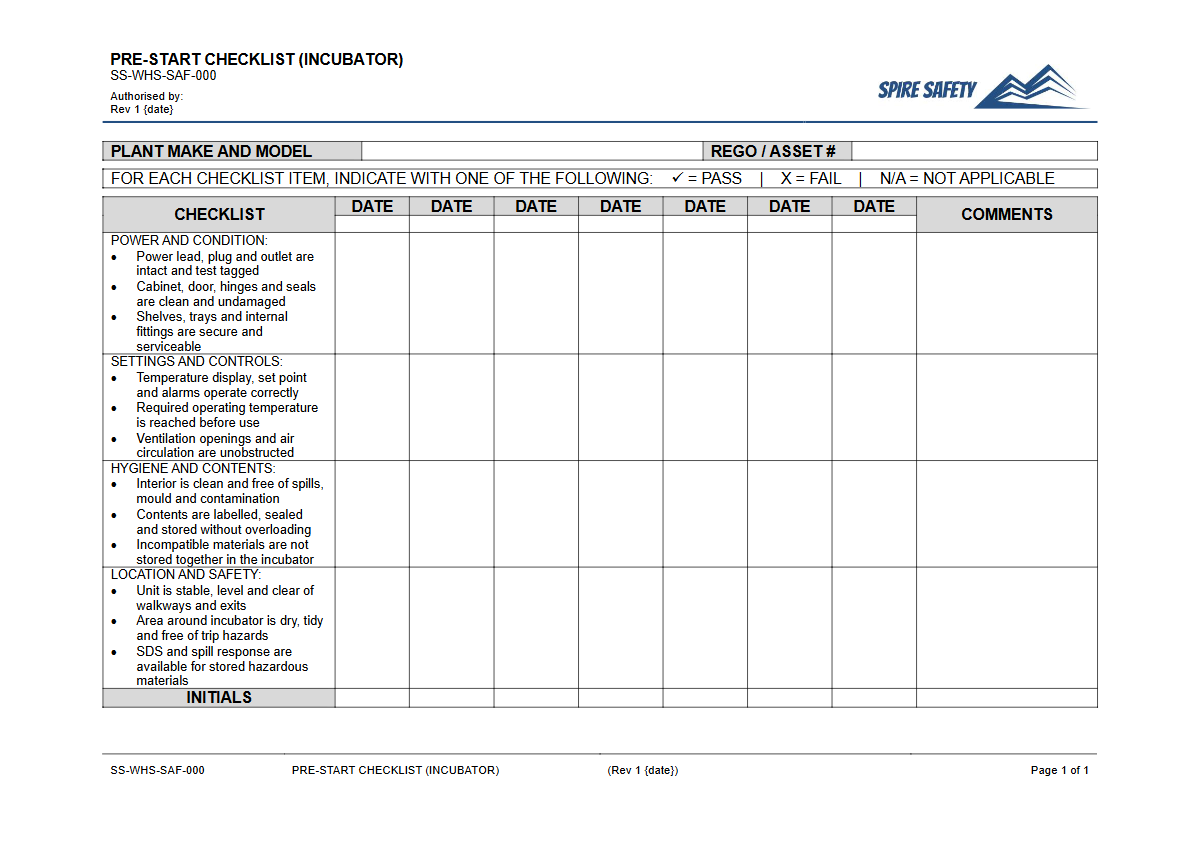
This free Pre-Start Checklist (Incubator) Template provides a structured method for operators to verify that the equipment is safe and ready for use before they begin work.
Implementing routine checks helps identify potential issues like faulty temperature controls, damaged door seals, or electrical hazards before they escalate. By formalising this process, organisations can improve equipment reliability, protect the integrity of their work, and demonstrate a commitment to proactive WHS management. A consistent inspection routine is a fundamental part of equipment safety, a principle you can reinforce with our Pre-Start Checks and Plant Maintenance Toolbox Talk Template.
Video walkthrough
How to use the Free Pre-Start Checklist (Incubator) Template
Using this template effectively involves a few simple steps. First, download the file in your preferred format.
The DOCX version is fully editable, allowing you to tailor the checklist to your specific needs, while the PDF is ready for immediate printing and use.
Next, it's essential to customise the document. This template provides a strong foundation based on common safety principles.
However, you must adapt it to reflect the specific make, model, and configuration of your incubator, as well as the unique risks present in your workplace. We cannot guarantee its suitability for your specific circumstances without this customisation.
Once customised, train all relevant personnel on how to complete the checklist correctly and what actions to take if they identify a fault. Integrating this process into your broader WHS management systems ensures consistency and accountability across all teams.
Key Elements of an Incubator Pre-Start Checklist
A thorough incubator check should cover several key areas to ensure both operational integrity and user safety. While your customised list will be more detailed, it should include points related to:
- External Inspection: Check for physical damage to the casing, ensure the unit is level and stable, and verify the surrounding area is clear of obstructions or flammable materials.
- Power and Electrical: Inspect the power cord and plug for any signs of damage, fraying, or wear. Confirm the unit is plugged securely into an appropriate outlet.
- Door and Seals: Examine the door seal for cracks, brittleness, or gaps that could compromise the internal atmosphere. Ensure the latching mechanism works correctly.
- Internal Components: Check that internal shelves are clean, secure, and correctly installed. Look for any signs of contamination or spills from previous use.
- Controls and Displays: Verify that the control panel is functioning, displays are legible, and that temperature, humidity, and CO2 settings are correct for the intended procedure.
- Alarms: If equipped, test the function of any audible or visual alarms (e.g., over-temperature, low CO2) according to the manufacturer's instructions. The level of detail required can vary, just as it does between this template and our Free Pre-Start Checklist (Coffee Grinder) Template.
When to use this Pre-Start Checklist
This Pre-Start Checklist should be completed before the first use of the incubator at the beginning of each day or shift. This frequency ensures that any issues that may have developed overnight, such as from a power fluctuation, are caught before new samples are introduced.
It may also be prudent to perform a check after maintenance, cleaning, relocation of the unit, or if an operational anomaly was previously observed.
Who should use this Pre-Start Checklist
The checklist is designed to be completed by the person operating the equipment. This includes laboratory technicians, research associates, students, and any other personnel who have been trained and authorised to use the incubator.
Direct responsibility empowers users to take ownership of their equipment's condition. Supervisors and lab managers should be responsible for ensuring the checks are being completed correctly and for reviewing the completed records.
These periodic reviews are essential to ensure the system is working effectively, which can be validated through a formal WHS compliance auditing process.
Properly documenting equipment safety checks is a key part of any robust safety framework. This template is one of many tools available in our comprehensive free WHS resources library to help you build a safer and more compliant workplace.
Common mistakes
Common mistakes to avoid
- Failing to customise the generic template for the specific incubator model.
- Ticking boxes on the checklist without physically performing the checks ("pencil-whipping").
- Not reporting identified faults or continuing to use malfunctioning equipment.
- Poor record-keeping, making it impossible to track recurring issues or demonstrate due diligence.
Legal references
Legal considerations
The following legal requirements may be relevant to this type of work.
- Work Health and Safety Act (Harmonised) — Provides the primary duties for protecting workers and other people from work health and safety risks.
- Work Health and Safety Regulations (Harmonised) — Sets out requirements supporting the management of workplace hazards and risks.
The following codes may be relevant to this type of work.
- Managing WHS Risks Code of Practice — Provides practical guidance on identifying hazards, assessing risks and applying effective controls.
- Work Health and Safety Consultation, Cooperation and Coordination Code of Practice — Provides practical guidance on consulting workers and coordinating with other duty holders.
- Managing the Work Environment and Facilities Code of Practice — Provides practical guidance on safe work environments, workplace facilities and related controls.
Did you know
Temperature Stability
Modern laboratory incubators can often maintain an internal temperature with a stability of ±0.1°C. This precision is critical for the viability of many cell cultures, where even minor fluctuations can ruin an experiment.
CO2 Levels
Many incubators use CO2 to maintain a stable pH in cell culture media, typically around 7.2 to 7.4. A faulty CO2 sensor or supply can be just as detrimental as incorrect temperature.
FAQ
Frequently asked questions
01What should be checked on an incubator before use?
02Why are pre-start checks for laboratory incubators important?
03How often should an incubator pre-start check be performed?
04Is this incubator checklist template compliant with Australian WHS laws?
Share this resource
Free Pre-Start Checklist (Incubator) Template
Browse Categories
How To Use It
- 1Download and open in Word or PDF.
- 2Replace the placeholders with your business details.
- 3Get it reviewed by a WHS specialist before rollout.
Need it customised?
Our WHS consultants can adapt this template to your site, run a gap analysis, or audit what you already have in place.
Book a Free Consultation WHS consulting servicesor call 1300 156 382