
Free Pre-Start Checklist (Impact Crush) Template
Formalise impact crusher safety inspections with our free, customisable template. Download the Pre-Start Checklist in DOCX and PDF to manage WHS risks.
Free Pre-Start Checklist (Impact Crush) Template
DOCX • 125 KB + PDF
Updated Oct 2026
No signup required
Purpose of the Free Pre-Start Checklist (Impact Crush) Template
Impact crushers are powerful machines used in quarrying, recycling, and demolition to reduce the size of materials. The high forces and moving parts involved present significant risks, including entanglement, crushing, unexpected movement, and exposure to noise and dust.
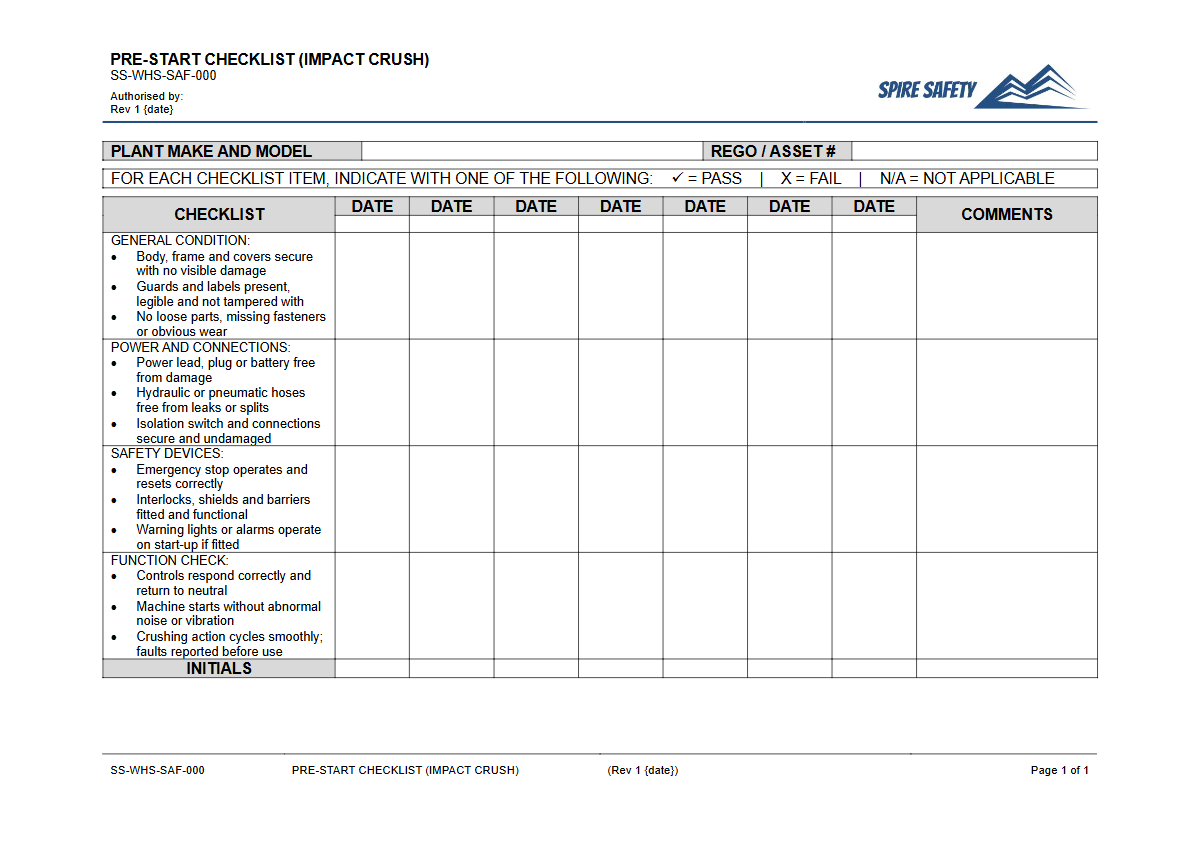
This Free Pre-Start Checklist (Impact Crush) Template provides a structured framework for operators to conduct thorough pre-operational inspections before each use.
Using this Pre-Start Checklist helps formalise the inspection process, ensuring that critical safety components are checked consistently. It serves as a record of inspection, aids in the early identification of faults or damage, and promotes a proactive safety culture.
Integrating such checks is a fundamental part of robust WHS management systems, helping your organisation meet its duty of care to provide safe plant and equipment.
Video walkthrough
How to use the Free Pre-Start Checklist (Impact Crush) Template
This document is a template designed as a starting point. To use it effectively, follow these steps:
- Download: Select your preferred format, either the editable DOCX or the ready-to-print PDF.
- Customise: This is the most critical step. You must adapt the checklist to the specific make, model, and configuration of the impact crusher(s) at your workplace. Review the manufacturer’s operating manual and your own risk assessments to add or remove items. Consider the operating environment and specific site hazards.
- Train: Ensure all operators are trained on how to use the customised checklist correctly. They must understand what each item refers to and the required standard for a 'pass'.
- Implement: Integrate the checklist into your daily operational procedures, making it a mandatory step before any impact crusher is started.
While this checklist is for impact crushers, the principles apply to similar size-reduction machinery. For related equipment, you might find our Free Pre-Start Checklist (Granulator) Template a useful reference for comparison and customisation ideas.
A Note on Customisation
Every workplace is unique, and so is every piece of equipment. This template is a guide, not a one-size-fits-all solution.
We have not been to your site, assessed your specific crusher, or reviewed your operational context. It is your responsibility to ensure the final document is comprehensive and suitable for your needs.
When to use it
The Pre-Start Checklist should be completed by a competent operator before the start of every shift or before the machine is used for the first time each day. It is a 'pre-start' or 'pre-operational' check designed to catch issues that may have developed since the last use or overnight.
It does not replace the need for regular, scheduled maintenance by qualified personnel, but it is a vital part of the overall maintenance and safety program. For other heavy-duty equipment used in construction, similar daily checks are essential, as seen in our Free Pre-Start Checklist (Floor Saw) Template.
Who should use it
This checklist should be completed by a person who is trained, licensed (where required), and deemed competent to operate the specific impact crusher. This operator must have the knowledge to identify potential defects or hazards listed on the form.
Supervisors and managers should also be familiar with the checklist's contents to review completed forms and ensure the process is being followed correctly. Completed records provide valuable data for safety reviews and can be a key point of verification during a WHS compliance auditing process, demonstrating that safety procedures are being actively implemented.
Proper use of safety checklists for all plant is crucial. For smaller, but equally hazardous workshop equipment, a similar diligent approach is required, which you can see in our Free Pre-Start Checklist (Bench Grinder) Template. Find more templates like this in our complete free WHS resources library to build out your safety documentation.
Common mistakes
Common mistakes to avoid
- Failing to physically verify items and 'pencil-whipping' the checklist.
- Using a generic, non-customised checklist that misses machine-specific hazards.
- Proceeding with operation despite identifying a minor fault, assuming it's 'not that bad'.
- Not properly isolating and tagging out faulty equipment, leaving it available for others to use.
Legal references
Legal considerations
The following legal requirements may be relevant to this type of work.
- Work Health and Safety Act (Harmonised) — Provides the primary duties for protecting workers and other people from work health and safety risks.
- Work Health and Safety Regulations (Harmonised) — Sets out requirements supporting the management of workplace hazards and risks.
The following codes may be relevant to this type of work.
- Managing WHS Risks Code of Practice — Provides practical guidance on identifying hazards, assessing risks and applying effective controls.
- Work Health and Safety Consultation, Cooperation and Coordination Code of Practice — Provides practical guidance on consulting workers and coordinating with other duty holders.
- Managing the Work Environment and Facilities Code of Practice — Provides practical guidance on safe work environments, workplace facilities and related controls.
Did you know
Kinetic Energy
Impact crushers don't use pressure to crush rock. Instead, they use kinetic energy, where a high-speed rotor with blow bars strikes the material, shattering it along natural fracture lines.
Plant and Equipment Hazards
According to Safe Work Australia, contact with plant and machinery is a leading cause of workplace fatalities and serious injuries in Australia, highlighting the importance of diligent pre-start inspections.
FAQ
Frequently asked questions
01What are the most critical safety checks for an impact crusher?
02How often should an impact crusher pre-start check be performed?
03Who is responsible for completing the impact crusher pre-start checklist?
04What should happen if a fault is found during the pre-start inspection?
Share this resource
Free Pre-Start Checklist (Impact Crush) Template
Browse Categories
How To Use It
- 1Download and open in Word or PDF.
- 2Replace the placeholders with your business details.
- 3Get it reviewed by a WHS specialist before rollout.
Need it customised?
Our WHS consultants can adapt this template to your site, run a gap analysis, or audit what you already have in place.
Book a Free Consultation WHS consulting servicesor call 1300 156 382