
Free Pre-Start Checklist (Hydrovac) Template
Download our free Pre-Start Checklist (Hydrovac) Template.
Free Pre-Start Checklist (Hydrovac) Template
DOCX • 125 KB + PDF
Updated Oct 2026
No signup required
Purpose of the Free Pre-Start Checklist (Hydrovac) Template
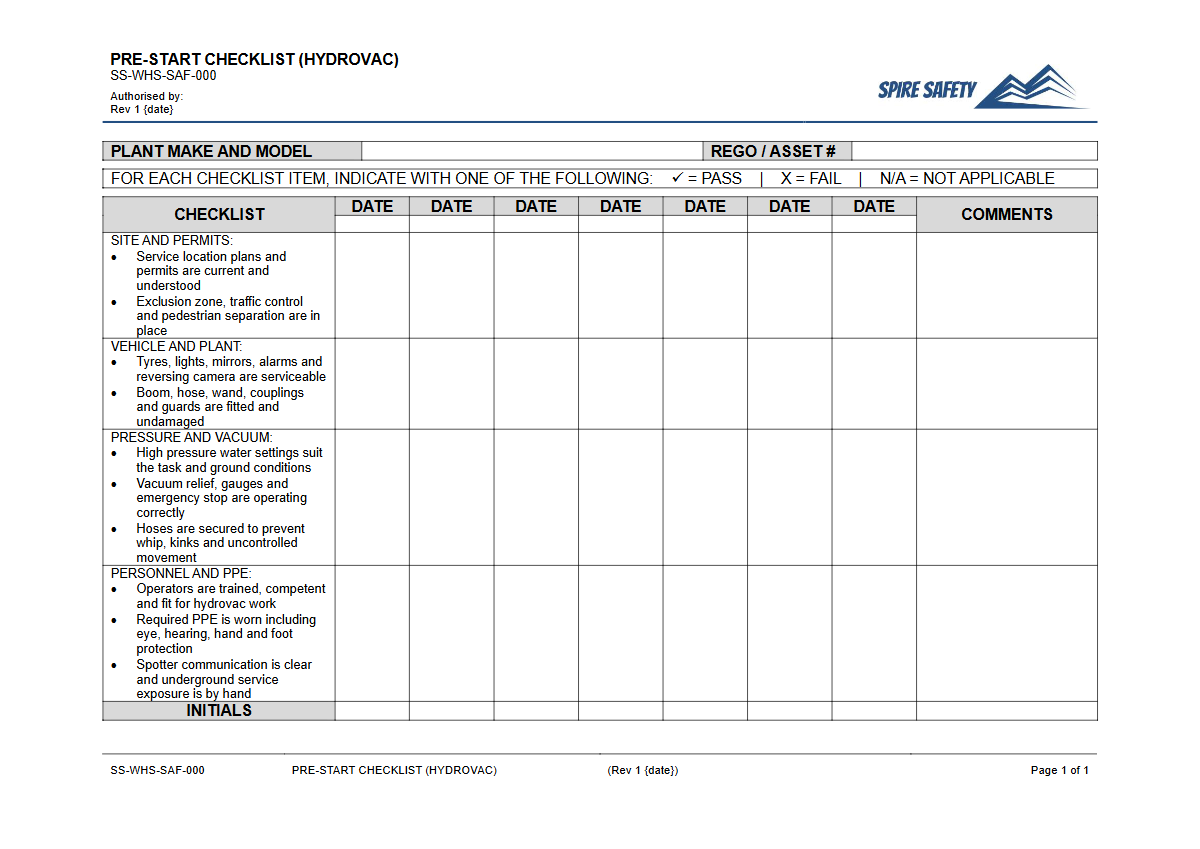
This Free Pre-Start Checklist (Hydrovac) Template provides a structured format for conducting and recording daily safety inspections of hydrovac or vacuum excavator trucks. Its primary purpose is to help operators systematically verify that the equipment is in safe working order before commencing operations.
By identifying potential faults, damage, or wear and tear early, organisations can prevent equipment failure, reduce the risk of incidents, and ensure the safety of workers and the public. Regular checks are a fundamental component of proactive plant and equipment safety management.
Integrating this checklist into your daily routine helps formalise your safety procedures and demonstrates a commitment to meeting your WHS duties. A documented trail of pre-start checks is a critical part of a business's safety records, providing evidence of due diligence.
These records are essential for incident investigations, maintenance planning, and demonstrating proactive safety management within your broader WHS management systems. For high-risk machinery like hydrovac trucks, having a clear process is not just good practice; it's a necessity.
Video walkthrough
How to use the Free Pre-Start Checklist (Hydrovac) Template
Our template is available in both DOCX and PDF formats for your convenience. The DOCX file is fully editable, allowing you to tailor it to your specific needs.
Before use, it is crucial that you adapt the checklist to the make and model of your hydrovac equipment, the specific tasks it performs, and your site's unique environmental conditions. A generic checklist may overlook critical components specific to your machinery.
IMPORTANT: This document is a template only. We have designed it as a comprehensive starting point, but you must customise it to suit the specific make and model of your hydrovac unit, your operational environment, and your organisation's procedures.
It's also vital to ensure that the person completing the check is deemed competent to operate the machinery. You can use our Verification of Competency (Hydrovac or Vacuum Excavator) template to assess and confirm operator skills.
The process for use is straightforward:
- The designated operator conducts a thorough visual inspection of the hydrovac truck before starting their shift.
- They work through each item on the checklist, marking it as satisfactory (S), unsatisfactory (U), or not applicable (N/A).
- Any item marked 'unsatisfactory' must be detailed in the 'Defects/Comments' section.
- The equipment must not be used if a safety-critical defect is identified. The issue must be reported to a supervisor immediately and the unit tagged out of service until it is repaired by a qualified person.
- Once completed, the operator signs and dates the form, which is then reviewed and countersigned by a supervisor.
When to use it
The Pre-Start Checklist should be completed at the beginning of every shift or workday before the hydrovac truck is first operated. It should also be completed if a new operator takes over the equipment during a shift.
This ensures continuous oversight and accountability for the machine's condition throughout its operational day. Discussing the results of pre-start checks can also be a valuable part of daily safety briefings, which can be documented using a Pre-Start Meeting Template.
Who should use it
This checklist is designed to be used by trained and competent hydrovac operators. These are the individuals with the most hands-on interaction with the equipment and are best placed to identify any changes, new noises, or visible defects.
Supervisors and managers also have a role in reviewing the completed checklists to ensure they are being filled out correctly and to action any reported defects promptly. Safety officers or auditors may also use the completed forms during WHS compliance auditing to verify that safety procedures are being followed.
Key Items on a Hydrovac Checklist
While your customised checklist will be specific to your equipment, a comprehensive pre-start inspection for a hydrovac truck should cover several key areas. These checks are a practical way to reinforce key safety messages, which can also be delivered through a Pre-Start Checks and Plant Maintenance Toolbox Talk.
Core inspection areas include:
- Vehicle/Chassis: Tyres, wheels, lights, indicators, brakes, steering, fluids (oil, coolant), and general vehicle condition.
- High-Pressure Water System: Water pump, hoses, nozzles, pressure gauges, and connections for leaks or damage.
- Vacuum System: Vacuum pump/blower, debris tank, hoses, seals, filters, and relief valves.
- Boom & Controls: Boom structure, hydraulic lines, rotational movement, remote control functionality, and warning signals.
- Safety Equipment: Emergency stops (E-stops), reversing alarms, camera systems, fire extinguishers, first aid kits, and operator PPE.
- Housekeeping: Cleanliness of the operator cabin, clear access to controls, and secure storage of tools and equipment.
Common mistakes
Common mistakes to avoid
- Operator 'pencil-whipping' the checklist without physically inspecting the items.
- Using a generic heavy vehicle checklist that misses hydrovac-specific components like the water pump, boom, and vacuum system.
- Failing to report, document, or action identified defects, rendering the check ineffective.
- Not retaining completed checklists as part of the organisation's safety and maintenance records.
Legal references
Legal considerations
The following legal requirements may be relevant to this type of work.
- Work Health and Safety Act (Harmonised) — Provides the primary duties for protecting workers and other people from work health and safety risks.
- Work Health and Safety Regulations (Harmonised) — Sets out requirements supporting the management of workplace hazards and risks.
The following codes may be relevant to this type of work.
- Managing WHS Risks Code of Practice — Provides practical guidance on identifying hazards, assessing risks and applying effective controls.
- Work Health and Safety Consultation, Cooperation and Coordination Code of Practice — Provides practical guidance on consulting workers and coordinating with other duty holders.
- Managing the Work Environment and Facilities Code of Practice — Provides practical guidance on safe work environments, workplace facilities and related controls.
Did you know
Dual-Force Technology
Hydro-excavation uses two forces simultaneously: high-pressure water to liquefy the soil and a powerful vacuum to remove the slurry. This non-destructive digging method significantly reduces the risk of damaging underground utilities compared to traditional mechanical excavation.
FAQ
Frequently asked questions
01What is a hydrovac pre-start checklist?
02Why are pre-start checks important for vacuum excavators?
03How often should I conduct a hydrovac pre-start check?
04Can I use a digital pre-start checklist for my hydrovac truck?
Share this resource
Free Pre-Start Checklist (Hydrovac) Template
Browse Categories
How To Use It
- 1Download and open in Word or PDF.
- 2Replace the placeholders with your business details.
- 3Get it reviewed by a WHS specialist before rollout.
Need it customised?
Our WHS consultants can adapt this template to your site, run a gap analysis, or audit what you already have in place.
Book a Free Consultation WHS consulting servicesor call 1300 156 382