
Free Pre-Start Checklist (Hydraulic Press) Template
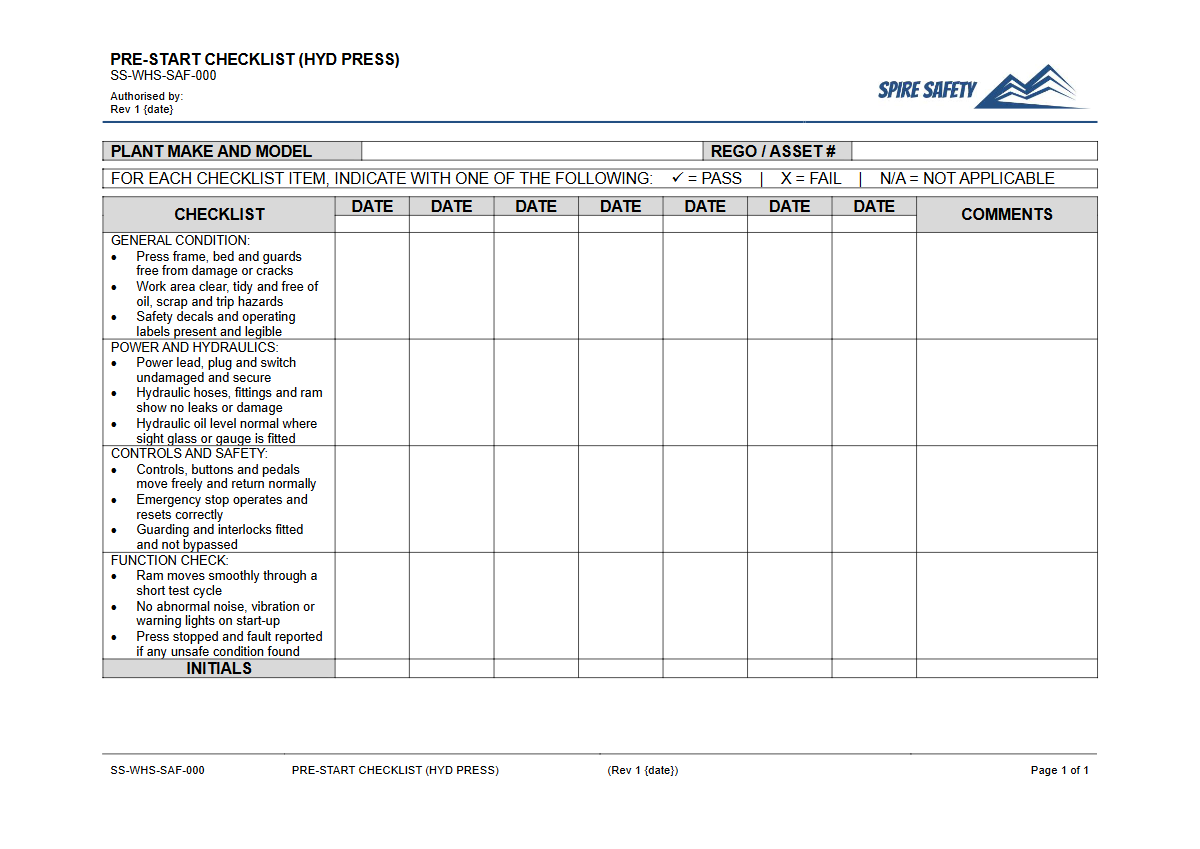
Formalise daily equipment inspections with our free Pre-Start Checklist (Hydraulic Press) Template. This DOCX & PDF resource helps manage WHS risks.
Free Pre-Start Checklist (Hydraulic Press) Template
DOCX • 125 KB + PDF
Updated Oct 2026
No signup required
Purpose of the Free Pre-Start Checklist (Hydraulic Press) Template
Hydraulic presses are powerful pieces of machinery capable of exerting immense force. This power also presents significant WHS risks, including crushing, amputation, and high-pressure fluid injection injuries.
A systematic inspection before each use is a critical administrative control to ensure the equipment is safe to operate. This free Pre-Start Checklist (Hydraulic Press) Template provides a structured framework for operators to verify safety features and operational integrity before commencing work.
Regular use helps formalise your safety procedures, create a documented record of inspections, and demonstrate due diligence in managing plant-related hazards.
Implementing documented checks is a fundamental part of any safety framework. Pre-start checklists for various types of plant, such as our free Pre-Start Checklist (Bench Grinder) Template, help create a consistent approach to machinery safety across the workshop.
Integrating these procedures into a broader framework helps to systematically manage workplace hazards and foster a proactive safety culture.
Using this checklist helps a Person Conducting a Business or Undertaking (PCBU) meet their primary duty of care. It provides a practical tool to ensure, so far as is reasonably practicable, that machinery is safe for use and that risks are monitored and controlled.
A well-implemented pre-start system is a key component of a robust WHS management system, providing evidence that safety is being actively managed at the operational level.
Video walkthrough
How to use the Free Pre-Start Checklist (Hydraulic Press) Template
This template is designed to be a comprehensive starting point. To use it effectively, download the DOCX or PDF file and follow these steps:
- Customise: Adapt the checklist to the specific make, model, and configuration of the hydraulic press in your workplace. Add or remove items to address unique attachments, controls, guarding arrangements, and known fault points.
- Train: Ensure all operators are thoroughly trained on not only how to use the press safely, but also how to conduct the pre-start inspection correctly. They must understand what each checkpoint means and what constitutes a 'pass' or 'fail'.
- Implement: Integrate the checklist into your daily operational routine. Make it a non-negotiable step before any operator begins work with the press. Store completed checklists for a defined period as part of your WHS records.
- Review: Periodically review the checklist's effectiveness. If new hazards are identified or if the press is modified, update the document accordingly. This review process can be supported by periodic WHS compliance auditing to ensure procedures remain effective and aligned with legal requirements.
Please note: This document is a template. We have designed it as a starting point, but you must customise it to reflect the specific makes, models, configurations, and risks present in your workplace.
When to use it
A pre-start checklist for a high-risk piece of plant like a hydraulic press should be completed before the first use on every shift. If the press is used intermittently throughout the day by different operators, it is good practice for each new operator to conduct their own check before they begin.
This frequency ensures that any faults or damage that may have occurred during operation, overnight, or between shifts are identified before the machine is put back into service, preventing potential incidents.
This routine is just as important for other common workshop equipment. For example, similar principles apply when using our free Drill Press Pre-Start Checklist. Consistency across all machinery reinforces the importance of pre-operational safety checks as a standard, non-negotiable behaviour.
Who should use it
The pre-start checklist must be completed by a worker who is trained, competent, and authorised to operate the specific hydraulic press. Competency means the person has the necessary knowledge and skills, acquired through training and experience, to perform the task safely.
They should be able to accurately identify whether the press's safety components are functioning correctly and recognise signs of wear, damage, or malfunction that could lead to failure. The responsibility for ensuring operators are competent rests with the PCBU.
Supervisors and managers should also be familiar with the checklist. They are responsible for ensuring the checks are being completed correctly and for taking appropriate action when faults are reported.
This includes removing the equipment from service and arranging for repair by a qualified person. If you need assistance defining competency requirements or establishing safe operating procedures, seeking WHS consulting can provide valuable expert guidance.
You can also explore our free WHS resources library for more templates and guides.
Common mistakes
Common mistakes to avoid
- Using a generic checklist without customising it for the specific press model and tasks.
- "Ticking and flicking" the checklist without physically verifying each item.
- Failing to immediately tag out and report faulty equipment identified during the inspection.
- Not providing adequate operator training on how to conduct the pre-start check correctly and what to look for.
Legal references
Legal considerations
The following legal requirements may be relevant to this type of work.
- Work Health and Safety Act (Harmonised) — Provides the primary duties for protecting workers and other people from work health and safety risks.
- Work Health and Safety Regulations (Harmonised) — Sets out requirements supporting the management of workplace hazards and risks.
The following codes may be relevant to this type of work.
- Managing WHS Risks Code of Practice — Provides practical guidance on identifying hazards, assessing risks and applying effective controls.
- Work Health and Safety Consultation, Cooperation and Coordination Code of Practice — Provides practical guidance on consulting workers and coordinating with other duty holders.
- Managing the Work Environment and Facilities Code of Practice — Provides practical guidance on safe work environments, workplace facilities and related controls.
Did you know
Hydraulic Power
Hydraulic systems multiply force using Pascal's principle. A small force applied to a small piston can generate a massive force on a larger piston, enabling presses to shape, bend, and form solid metal with precision.
Guarding is Critical
Many of the most serious injuries involving hydraulic presses are caused by inadequate or deliberately bypassed machine guarding. Effective guarding is the most critical control for preventing crushing and amputation injuries.
FAQ
Frequently asked questions
01What should be included in a hydraulic press pre-start check?
02How often should a hydraulic press be inspected?
03Is a pre-start checklist a legal requirement in Australia?
04Who is qualified to operate a hydraulic press?
Share this resource
Free Pre-Start Checklist (Hydraulic Press) Template
Browse Categories
How To Use It
- 1Download and open in Word or PDF.
- 2Replace the placeholders with your business details.
- 3Get it reviewed by a WHS specialist before rollout.
Need it customised?
Our WHS consultants can adapt this template to your site, run a gap analysis, or audit what you already have in place.
Book a Free Consultation WHS consulting servicesor call 1300 156 382