
Free Pre-Start Checklist (Guillotine) Template
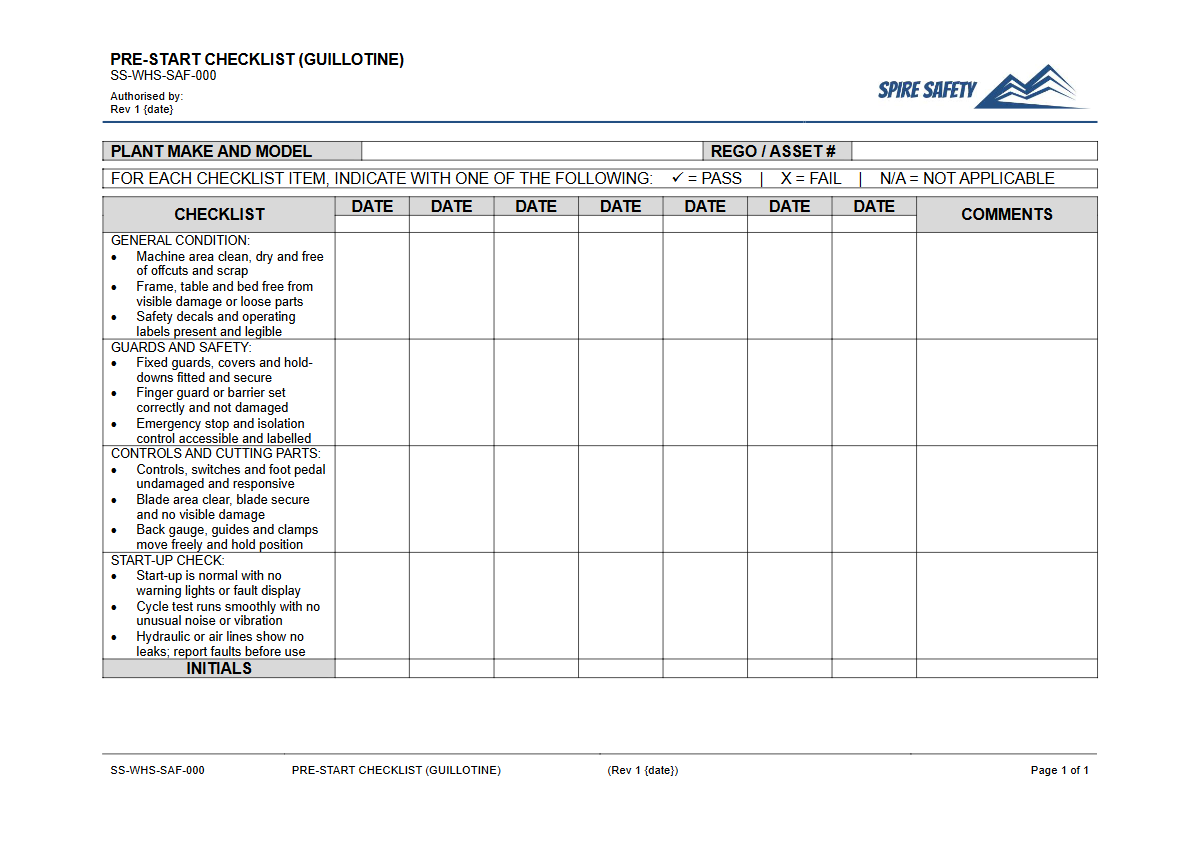
Formalise daily equipment inspections and manage WHS risks associated with guillotines. Download our free Pre-Start Checklist (Guillotine) Template today.
Free Pre-Start Checklist (Guillotine) Template
DOCX • 125 KB + PDF
Updated Oct 2026
No signup required
Purpose of the Free Pre-Start Checklist (Guillotine) Template
Guillotines are high-risk plant capable of causing severe injuries, including amputation, crushing, and shearing. This Free Pre-Start Checklist (Guillotine) Template provides a structured framework for operators to conduct vital safety inspections before use.
Systematically checking key components like guards, emergency stops, and blades helps identify defects or damage that could lead to an incident. A documented pre-start process is a fundamental part of a safe system of work, demonstrating a Person Conducting a Business or Undertaking's (PCBU) commitment to managing workplace hazards.
Implementing consistent, documented checks is a practical way to manage risks associated with machinery. Integrating such procedures into your daily operations is a core component of effective WHS management systems, helping to foster a proactive safety culture and ensure equipment remains safe for use.
Video walkthrough
How to use the Free Pre-Start Checklist (Guillotine) Template
Using this template effectively involves more than just downloading and printing. Follow these steps to integrate it properly into your safety procedures:
- Download: Select your preferred format, either the DOCX for easy editing or the PDF for immediate printing.
- Customise: Adapt the checklist to the specific make, model, and configuration of the guillotine(s) in your workplace. Add or remove checks based on manufacturer recommendations and your own risk assessment.
- Train: Ensure all operators are trained not only on how to use the guillotine safely but also on the importance of the pre-start check and how to complete it accurately.
- Implement: Make the pre-start check a non-negotiable step before any operator begins work on the machine.
Important Note: This document is a template, not a finished safety procedure. We have provided a structured starting point aligned with Australian WHS principles, but you must customise it to reflect the specific hazards, controls, and operational context of your workplace.
If you require assistance with this customisation or a machinery risk assessment, our WHS consulting team can provide expert guidance.
The checks required for a guillotine will differ significantly from those for other workshop equipment. For example, our Free Pre-Start Checklist (Bench Grinder) Template focuses on wheel integrity and tool rests, highlighting the need for machine-specific documentation.
When to use it
A pre-start checklist should be completed before the first use of the guillotine on any given day or at the beginning of each shift. This frequency ensures that any damage that may have occurred overnight, during maintenance, or during a previous shift is identified before the machine is put into operation.
It creates a formal record that the equipment was in a safe condition at the start of work.
Completed checklists should be retained as part of your safety records. These documents are invaluable during incident investigations or when conducting a WHS compliance auditing process, as they provide clear evidence of your organisation's inspection and maintenance practices.
Who should use it
The primary user of the pre-start checklist is the trained and authorised operator of the guillotine. They have the hands-on familiarity to spot subtle changes in the machine's condition or performance.
Supervisors also have a key role in reviewing the completed checklists to ensure they are being filled out correctly and to action any reported faults or maintenance requests promptly.
Maintenance personnel may also refer to these checklists to track recurring issues or to understand the condition of the machine before they commence servicing or repairs. The clear, documented nature of the checklist helps bridge communication between operators and maintenance teams, much like our Free Pre-Start Checklist (Floor Saw) Template does for mobile plant.
By formalising equipment inspections with documents like this checklist or our Free Pre-Start Checklist (Granulator) Template, you empower workers to take ownership of safety. For more tools to support your safety management system, explore our complete free WHS resources library.
Common mistakes
Common mistakes to avoid
- Using a generic checklist that doesn't cover the specific model's safety features.
- Completing the checklist as a 'tick and flick' exercise without physically testing items like E-stops and guards.
- Failing to report and immediately tag out the machine for any identified defects or faults.
- Poor record-keeping, making it impossible to track recurring faults or prove inspections occurred.
Legal references
Legal considerations
The following legal requirements may be relevant to this type of work.
- Work Health and Safety Act (Harmonised) — Provides the primary duties for protecting workers and other people from work health and safety risks.
- Work Health and Safety Regulations (Harmonised) — Sets out requirements supporting the management of workplace hazards and risks.
The following codes may be relevant to this type of work.
- Managing WHS Risks Code of Practice — Provides practical guidance on identifying hazards, assessing risks and applying effective controls.
- Work Health and Safety Consultation, Cooperation and Coordination Code of Practice — Provides practical guidance on consulting workers and coordinating with other duty holders.
- Managing the Work Environment and Facilities Code of Practice — Provides practical guidance on safe work environments, workplace facilities and related controls.
Did you know
Light Curtains
Many modern guillotines use 'light curtains' as a primary safety guard. These photoelectric sensors create an invisible barrier that, if crossed by an operator's hands or body, immediately stops the machine's cycle before injury can occur.
Two-Hand Controls
Another common safety feature is two-hand control, which requires the operator to press two separate buttons simultaneously to activate the blade. This design ensures their hands are kept clear of the cutting zone during operation.
FAQ
Frequently asked questions
01Is a pre-start checklist for a guillotine legally required in Australia?
02What are the most critical checks on a guillotine pre-start?
03How often should a guillotine be inspected?
04Can I use a digital app instead of this paper template?
Share this resource
Free Pre-Start Checklist (Guillotine) Template
Browse Categories
How To Use It
- 1Download and open in Word or PDF.
- 2Replace the placeholders with your business details.
- 3Get it reviewed by a WHS specialist before rollout.
Need it customised?
Our WHS consultants can adapt this template to your site, run a gap analysis, or audit what you already have in place.
Book a Free Consultation WHS consulting servicesor call 1300 156 382