
Free Pre-Start Checklist (Hammer Drill) Template
Formalise your tool safety checks with our free Pre-Start Checklist (Hammer Drill) Template. Aligned with Australian WHS standards.
Free Pre-Start Checklist (Hammer Drill) Template
DOCX • 125 KB + PDF
Updated Oct 2026
No signup required
Purpose of the Free Pre-Start Checklist (Hammer Drill) Template
A hammer drill is a powerful and versatile tool found on construction sites, in workshops, and across many trades. However, its operation introduces significant risks, including electric shock, entanglement, and musculoskeletal injuries from vibration and forceful exertion.
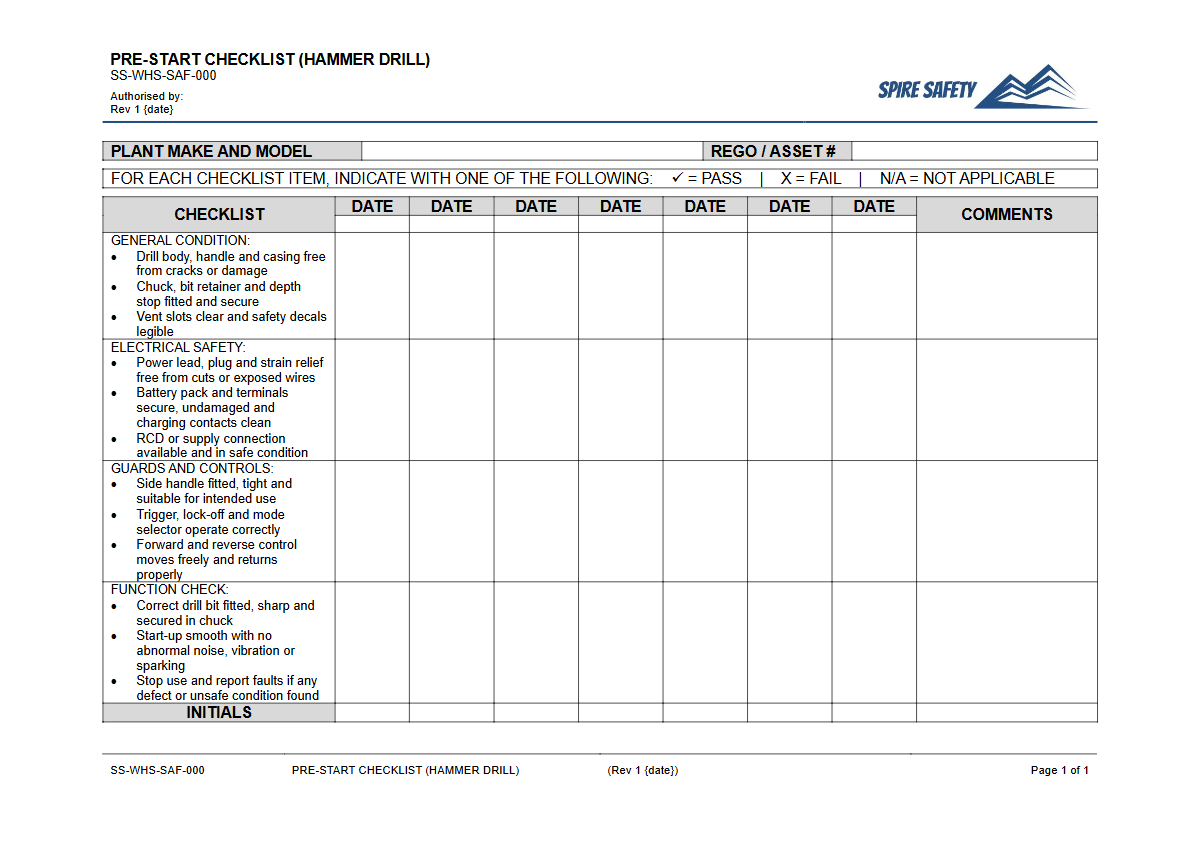
This free Pre-Start Checklist (Hammer Drill) Template provides a structured framework for operators to conduct essential safety and maintenance inspections before each use. Using a documented checklist helps to systematically identify potential faults or damage that could lead to an incident, ensuring the equipment is safe to operate.
Integrating this checklist into your daily routine is a key step in fulfilling your duty of care as a PCBU (Person Conducting a Business or Undertaking). It formalises the inspection process, creates a record of due diligence, and fosters a proactive safety culture where equipment condition is checked, not assumed.
Consistent use helps minimise equipment downtime and prevent workplace incidents related to tool failure. For workshops with multiple types of drilling equipment, you may also find our Pre-Start Checklist for Drill Presses a useful addition to your safety documentation.
Video walkthrough
How to use the Free Pre-Start Checklist (Hammer Drill) Template
This template is provided in both DOCX and PDF formats for your convenience. The DOCX file is fully editable, allowing you to tailor the checklist to the specific makes and models of hammer drills used in your workplace.
To effectively implement the checklist, start by adding your company branding and specific site details. Review each checkpoint and modify, add, or remove items to reflect the unique features and risks of your equipment and tasks.
It is crucial that you customise this document to suit your specific operational context. We are not WHS lawyers, and this template is a starting point, not a complete, out-of-the-box solution.
Once customised, train all operators on how to properly complete the checklist. The process should involve a physical and visual inspection of the hammer drill, covering the housing, chuck, power cord, plug, and controls.
The operator should sign and date the form before starting work, with completed checklists stored as part of your safety records. These records are invaluable evidence during formal WHS compliance audits.
When to use it
A hammer drill pre-start check should be conducted before the first use of the tool on any given day or shift. It should also be performed if the tool has been dropped, serviced, or if a new operator is taking over mid-shift.
This frequency ensures that any damage sustained during previous use, transport, or storage is identified before the tool is operated again. For tools that are used infrequently, a pre-start check is essential to confirm they have not deteriorated while in storage.
This proactive inspection is a core component of managing plant safety and is much more effective than relying on periodic maintenance alone. For other high-risk tools, such as those used in concrete cutting, a similar pre-use inspection is critical.
You can adapt the principles from this checklist or use a specific resource like our Pre-Start Checklist for Floor Saws to manage those assets.
Who should use it
This Pre-Start Checklist is designed for any worker, contractor, or employee tasked with operating a hammer drill. The person using the equipment is best placed to identify any issues, as they are most familiar with its normal operating condition.
Supervisors and managers should also use the template to verify that checks are being completed correctly and to review any reported faults. By empowering operators to take ownership of equipment safety, you create a more resilient safety process.
Effectively managing plant and equipment safety is a key pillar of robust WHS management systems. This checklist serves as a practical tool at the operational level, feeding crucial information into the broader system. Whether you are a sole trader or part of a large organisation, formalising your pre-start checks demonstrates a commitment to workplace health and safety. The principles here can be applied to even larger machinery, as seen in our Pre-Start Checklist for Drill Rigs.
This document is just one of many templates designed to assist Australian businesses in managing their WHS obligations. Explore our complete free WHS resources library for more checklists, forms, and policies to support your safety management system.
Common mistakes
Common mistakes to avoid
- Failing to inspect the full length of the power cord for cuts, abrasions, or exposed wires.
- Using dull or incorrect drill bits, which requires excessive force and increases risk of injury.
- Ignoring minor cracks or damage to the tool's housing, which can compromise electrical safety.
- Performing a 'tick and flick' exercise without physically and visually inspecting each item.
Legal references
Legal considerations
The following legal requirements may be relevant to this type of work.
- Work Health and Safety Act (Harmonised) — Provides the primary duties for protecting workers and other people from work health and safety risks.
- Work Health and Safety Regulations (Harmonised) — Sets out requirements supporting the management of workplace hazards and risks.
The following codes may be relevant to this type of work.
- Managing WHS Risks Code of Practice — Provides practical guidance on identifying hazards, assessing risks and applying effective controls.
- Work Health and Safety Consultation, Cooperation and Coordination Code of Practice — Provides practical guidance on consulting workers and coordinating with other duty holders.
- Managing the Work Environment and Facilities Code of Practice — Provides practical guidance on safe work environments, workplace facilities and related controls.
Did you know
Vibration Risk
Prolonged use of hammer drills is a primary cause of Hand-Arm Vibration Syndrome (HAVS), a painful and disabling condition affecting nerves, blood vessels, and joints. Pre-start checks help ensure anti-vibration features are intact.
Silica Dust
When drilling into concrete, brick, or stone, hammer drills can generate hazardous crystalline silica dust. A pre-start check should include confirming that dust control measures, like water suppression or on-tool dust extraction, are ready and functional.
FAQ
Frequently asked questions
01What should be checked on a hammer drill before use?
02Why is a pre-start check for a hammer drill necessary?
03How often should a hammer drill pre-start checklist be completed?
04Can this template be used for other power tools?
Share this resource
Free Pre-Start Checklist (Hammer Drill) Template
Browse Categories
How To Use It
- 1Download and open in Word or PDF.
- 2Replace the placeholders with your business details.
- 3Get it reviewed by a WHS specialist before rollout.
Need it customised?
Our WHS consultants can adapt this template to your site, run a gap analysis, or audit what you already have in place.
Book a Free Consultation WHS consulting servicesor call 1300 156 382