
Free Pre-Start Checklist (Goods Lift) Template
Download our Free Pre-Start Checklist (Goods Lift) Template in Word and PDF. A structured starting point for formalising daily equipment safety checks.
Free Pre-Start Checklist (Goods Lift) Template
DOCX • 125 KB + PDF
Updated Oct 2026
No signup required
Purpose of the Free Pre-Start Checklist (Goods Lift) Template
Goods lifts are essential for moving materials efficiently, but they also present significant crush, shear, and impact hazards if they are not maintained or operated correctly. Implementing a routine inspection before use is a critical control measure to ensure the equipment is safe to operate.
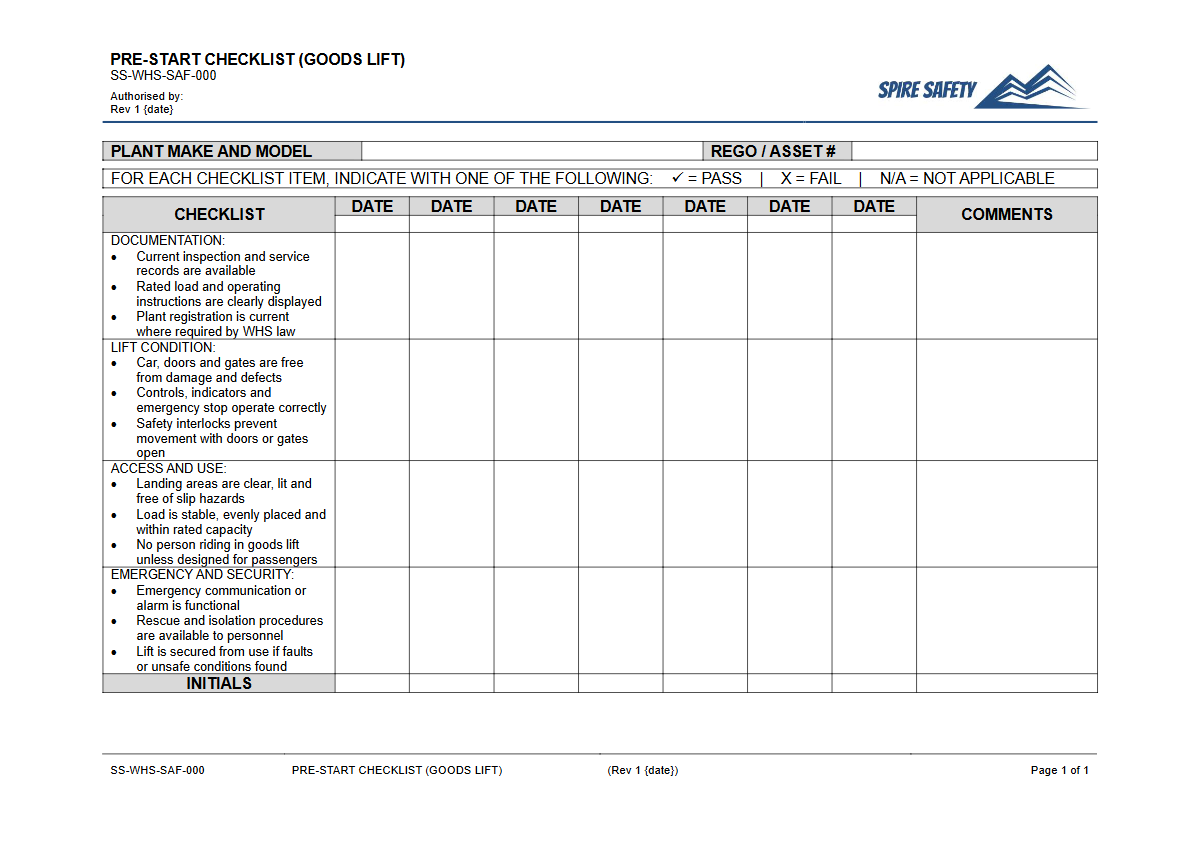
Our Free Pre-Start Checklist (Goods Lift) Template provides a structured framework for operators to conduct these vital checks, helping your organisation identify mechanical, electrical, and structural faults before they lead to an incident. Regular inspections help prevent unexpected equipment failure, protect workers from harm, and demonstrate proactive safety management.
Formalising this process is a key component of any effective plant safety program, reinforcing safe behaviour through consistent daily habits. For broader team engagement on this topic, consider using our pre-start checks and plant maintenance toolbox talk to refresh your team's knowledge.
Video walkthrough
How to use the Free Pre-Start Checklist (Goods Lift) Template
This resource is available for immediate download in two formats. The DOCX file is fully editable, allowing you to tailor the checklist to your specific equipment and workplace conditions.
The PDF version is ready to print and use straight away if it meets your initial needs. A pre-start checklist is just one part of the overall risk management process for high-risk plant; it should be used in conjunction with other safety documents, such as a comprehensive scissor lift risk assessment, which can be adapted for similar types of lifting equipment.
Customisation is Essential
Important: This is a template only. We have designed it as a structured starting point aligned with Australian WHS principles, but you must customise it to reflect the specific make, model, capacity, and operating environment of the goods lifts at your workplace.
Consult the manufacturer’s instructions, consult with operators and maintenance staff, and conduct a risk assessment to ensure your final checklist is comprehensive and effective for your site.
When to use it
A pre-start check should be completed by the operator before the goods lift is used for the first time at the beginning of each shift or workday. It is not a weekly or monthly task.
This frequency ensures that any faults that may have developed overnight or during a previous shift are identified before the equipment is put back into service. Integrating this daily habit into your operational procedures is a fundamental aspect of building robust WHS management systems that actively manage risk rather than reacting to incidents.
The completed checklists should be retained as a record of your organisation's safety diligence.
Who should use it
The pre-start checklist should be completed by a person who is competent to operate the specific goods lift. Competency involves more than just holding a licence; it means the person has received adequate training and instruction, understands the operational features and limitations of the lift, and can recognise the potential hazards listed on the checklist.
Verifying that operators have the required skills is a key duty for any Person Conducting a Business or Undertaking (PCBU). While specific to a different machine, you can see an example of how to structure this process in our free Scissor Lift VOC template.
Key Inspection Points
While your customised checklist will be specific to your equipment, it should generally cover the following areas:
- Controls and Signals: Test that all operating controls, including the emergency stop button, are functional and clearly labelled. Check that audible alarms and visual warning lights are working correctly.
- Gates and Doors: Ensure all landing gates and car doors are in good condition and that their interlocking mechanisms function correctly, preventing the lift from operating if a door is open.
- Structural Integrity: Visually inspect the lift car, guide rails, chains, and suspension ropes for any signs of wear, corrosion, or damage. Check that the platform surface is clear and non-slip.
- Safety Signage: Confirm that all safety signs, including the safe working load (SWL) and any operational warnings, are in place, legible, and undamaged.
- Operating Area: Ensure the areas around the lift entrances on all floors are clear of obstructions, well-lit, and free from slip or trip hazards. The procedure for these checks can be detailed in documents like a Safe Work Method Statement for scissor lift operation.
After the Check
The checklist is only effective if action is taken. If an operator identifies any fault or defect during the pre-start inspection, they must not use the lift.
The equipment should be immediately isolated, tagged out of service, and the issue reported to a supervisor or maintenance manager for rectification. A clear 'Do Not Operate' tag should be affixed to the controls to prevent inadvertent use.
Periodically reviewing your completed checklists, fault reports, and maintenance logs is good practice and can be validated through professional WHS compliance auditing to ensure your safety processes are working as intended.
By embedding this simple yet powerful tool into your daily routine, you can significantly enhance the safety of your material handling operations. For more templates and guides to support your safety goals, browse our extensive library of free WHS resources.
Common mistakes
Common mistakes to avoid
- Failing to remove a faulty lift from service and tag it out correctly.
- Operators 'pencil-whipping' the form without actually conducting the checks.
- Using a generic checklist that doesn't match the specific make and model of the lift.
- Ignoring seemingly 'minor' issues like a flickering warning light or a slightly damaged door, which can indicate a more serious underlying problem.
Legal references
Legal considerations
The following legal requirements may be relevant to this type of work.
- Work Health and Safety Act (Harmonised) — Provides the primary duties for protecting workers and other people from work health and safety risks.
- Work Health and Safety Regulations (Harmonised) — Sets out requirements supporting the management of workplace hazards and risks.
The following codes may be relevant to this type of work.
- Managing WHS Risks Code of Practice — Provides practical guidance on identifying hazards, assessing risks and applying effective controls.
- Work Health and Safety Consultation, Cooperation and Coordination Code of Practice — Provides practical guidance on consulting workers and coordinating with other duty holders.
- Managing the Work Environment and Facilities Code of Practice — Provides practical guidance on safe work environments, workplace facilities and related controls.
Did you know
Load Capacity
Overloading is a primary cause of goods lift failure. The specified Safe Working Load (SWL) is not a target; it's a strict limit that includes the weight of any trolley or pallet jack used to move the goods onto the lift.
FAQ
Frequently asked questions
01What is the difference between a goods lift and a passenger lift?
02How often should a goods lift be professionally serviced?
03Is a pre-start check a legal requirement in Australia for goods lifts?
04Can this template be used for other types of lifting equipment?
Share this resource
Free Pre-Start Checklist (Goods Lift) Template
Browse Categories
How To Use It
- 1Download and open in Word or PDF.
- 2Replace the placeholders with your business details.
- 3Get it reviewed by a WHS specialist before rollout.
Need it customised?
Our WHS consultants can adapt this template to your site, run a gap analysis, or audit what you already have in place.
Book a Free Consultation WHS consulting servicesor call 1300 156 382