
Free Pre-Start Checklist (Reach Truck) Template
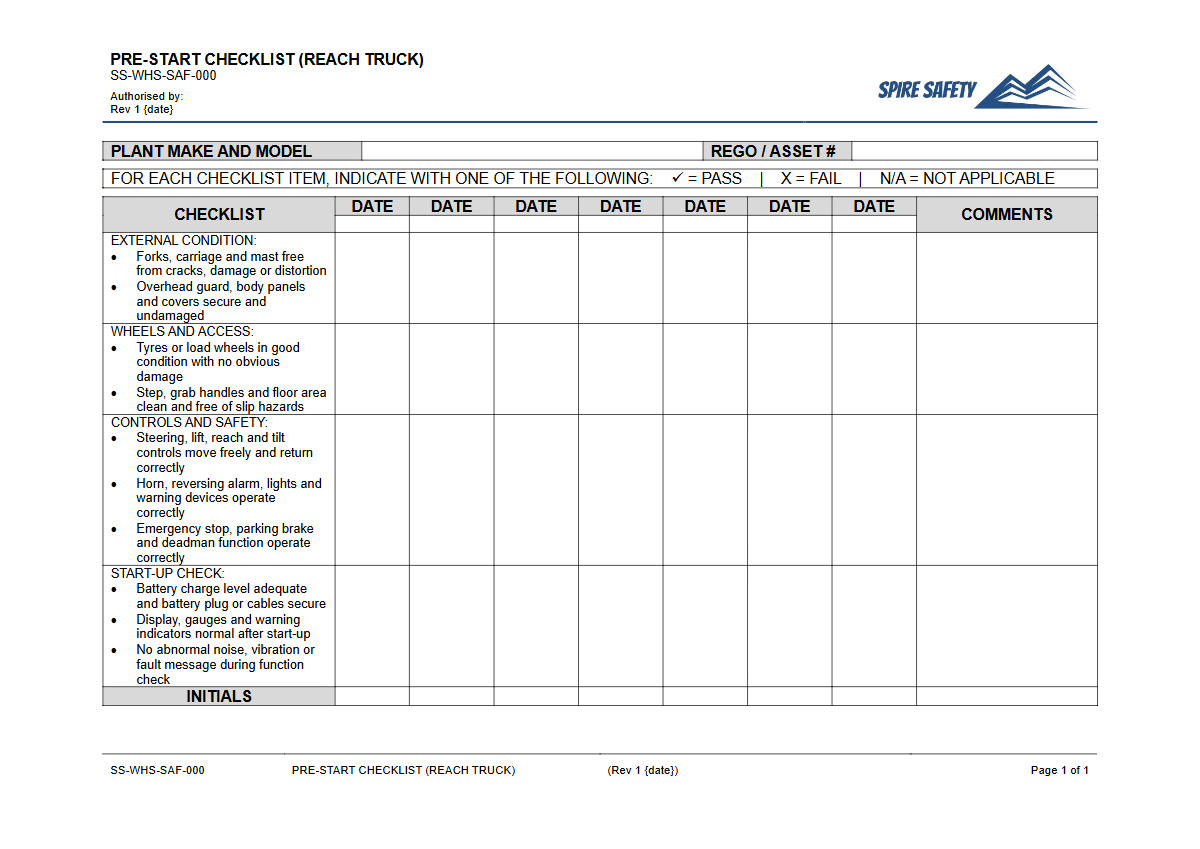
Download our free Pre-Start Checklist (Reach Truck) Template. This DOCX & PDF resource helps formalise daily equipment inspections and manage WHS risks.
Free Pre-Start Checklist (Reach Truck) Template
DOCX • 125 KB + PDF
Updated Oct 2026
No signup required
Purpose of the Free Pre-Start Checklist (Reach Truck) Template
Regularly inspecting high-risk plant like reach trucks is a cornerstone of a safe warehouse or factory environment. This Free Pre-Start Checklist (Reach Truck) Template provides a structured format for operators to systematically check their equipment before use.
Its primary purpose is to identify and report any faults, damage, or wear and tear that could compromise safety. A documented pre-start check helps prevent incidents, reduces equipment downtime, and demonstrates a proactive approach to managing workplace risks. By formalising this daily process, you create a consistent record of equipment condition, which is a vital component of effective WHS management systems.
Video walkthrough
How to Use the Free Pre-Start Checklist (Reach Truck) Template
This template is designed as a practical starting point for your organisation. To implement it effectively, first download the DOCX or PDF file.
The next step is crucial: you must customise the checklist to align with your specific reach truck models, workplace environment, and operational risks. We have provided a general list of checks, but your equipment may have unique features or safety requirements that need to be added.
Once customised, ensure all operators are trained on how to complete the checklist correctly and understand the procedure for reporting defects. The completed checklists should be regularly reviewed by a supervisor to supports your compliance efforts and address any reported issues promptly.
Integrating this process into periodic WHS compliance auditing can help verify its effectiveness over time.
When to Use a Reach Truck Pre-Start Checklist
A pre-start inspection should be completed at the beginning of every shift, before the reach truck is used for the first time that day. If the equipment is used across multiple shifts, each new operator should conduct their own check before commencing work.
This ensures that any issues that may have developed during a previous shift are identified immediately. Additionally, a full inspection should be considered after any incident involving the reach truck, no matter how minor, or after significant maintenance or repair work has been carried out.
A similar rigorous approach should be applied to other specialised machinery, as outlined in our Pre-Start Checklist (Forwarder) Template for forestry equipment.
Who Should Use This Checklist
The pre-start check must be carried out by a person who is competent to operate the reach truck. This means they must hold the appropriate High Risk Work Licence (LF or LO, depending on the specific equipment and state regulations) and have received adequate training on the specific model in use.
While the operator is responsible for performing the daily check, supervisors and managers have a duty to ensure the system is working. This includes providing the checklists, training workers, and establishing a clear process for tagging out and repairing unsafe equipment. This principle of operator responsibility is common across different types of plant, such as those covered in this Pre-Start Checklist for a Bin Lifter.
Implementing a robust pre-start inspection routine is a simple yet powerful way to enhance safety. It empowers operators to take ownership of their equipment's condition and provides a clear, documented process for managing risks associated with mobile plant. While this document is specific to reach trucks, the same principles can be applied to other machinery, such as concrete saws, using resources like our pre-start checklist for a floor saw. For a wider range of safety documents, browse our complete free WHS resources library.
Common mistakes
Common mistakes to avoid
- Failing to customise the generic template for specific reach truck models and site conditions.
- Operators 'pencil-whipping' the checklist without physically inspecting the items.
- Not having a clear procedure for reporting faults and removing defective equipment from service.
- Poor record-keeping, such as losing completed checklists or failing to have supervisors review them.
Legal references
Legal considerations
The following legal requirements may be relevant to this type of work.
- Work Health and Safety Act (Harmonised) — Provides the primary duties for protecting workers and other people from work health and safety risks.
- Work Health and Safety Regulations (Harmonised) — Sets out requirements supporting the management of workplace hazards and risks.
The following codes may be relevant to this type of work.
- Managing WHS Risks Code of Practice — Provides practical guidance on identifying hazards, assessing risks and applying effective controls.
- Work Health and Safety Consultation, Cooperation and Coordination Code of Practice — Provides practical guidance on consulting workers and coordinating with other duty holders.
- Managing the Work Environment and Facilities Code of Practice — Provides practical guidance on safe work environments, workplace facilities and related controls.
Did you know
A Tight Squeeze
Reach trucks are designed for narrow aisle warehousing. Unlike a standard counterbalance forklift, their forks can extend (or 'reach') forward into racking, allowing them to operate in aisles as narrow as 2.5 metres.
Forklift Dangers
According to Safe Work Australia, between 2015 and 2019, there were 7,723 serious claims for injuries and 16 fatalities involving forklifts in Australian workplaces, highlighting the critical importance of regular safety checks.
FAQ
Frequently asked questions
01What should an operator do if they find a defect during a pre-start check?
02How long should completed reach truck pre-start checklists be kept?
03Is a digital pre-start checklist better than a paper one?
04Who is responsible for ensuring pre-start checks are completed properly?
Share this resource
Free Pre-Start Checklist (Reach Truck) Template
Browse Categories
How To Use It
- 1Download and open in Word or PDF.
- 2Replace the placeholders with your business details.
- 3Get it reviewed by a WHS specialist before rollout.
Need it customised?
Our WHS consultants can adapt this template to your site, run a gap analysis, or audit what you already have in place.
Book a Free Consultation WHS consulting servicesor call 1300 156 382