
Free Pre-Start Checklist (Recip Saw) Template
Download our Free Pre-Start Checklist for Reciprocating Saws. This structured DOCX & PDF template helps formalise daily safety inspections. Download now.
Free Pre-Start Checklist (Recip Saw) Template
DOCX • 125 KB + PDF
Updated Oct 2026
No signup required
Purpose of the Free Pre-Start Checklist (Recip Saw) Template
A reciprocating saw, often called a recip saw or sabre saw, is a powerful and versatile tool used in demolition, construction, and maintenance. However, its power also introduces significant hazards, including severe cuts, electric shock, and injuries from vibration or kickback.
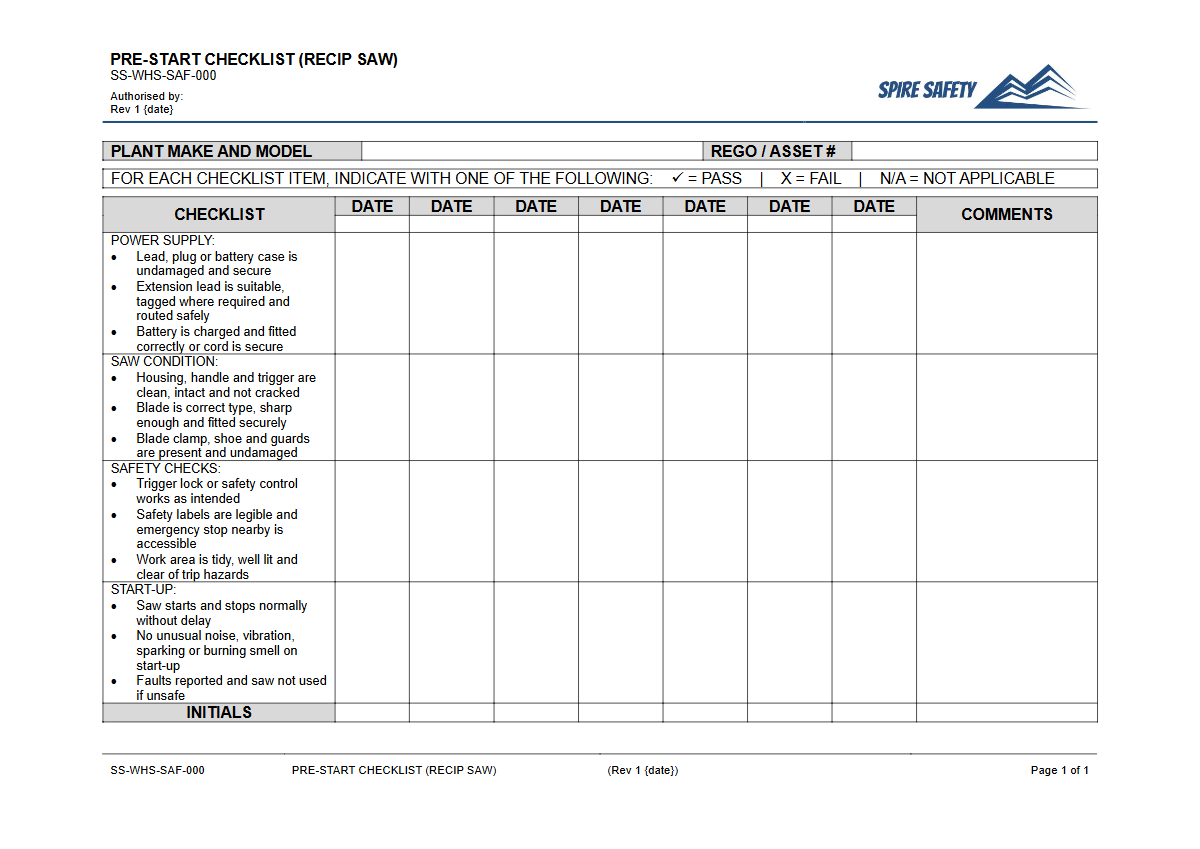
Our Free Pre-Start Checklist (Recip Saw) Template provides a structured framework to guide operators through a systematic inspection before each use. Using this checklist helps formalise safety procedures, identify potential faults before they cause an incident, and demonstrates a proactive approach to managing workplace health and safety obligations.
It encourages a consistent and thorough check of critical components like the blade, shoe, power cord, and safety guards, reducing the risk of equipment failure during operation.
Video walkthrough
How to use the Free Pre-Start Checklist (Recip Saw) Template
This template is provided as a starting point and is available in both DOCX for easy editing and PDF for straightforward printing. The process is simple: download the file, and integrate it into your daily operational procedures.
It is crucial to recognise that this document is a general template and not a complete, out-of-the-box solution.
Important Note: We have not assessed your specific reciprocating saw model, the materials you are cutting, the training of your operators, or your unique work environment. Therefore, you must customise this Pre-Start Checklist to reflect the manufacturer’s operating manual and the specific hazards identified in your own risk assessment.
For complex environments, professional guidance from a WHS consulting service can help ensure your safety documentation is robust and site-specific.
Proper implementation involves more than just ticking boxes. The checklist should be a trigger for action.
If a fault is identified, the saw must be tagged out of service and reported for repair immediately. Completed checklists should be filed as a record of your safety activities, which is a key component of effective WHS management systems. These records can be invaluable during safety audits and incident investigations.
When to use the Pre-Start Checklist
A pre-start inspection for a reciprocating saw should be completed before its first use on any given day or shift. It should also be performed by any new operator taking over the tool during a shift.
This frequency ensures that any damage or faults that may have occurred during previous use, transport, or storage are identified before the tool is put back into service. A quick visual check may also be prudent after changing a blade or if the tool is dropped, even if a full pre-start has already been completed for the day.
This consistent, high-frequency approach to inspections is fundamental for managing risks associated with portable power tools. The same principle of regular checks applies to other high-risk cutting equipment, as reflected in our Pre-Start Checklist for Floor Saws, which addresses hazards specific to that machinery.
Who should use the Pre-Start Checklist
The pre-start check should be conducted by the person who will be operating the reciprocating saw. The operator is the person most familiar with the tool's feel and performance and is best placed to notice subtle changes or signs of wear and tear.
This task should only be assigned to workers who are competent, meaning they have received the necessary training and instruction on how to safely operate the specific model of saw and how to properly conduct the inspection.
Empowering operators to take ownership of equipment safety fosters a positive safety culture. It shifts the perception of safety from a managerial task to a shared responsibility.
This approach is effective across all workshop and site equipment, where a consistent process using tools like our Pre-Start Checklist (Bench Grinder) Template can help standardise safety behaviour. Ultimately, the Person Conducting a Business or Undertaking (PCBU) is responsible for ensuring these checks happen, but the physical inspection is best performed at the frontline.
By embedding this checklist into your standard operating procedures, you provide your team with the tools they need to work safely and efficiently. You can find more templates to support your safety framework in our complete free WHS resources library, covering a wide range of plant and equipment.
Common mistakes
Common mistakes to avoid
- Skipping the check for a 'quick job', where many incidents occur.
- Using a dull, damaged, or incorrect type of blade for the cutting material.
- Failing to inspect the full length of the power cord for nicks, cuts, or exposed wires.
- Not removing a faulty saw from service immediately, leaving it for the next person to find.
Legal references
Legal considerations
The following legal requirements may be relevant to this type of work.
- Work Health and Safety Act (Harmonised) — Provides the primary duties for protecting workers and other people from work health and safety risks.
- Work Health and Safety Regulations (Harmonised) — Sets out requirements supporting the management of workplace hazards and risks.
The following codes may be relevant to this type of work.
- Managing WHS Risks Code of Practice — Provides practical guidance on identifying hazards, assessing risks and applying effective controls.
- Work Health and Safety Consultation, Cooperation and Coordination Code of Practice — Provides practical guidance on consulting workers and coordinating with other duty holders.
- Managing the Work Environment and Facilities Code of Practice — Provides practical guidance on safe work environments, workplace facilities and related controls.
Did you know
Invention of the Sawzall
The first powered reciprocating saw was invented by Milwaukee Tool in 1951. It was marketed under the trademarked name 'Sawzall', which has since become a generic term for the tool.
Vibration Risks
Prolonged use of high-vibration tools like reciprocating saws can lead to Hand-Arm Vibration Syndrome (HAVS). Regular pre-start checks help ensure anti-vibration features are functional, and operators should take regular breaks to minimise exposure.
FAQ
Frequently asked questions
01Why are pre-start checks important for a reciprocating saw?
02What is the difference between a pre-start check and scheduled maintenance?
03Who is responsible for completing the recip saw pre-start checklist?
04Can I use this template for my circular saw or angle grinder?
Share this resource
Free Pre-Start Checklist (Recip Saw) Template
Browse Categories
How To Use It
- 1Download and open in Word or PDF.
- 2Replace the placeholders with your business details.
- 3Get it reviewed by a WHS specialist before rollout.
Need it customised?
Our WHS consultants can adapt this template to your site, run a gap analysis, or audit what you already have in place.
Book a Free Consultation WHS consulting servicesor call 1300 156 382