
Free Pre-Start Checklist (Ride Mower) Template
Download our free Pre-Start Checklist (Ride Mower) Template to formalise daily equipment checks. This DOCX & PDF resource helps improve safety. Get yours now.
Free Pre-Start Checklist (Ride Mower) Template
DOCX • 125 KB + PDF
Updated Oct 2026
No signup required
Purpose of the Free Pre-Start Checklist (Ride Mower) Template
Regularly inspecting plant and equipment is a fundamental requirement of workplace health and safety. This free Pre-Start Checklist (Ride Mower) Template provides a structured way for operators to conduct thorough, documented inspections before each use.
Using this checklist helps identify mechanical faults, fluid leaks, damaged guards, and other hazards that could lead to an incident, injury, or costly equipment failure. Formalising these checks is a key step in fulfilling your duty of care as a PCBU (Person Conducting a Business or Undertaking) under Australian WHS laws.
By implementing a consistent pre-start process, your organisation can systematically manage the risks associated with ride-on mowers, which can include rollovers, entanglement, and blade contact. It also promotes a stronger safety culture by reinforcing the importance of operator responsibility. For a broader discussion on this topic with your team, you can use our Pre-Start Checks and Plant Maintenance Toolbox Talk.
Video walkthrough
How to use the Free Pre-Start Checklist (Ride Mower) Template
This template is provided in both DOCX and PDF formats for your convenience. The DOCX file is fully editable, allowing you to tailor it to your specific operational needs. Follow these steps to implement it effectively:
- Download: Save the template to your local system.
- Customise: Modify the checklist to include items specific to the make and model of your ride-on mowers. Add your company branding and any site-specific safety rules.
- Train: Ensure all operators are trained on how to properly complete the checklist, what each item means, and the procedure for reporting faults.
- Implement: Integrate the checklist into your daily start-up procedures. Determine whether you will use paper copies or a digital system.
- Review: Periodically review completed checklists to identify recurring faults or patterns of damage, which may indicate a need for revised maintenance schedules or operator training.
IMPORTANT: This is a template, not a finished document. We have provided a comprehensive starting point, but you must customise it to reflect the specific make and model of your ride-on mower, your site conditions, and your organisation's unique risks.
A generic checklist may not be sufficient to manage all potential hazards. Integrating this process into your broader WHS management systems ensures a cohesive approach to safety.
What's included in the template?
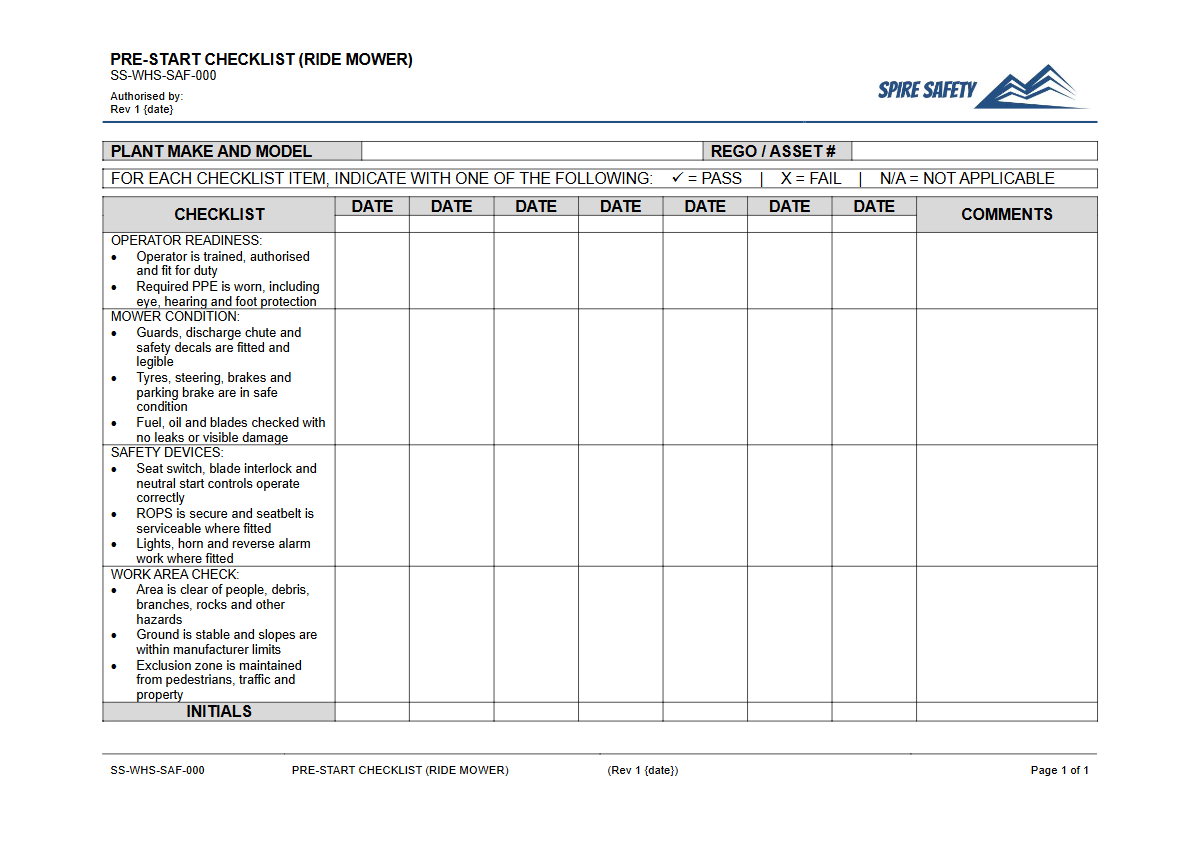
Our template prompts operators to inspect key components and safety features before starting work. It is organised into logical sections for clarity and ease of use, covering areas such as:
- General Condition: Checking for visible damage, leaks, and cleanliness.
- Safety Features: Verifying guards, seatbelts, Rollover Protective Structures (ROPS), and emergency stops are functional.
- Controls & Instruments: Ensuring steering, brakes, and operating controls work correctly.
- Engine & Fluids: Checking oil, fuel, and hydraulic fluid levels.
- Tyres & Cutting Deck: Inspecting tyre pressure, condition, and the security of blades and the cutting deck.
If your operations involve other types of groundskeeping machinery, you may find our pre-start checklist for an aerator a useful addition to your safety documentation.
When to use it
The ride-on mower pre-start checklist should be completed before the mower is used for the first time each day or at the beginning of every shift. This frequency ensures that any damage or faults that occurred during previous operation or while the machine was stored are identified before it is put back into service.
Consistent daily checks are far more effective at preventing incidents than weekly or ad-hoc inspections. For more tools to support your safety processes, browse our free WHS resources library.
Who should use it
This checklist is primarily designed for the equipment operator. The person who will be using the mower is best placed to conduct the physical inspection.
Supervisors also have a role in ensuring the checks are being completed correctly and for verifying that any reported faults are addressed promptly. Maintenance personnel will use the information from completed checklists to schedule repairs and preventative maintenance.
It's crucial that operators are not only trained on the pre-start process but are also deemed competent to operate the machinery itself; you can adapt our Verification of Competency for a ride-on sweeper for this purpose.
Completed checklists form part of your WHS records. They serve as evidence that your organisation is proactively managing plant safety risks and can be valuable during incident investigations or WHS compliance audits. These records help demonstrate that a system for ensuring equipment safety is in place and being followed.
Common mistakes
Common mistakes to avoid
- Using a generic checklist that doesn't match the specific make and model of the mower.
- "Pencil-whipping" the form by ticking boxes without physically inspecting each item.
- Failing to immediately remove faulty equipment from service, creating significant risk.
- Poor record-keeping, where completed checklists are not filed, reviewed, or actioned.
Legal references
Legal considerations
The following legal requirements may be relevant to this type of work.
- Work Health and Safety Act (Harmonised) — Provides the primary duties for protecting workers and other people from work health and safety risks.
- Work Health and Safety Regulations (Harmonised) — Sets out requirements supporting the management of workplace hazards and risks.
The following codes may be relevant to this type of work.
- Managing WHS Risks Code of Practice — Provides practical guidance on identifying hazards, assessing risks and applying effective controls.
- Work Health and Safety Consultation, Cooperation and Coordination Code of Practice — Provides practical guidance on consulting workers and coordinating with other duty holders.
- Managing the Work Environment and Facilities Code of Practice — Provides practical guidance on safe work environments, workplace facilities and related controls.
Did you know
Rollover Risk
According to Safe Work Australia, rollovers are a leading cause of fatalities involving ride-on mowers, particularly on slopes, embankments, and uneven terrain. A functional Rollover Protective Structure (ROPS) and the use of a seatbelt are critical controls.
Noise Exposure
The engine noise from a commercial ride-on mower can easily exceed 85 decibels (dB), the exposure standard at which hearing protection becomes mandatory. Always check the manufacturer's specifications and conduct a noise assessment if unsure.
FAQ
Frequently asked questions
01What should I do if a fault is found during a ride-on mower pre-start check?
02How often should our ride-on mower pre-start checklists be reviewed?
03Is a digital pre-start checklist better than a paper one?
04Can this template be used for other types of mowers?
Share this resource
Free Pre-Start Checklist (Ride Mower) Template
Browse Categories
How To Use It
- 1Download and open in Word or PDF.
- 2Replace the placeholders with your business details.
- 3Get it reviewed by a WHS specialist before rollout.
Need it customised?
Our WHS consultants can adapt this template to your site, run a gap analysis, or audit what you already have in place.
Book a Free Consultation WHS consulting servicesor call 1300 156 382