
Free Pre-Start Checklist (Ride Scrubber) Template
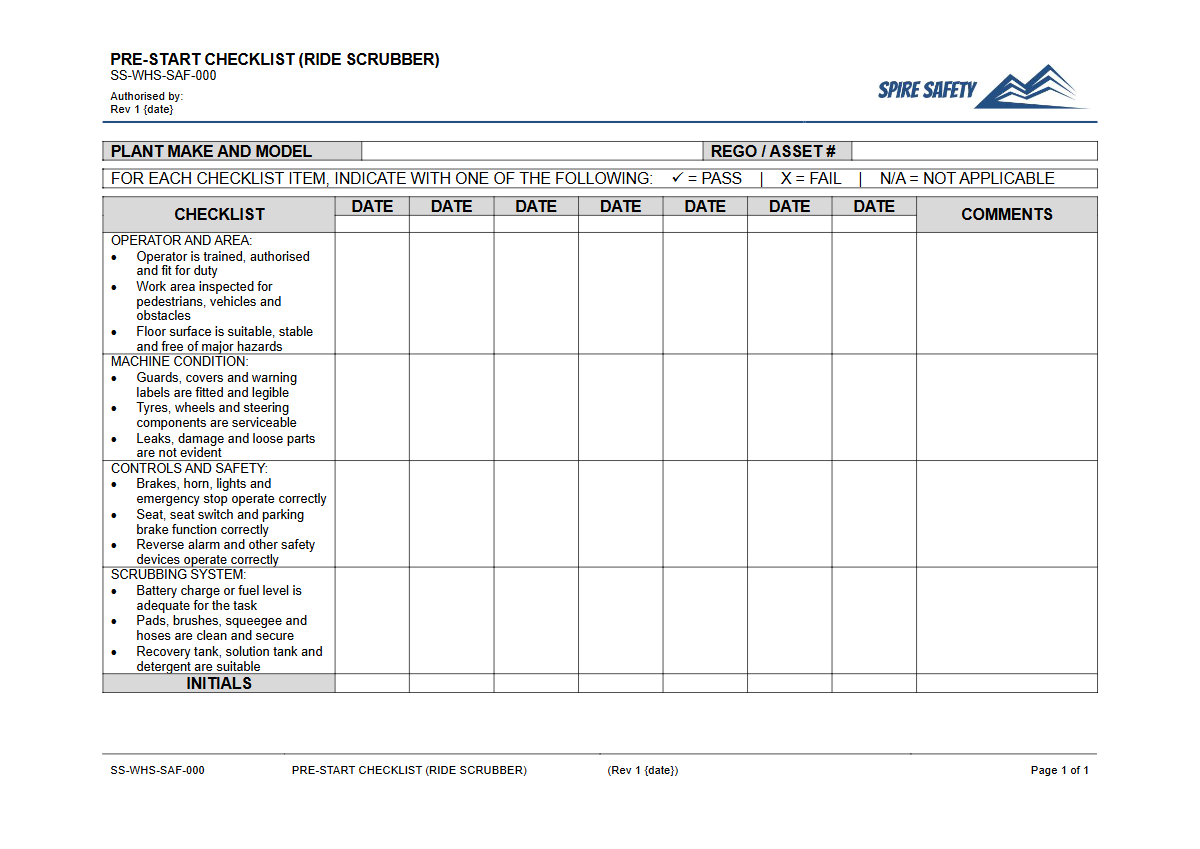
Download our free Pre-Start Checklist for ride-on scrubbers. This customisable template helps formalise safety checks and manage equipment hazards.
Free Pre-Start Checklist (Ride Scrubber) Template
DOCX • 125 KB + PDF
Updated Oct 2026
No signup required
Purpose of the Free Pre-Start Checklist (Ride Scrubber) Template
Operating a ride-on scrubber involves specific risks, from mechanical and electrical faults to potential collisions and slip hazards. This free Pre-Start Checklist (Ride Scrubber) Template provides a structured framework to guide operators through a thorough pre-operational inspection.
Using this checklist helps formalise the process of identifying and reporting potential faults before the equipment is used, which is a critical part of any effective WHS management system. Regular checks ensure the machinery is safe to operate, reduces the risk of accidents, and helps prolong the life of the asset by catching minor issues before they become major failures.
This document serves as a starting point, aligned with Australian WHS principles, to help a Person Conducting a Business or Undertaking (PCBU) meet their primary duty of care. It encourages a proactive safety culture where operators take ownership of their equipment's condition.
Documenting these checks creates a clear record of due diligence, which can be invaluable for maintenance scheduling, incident investigations, and demonstrating compliance.
Video walkthrough
How to use the Free Pre-Start Checklist (Ride Scrubber) Template
This template is available as a DOCX file for easy customisation and a PDF for immediate use. The goal is to create a checklist that is specific and relevant to the ride-on scrubbers used in your workplace.
A generic checklist is less effective than one tailored to your specific operational context.
Customisation is Essential
You must adapt this document to your workplace. Generic templates provide a foundation, but for a pre-start check to be effective, it needs to be specific.
- Equipment Specifics: Add or remove items to match the make, model, and features of your ride-on scrubbers (e.g., specific controls, battery type, squeegee assembly, warning light systems).
- Operational Environment: Consider your workplace hazards. Are there ramps, tight corners, high-traffic pedestrian areas, or specific floor surfaces that require special attention?
- Company Procedures: Integrate your organisation's specific defect reporting and corrective action procedures. Who should the operator notify if a fault is found? What is the process for taking faulty equipment out of service?
Please note: This is a template, not a finished document. We have designed it as a starting point, but you must customise it to reflect the specific make and model of your ride scrubber, your site conditions, and your organisation's specific WHS procedures.
When to use it
A pre-start check should be conducted before the first use of the ride-on scrubber at the beginning of every shift or workday. It is a pre-operational check designed to catch faults before the machine is put into service.
If the equipment is used by multiple operators across different shifts in a single day, each operator should perform their own check before they begin their work. This ensures continuous oversight and clear accountability.
To reinforce this routine, consider running a specific Pre-Start Checks and Plant Maintenance toolbox talk with your team.
Who should use it
The pre-start checklist is designed to be completed by the trained and authorised operator of the ride-on scrubber. They are the person most familiar with the day-to-day performance of the equipment and are best placed to notice subtle changes or developing issues.
Supervisors and managers also have a role; they should periodically review completed checklists to ensure they are being filled out correctly and that any reported defects are being addressed in a timely manner. These reviews are often a key component of routine WHS compliance audits.
It's important to distinguish between a pre-start check and a competency assessment. While this checklist verifies the machine's safety, confirming an operator's skill requires a different process.
For this, you may find our Verification of Competency (Floor Scrubber) template more suitable for formally assessing operator skills. Both documents are crucial for ensuring plant and people are safe. For similar but distinct equipment, you might also require documents like a Verification of Competency for a ride-on sweeper.
By implementing this checklist, you are taking a practical step towards a safer workplace. You can find more templates and safety documents in our free WHS resources library to support your health and safety framework.
Common mistakes
Common mistakes to avoid
- Using a generic checklist that doesn't match the specific model of ride scrubber.
- Performing a 'tick and flick' exercise without physically inspecting each item.
- Failing to report identified defects or continuing to use faulty equipment.
- Not retaining completed checklists as a record for maintenance and compliance.
Legal references
Legal considerations
The following legal requirements may be relevant to this type of work.
- Work Health and Safety Act (Harmonised) — Provides the primary duties for protecting workers and other people from work health and safety risks.
- Work Health and Safety Regulations (Harmonised) — Sets out requirements supporting the management of workplace hazards and risks.
The following codes may be relevant to this type of work.
- Managing WHS Risks Code of Practice — Provides practical guidance on identifying hazards, assessing risks and applying effective controls.
- Work Health and Safety Consultation, Cooperation and Coordination Code of Practice — Provides practical guidance on consulting workers and coordinating with other duty holders.
- Managing the Work Environment and Facilities Code of Practice — Provides practical guidance on safe work environments, workplace facilities and related controls.
Did you know
Slips, Trips, and Falls
According to Safe Work Australia, slips, trips and falls are a leading cause of serious injury in Australian workplaces. Properly functioning scrubbers with effective squeegees are critical for leaving floors dry and mitigating this risk.
Battery Hazards
The lead-acid batteries in many ride-on scrubbers can produce flammable hydrogen gas during charging and pose a chemical burn risk from acid. Checks should always be performed in a well-ventilated area with appropriate personal protective equipment (PPE).
FAQ
Frequently asked questions
01What should be included in a ride-on scrubber pre-start checklist?
02Why is a pre-start check necessary for a ride scrubber?
03How often should a ride scrubber pre-start check be completed?
04Who is responsible for completing the ride scrubber pre-start?
Share this resource
Free Pre-Start Checklist (Ride Scrubber) Template
Browse Categories
How To Use It
- 1Download and open in Word or PDF.
- 2Replace the placeholders with your business details.
- 3Get it reviewed by a WHS specialist before rollout.
Need it customised?
Our WHS consultants can adapt this template to your site, run a gap analysis, or audit what you already have in place.
Book a Free Consultation WHS consulting servicesor call 1300 156 382