
Free Pre-Start Checklist (Road Broom) Template
Download our Free Pre-Start Checklist (Road Broom) Template. This structured DOCX & PDF document helps formalise daily equipment checks. Get yours now.
Free Pre-Start Checklist (Road Broom) Template
DOCX • 125 KB + PDF
Updated Oct 2026
No signup required
Purpose of the Free Pre-start Checklist (Road Broom) Template
Operating a road broom, like any piece of mobile plant, involves significant safety risks if the equipment is not in sound working order. This Free Pre-Start Checklist (Road Broom) Template provides a structured framework for operators to conduct thorough, consistent inspections before commencing work.
The primary purpose is to identify and report any faults, damage, or wear and tear that could compromise the safe operation of the machine, protecting the operator and others in the vicinity.
Systematic pre-start checks are a fundamental component of proactive risk management. They help organisations meet their duties under Australian WHS legislation by ensuring plant is maintained in a safe condition.
Formalising this process helps prevent incidents, reduce equipment downtime, and demonstrate due diligence. To further embed this safety behaviour, you can reinforce key concepts with our Pre-Start Checks and Plant Maintenance Toolbox Talk Template.
Video walkthrough
How to use the Free Pre-Start Checklist (Road Broom) Template
This resource is available for immediate download in both DOCX and PDF formats. While the PDF is useful for quick printing, the DOCX (Microsoft Word) version is fully editable, allowing you to tailor the checklist to your specific operational needs.
Different makes and models of road brooms have unique features and potential failure points, so customisation is essential.
Important: This document is a template, not a finished procedure. You must customise it to reflect the specific hazards and controls relevant to your workplace, the particular road broom in use (including any attachments), and your organisation's internal safety procedures.
We recommend adding your company logo and specific defect reporting instructions. A checklist is just one part of an effective safety framework; it should be integrated into your broader WHS management systems to ensure it is used correctly and records are managed appropriately.
What's in the template?
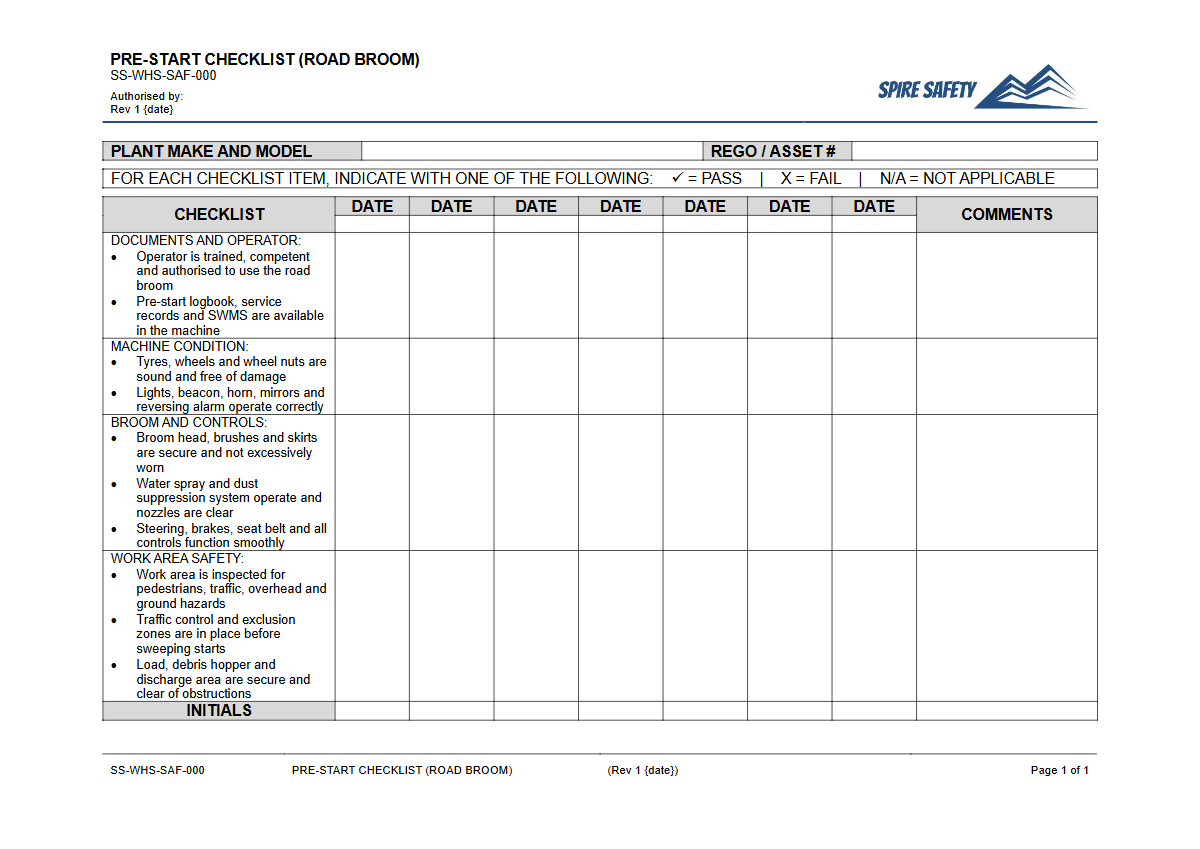
Our road broom pre-start checklist is a comprehensive starting point, prompting checks across key safety-critical areas:
- General Condition: Checks for fluid leaks, structural damage, and overall cleanliness.
- Operator's Cabin: Seatbelt, controls, gauges, horn, mirrors, and glass condition.
- Safety Features: Emergency stop functionality, reverse alarm, and rotating beacon.
- Mechanical Components: Tyre condition and pressure, braking systems, and steering.
- Hydraulics: Hoses, rams, and fluid levels.
- Broom Components: Condition of main and side brooms, water spray/dust suppression systems, and hopper.
When to use it
A pre-start check should be conducted at the beginning of every shift or before the road broom is used for the first time each day. If operators switch during a shift, the incoming operator should also perform a check to ensure they are satisfied with the machine's condition before they take control. These checks form a critical control measure within the overall risk management plan for a worksite, as might be detailed in a Free Road Construction SWMS Template.
Who should use it
This checklist should be used by any person who is tasked with operating a road broom. It is vital that the user is a competent person, meaning they have received the necessary training, instruction, and information to perform both the pre-start inspection and the operation of the machine safely.
Supervisors and managers also have a role in ensuring these checks are completed correctly and that any reported defects are addressed promptly and effectively. If you need assistance developing competency frameworks or training plans, our WHS consulting services can provide expert guidance.
Record Keeping and Defect Reporting
Completed checklists are important records. They provide a documented history of the machine's condition and demonstrate that regular inspections are taking place.
These records are often a key part of the evidence reviewed during WHS compliance auditing. The template includes space to record defects. Your workplace must have a clear procedure for what an operator should do when a fault is found.
This typically involves stopping work, isolating and tagging the equipment ('Danger, Do Not Operate'), and immediately reporting the issue to a supervisor or the maintenance team.
Common mistakes
Common mistakes to avoid
- Completing the checklist from memory without physically inspecting the machine ('pencil-whipping').
- Failing to follow the workplace procedure for reporting and rectifying defects found during the check.
- Using a generic checklist that doesn't cover the specific features or known issues of the road broom model in use.
- Not retaining completed checklists as a formal record of inspection, which can be vital for maintenance tracking and incident investigations.
Legal references
Legal considerations
The following legal requirements may be relevant to this type of work.
- Work Health and Safety Act (Harmonised) — Provides the primary duties for protecting workers and other people from work health and safety risks.
- Work Health and Safety Regulations (Harmonised) — Sets out requirements supporting the management of workplace hazards and risks.
The following codes may be relevant to this type of work.
- Managing WHS Risks Code of Practice — Provides practical guidance on identifying hazards, assessing risks and applying effective controls.
- Work Health and Safety Consultation, Cooperation and Coordination Code of Practice — Provides practical guidance on consulting workers and coordinating with other duty holders.
- Managing the Work Environment and Facilities Code of Practice — Provides practical guidance on safe work environments, workplace facilities and related controls.
Did you know
Dust Hazards
Road brooms can generate significant amounts of airborne dust, including hazardous crystalline silica. Effective water suppression systems are a crucial engineering control to protect operators and the public from respiratory diseases.
Mobile Plant Risks
According to Safe Work Australia, incidents involving mobile plant are a leading cause of workplace fatalities and serious injuries, highlighting the critical importance of measures like pre-start inspections.
FAQ
Frequently asked questions
01Is a road broom pre-start checklist a legal requirement in Australia?
02How often should a road broom pre-start check be done?
03What happens if a defect is found during a pre-start check?
04Can I use a digital app instead of this paper template?
Share this resource
Free Pre-Start Checklist (Road Broom) Template
Browse Categories
How To Use It
- 1Download and open in Word or PDF.
- 2Replace the placeholders with your business details.
- 3Get it reviewed by a WHS specialist before rollout.
Need it customised?
Our WHS consultants can adapt this template to your site, run a gap analysis, or audit what you already have in place.
Book a Free Consultation WHS consulting servicesor call 1300 156 382