
Free Pre-Start Checklist (Road Sweeper) Template
Download our Free Pre-Start Checklist (Road Sweeper) Template to formalise your equipment safety inspections.
Free Pre-Start Checklist (Road Sweeper) Template
DOCX • 125 KB + PDF
Updated Oct 2026
No signup required
Purpose of the Free Pre-Start Checklist (Road Sweeper) Template
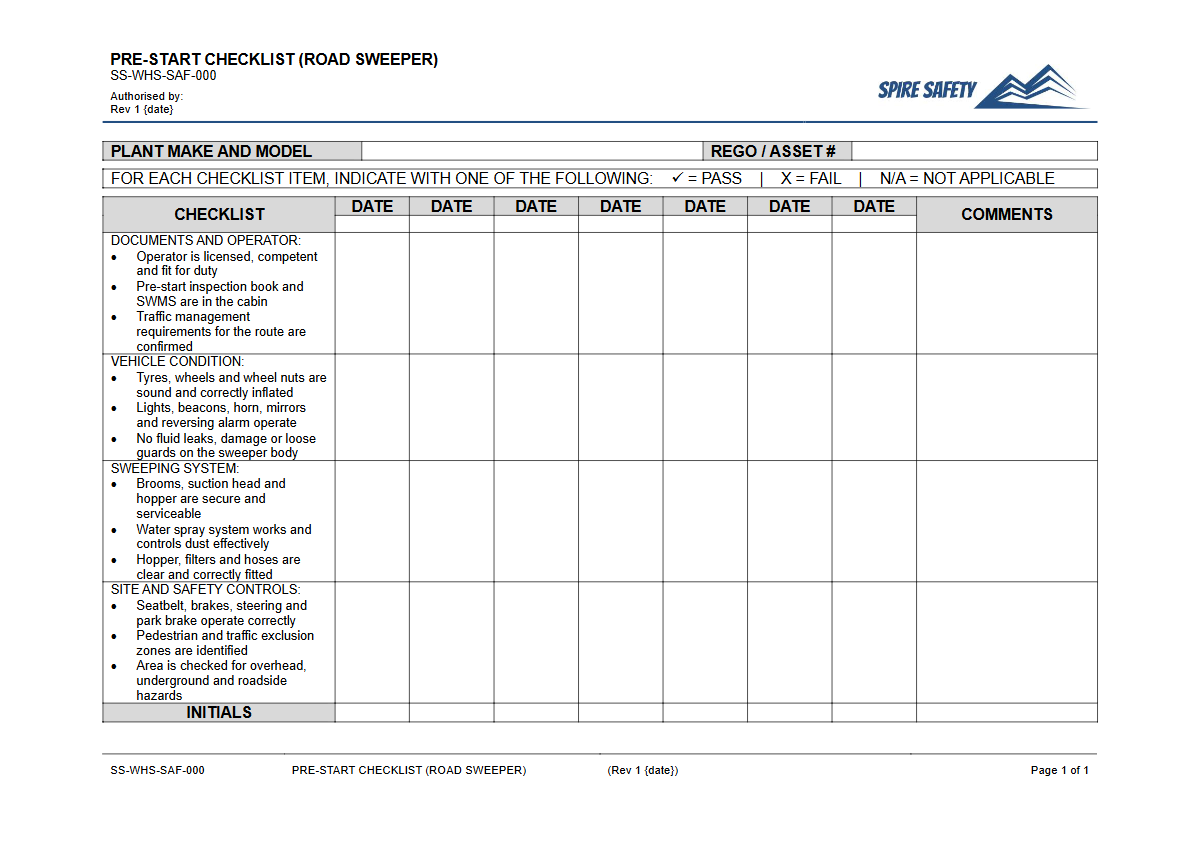
Operating a road sweeper, like any piece of heavy mobile plant, introduces significant workplace hazards. This Free Pre-Start Checklist (Road Sweeper) Template provides a structured framework for operators to conduct a thorough and consistent safety inspection before each use.
The primary purpose is to identify any mechanical defects, damage, or missing safety components that could lead to an incident. Regular checks help ensure the equipment is in safe working order, reducing the risk of accidents and injuries to the operator and others nearby.
Furthermore, completed checklists form a crucial part of your plant maintenance records, demonstrating a proactive approach to safety management and due diligence.
Integrating these checks into your daily routine is a key component of a robust safety system. Reinforcing the importance of these inspections can be achieved through regular safety discussions, such as a pre-start checks and plant maintenance toolbox talk, which helps embed safe behaviour across your team.
Video walkthrough
How to use the Free Pre-Start Checklist (Road Sweeper) Template
Using this Pre-Start Checklist for your road sweeper is straightforward. It is designed to be a practical tool that can be immediately implemented into your operational procedures.
First, download the template in your preferred format (DOCX for easy editing or PDF for direct printing). The next step is critical for ensuring its effectiveness and relevance to your specific operations.
Important: This document is a template and not a complete, out-of-the-box solution. We do not know the specific make, model, or configuration of your equipment, nor the unique hazards of your work environment.
You must customise this checklist to align with the manufacturer’s recommendations and a site-specific risk assessment. This may involve adding or removing checklist items to suit your road sweeper and its intended tasks.
Once customised, train all operators on how to complete the checklist correctly. This training should confirm they are not just ticking boxes, but physically and visually inspecting each component.
It's also an opportune time to confirm their skills with a Verification of Competency for a Ride-On Sweeper to ensure their operational capabilities are current and safe.
Key Inspection Areas
Your customised checklist should cover all critical safety and operational components of the road sweeper. While specifics will vary, a comprehensive check typically includes:
- General Condition: Checking for fluid leaks (oil, hydraulic, coolant), structural damage, or loose parts.
- Operator's Cabin: Ensuring seat, seatbelt, controls, and cabin glass are secure and functional.
- Brakes and Steering: Testing the service brakes, park brake, and steering responsiveness.
- Tyres and Wheels: Inspecting for correct inflation, excessive wear, and any visible damage.
- Lights and Alarms: Verifying headlights, brake lights, indicators, flashing beacons, and reversing alarms are all working.
- Sweeping Components: Checking the condition of brooms, brushes, conveyor systems, and water spray nozzles for dust suppression.
- Hydraulic Systems: Visually inspecting hoses and connections for leaks or damage.
- Safety Equipment: Ensuring the fire extinguisher is charged and mounted, and a first aid kit is accessible.
When to use it
A pre-start check must be completed by the operator at the beginning of every shift or before the road sweeper is used for the first time that day. It should also be performed if a new operator takes over the machine during a shift.
This frequency ensures that any faults that may have developed overnight or during a previous operation are caught before the machine is put into service. These checks are a fundamental part of a Road Construction SWMS, where mobile plant is a primary hazard.
Who should use it
The pre-start checklist should be completed by the person operating the road sweeper. They must be deemed competent, meaning they have received the necessary training and instruction to both operate the machine safely and understand the importance of each item on the checklist.
Supervisors and WHS managers also have a role; they are responsible for reviewing completed checklists to identify recurring faults, schedule maintenance, and ensure the inspection process is being followed correctly. These records are a valuable data source for an organisation’s broader WHS management systems, helping to track plant health and operator behaviour.
Legal and Other Considerations
Under Australian WHS law, a Person Conducting a Business or Undertaking (PCBU) has a primary duty of care to ensure the health and safety of workers. This includes ensuring that plant and equipment are safe to use and properly maintained.
While this template is a useful tool, its use is just one part of a comprehensive safety strategy. Regular, documented inspections provide tangible evidence that you are taking steps to manage risks associated with mobile plant.
These records can be invaluable during internal reviews or a formal WHS compliance auditing process.
This document is one of many tools designed to help you manage workplace safety effectively. Feel free to explore our complete free WHS resources library for more templates, checklists, and toolbox talks to support your safety initiatives.
Common mistakes
Common mistakes to avoid
- "Pencil-whipping" the checklist by ticking boxes without physically inspecting the items.
- Ignoring seemingly minor faults like a faulty horn, worn warning decals, or a cracked mirror.
- Failing to immediately report a major defect and tag the equipment as "Out of Service".
- Using a generic checklist that doesn't cover the specific safety features and components of the sweeper's make and model.
Legal references
Legal considerations
The following legal requirements may be relevant to this type of work.
- Work Health and Safety Act (Harmonised) — Provides the primary duties for protecting workers and other people from work health and safety risks.
- Work Health and Safety Regulations (Harmonised) — Sets out requirements supporting the management of workplace hazards and risks.
The following codes may be relevant to this type of work.
- Managing WHS Risks Code of Practice — Provides practical guidance on identifying hazards, assessing risks and applying effective controls.
- Work Health and Safety Consultation, Cooperation and Coordination Code of Practice — Provides practical guidance on consulting workers and coordinating with other duty holders.
- Managing the Work Environment and Facilities Code of Practice — Provides practical guidance on safe work environments, workplace facilities and related controls.
Did you know
Hydraulic System Pressure
The hydraulic systems on industrial road sweepers can operate at pressures exceeding 2,000 PSI. A pinhole leak can inject fluid into the skin, causing severe injury that requires immediate medical attention.
Dust Control
Modern road sweepers use water suppression systems not just to keep dust down, but to minimise the inhalation of respirable crystalline silica, a significant health hazard in construction and road work.
FAQ
Frequently asked questions
01What is the purpose of a road sweeper pre-start checklist?
02How often should a road sweeper pre-start check be done?
03Who is responsible for completing the road sweeper pre-start checklist?
04Can I use a digital pre-start checklist for a road sweeper?
Share this resource
Free Pre-Start Checklist (Road Sweeper) Template
Browse Categories
How To Use It
- 1Download and open in Word or PDF.
- 2Replace the placeholders with your business details.
- 3Get it reviewed by a WHS specialist before rollout.
Need it customised?
Our WHS consultants can adapt this template to your site, run a gap analysis, or audit what you already have in place.
Book a Free Consultation WHS consulting servicesor call 1300 156 382