
Free Pre-Start Checklist (Rock Bucket) Template
Download our free Pre-Start Checklist (Rock Bucket) Template in DOCX & PDF. A structured starting point for formalising your WHS equipment inspections.
Free Pre-Start Checklist (Rock Bucket) Template
DOCX • 125 KB + PDF
Updated Oct 2026
No signup required
Purpose of this Free Pre-Start Checklist (Rock Bucket) Template
Rock buckets are heavy-duty attachments designed for quarrying, mining, and civil construction. Subjected to extreme abrasion and high-impact forces, their structural integrity is critical for safe operation.
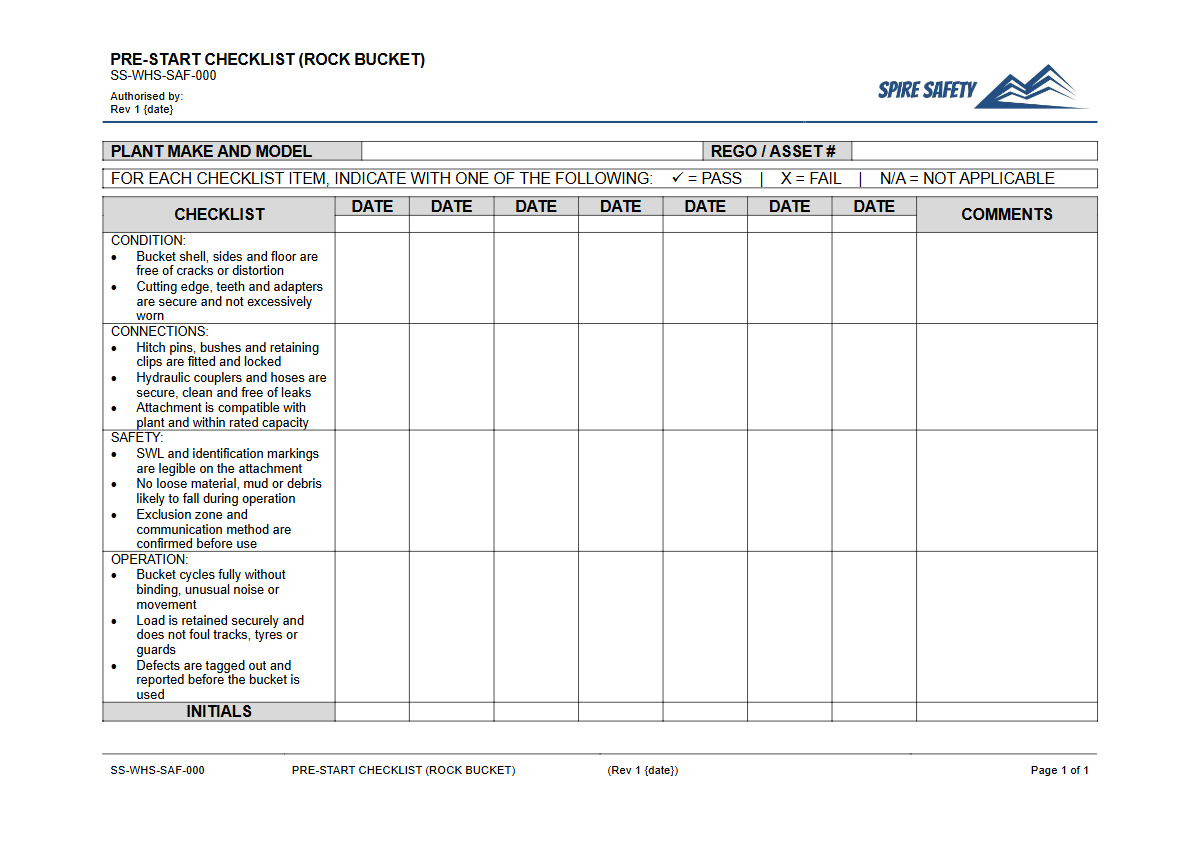
This Free Pre-Start Checklist (Rock Bucket) Template provides a structured framework for operators and maintenance personnel to conduct thorough daily inspections. Formalising these checks helps identify potential defects like cracks, excessive wear on teeth and cutting edges, or issues with mounting points before they lead to equipment failure, property damage, or serious injury.
A consistent pre-start process is a fundamental part of a safe system of work for any operation involving heavy earthmoving equipment.
Using a documented checklist ensures that inspections are performed consistently and that a record is kept for maintenance and compliance purposes. This is especially important for high-wear components like ground-engaging tools (GET).
Proactive identification of hazards is a cornerstone of effective risk management, helping your organisation meet its duties under WHS legislation. Integrating such procedures into a robust WHS management system strengthens your overall safety culture and operational discipline.
The devastating consequences of attachment failure are highlighted in a case where a company received a $450,000 fine after an excavator bucket killed a worker, underscoring the importance of diligent checks.
Video walkthrough
How to use the Free Pre-Start Checklist (Rock Bucket) Template
This document is provided as a starting point in both Word (DOCX) and PDF formats. Download the file and integrate it into your organisation's safety procedures.
The checklist should be completed by a competent person before the first use of the rock bucket each day or at the beginning of each shift. The operator should visually inspect all key components listed and tick off each item.
Any faults, damage, or excessive wear discovered must be reported immediately to a supervisor and recorded in the designated section. The equipment must not be used until it is assessed by a qualified person and cleared for service.
Important: This is a generic template aligned with general Australian WHS principles. It must be customised to suit the specific models of rock buckets and parent machines (e.g., excavators, wheel loaders) used in your workplace, as well as the specific operational risks.
We are not liable for any incidents arising from the use of this document as it is a template only. We recommend seeking expert WHS consulting services to ensure your safety documentation is tailored to your unique needs.
When to use a Rock Bucket Pre-Start Checklist
A pre-start inspection should be conducted at the following times:
- Before the first use of the equipment at the start of each workday or shift.
- After changing the attachment to ensure it has been correctly fitted.
- After any event that may have caused damage to the bucket, such as striking a concealed object with significant force.
Regularly reinforcing the importance of these checks can be achieved with short, focused safety meetings. You can use our Pre-Start Checks and Plant Maintenance Toolbox Talk to facilitate these discussions with your team and maintain a high level of safety awareness.
Who should use this Checklist
This checklist is designed for use by individuals who are trained, competent, and authorised to operate the parent machinery the rock bucket is attached to. This typically includes:
- Plant Operators: As the primary users, they are the first line of defence in identifying issues before operation begins.
- Maintenance Fitters: They may use the checklist as part of routine servicing or when conducting repairs to ensure all safety-critical components are inspected.
- Supervisors: They are responsible for ensuring operators are completing the checks correctly and that any reported defects are addressed promptly.
Documenting these checks is also a key part of daily site management. Information from the pre-start can be a valuable input for daily safety briefings, which can be formalised using a pre-start meeting template to ensure all workers are aware of equipment status and potential hazards.
Common mistakes
Common mistakes to avoid
- Overlooking small hairline cracks in welds or high-stress areas like mounting pins.
- Failing to check the security and function of the quick hitch or coupling system.
- Using a generic 'bucket' checklist that doesn't account for the specific wear patterns of a rock bucket.
- Not documenting identified defects or failing to follow up on required repairs.
Legal references
Legal considerations
The following legal requirements may be relevant to this type of work.
- Work Health and Safety Act (Harmonised) — Provides the primary duties for protecting workers and other people from work health and safety risks.
- Work Health and Safety Regulations (Harmonised) — Sets out requirements supporting the management of workplace hazards and risks.
The following codes may be relevant to this type of work.
- Managing WHS Risks Code of Practice — Provides practical guidance on identifying hazards, assessing risks and applying effective controls.
- Work Health and Safety Consultation, Cooperation and Coordination Code of Practice — Provides practical guidance on consulting workers and coordinating with other duty holders.
- Managing the Work Environment and Facilities Code of Practice — Provides practical guidance on safe work environments, workplace facilities and related controls.
Did you know
Metal Fatigue
Repeated stress cycles, even those below the material's ultimate tensile strength, can cause microscopic cracks to form and propagate in steel components like rock buckets. These cracks, often invisible to the naked eye initially, can lead to sudden and catastrophic failure, which is why regular inspections are critical.
FAQ
Frequently asked questions
01What is the primary purpose of a rock bucket pre-start check?
02Why is it critical to inspect the teeth and cutting edge on a rock bucket?
03How often should a rock bucket pre-start inspection be completed?
04Who is responsible for ensuring a faulty rock bucket is not used?
Share this resource
Free Pre-Start Checklist (Rock Bucket) Template
Browse Categories
How To Use It
- 1Download and open in Word or PDF.
- 2Replace the placeholders with your business details.
- 3Get it reviewed by a WHS specialist before rollout.
Need it customised?
Our WHS consultants can adapt this template to your site, run a gap analysis, or audit what you already have in place.
Book a Free Consultation WHS consulting servicesor call 1300 156 382